
Most veterans with service-connected hypertension are rated 10 percent, and most of them stay there. The criteria above that level are demanding, and a condition that is well controlled on medication does not produce the readings the higher levels require.
So the useful question is not how to turn 10 into 40. It is what the 10 is attached to.
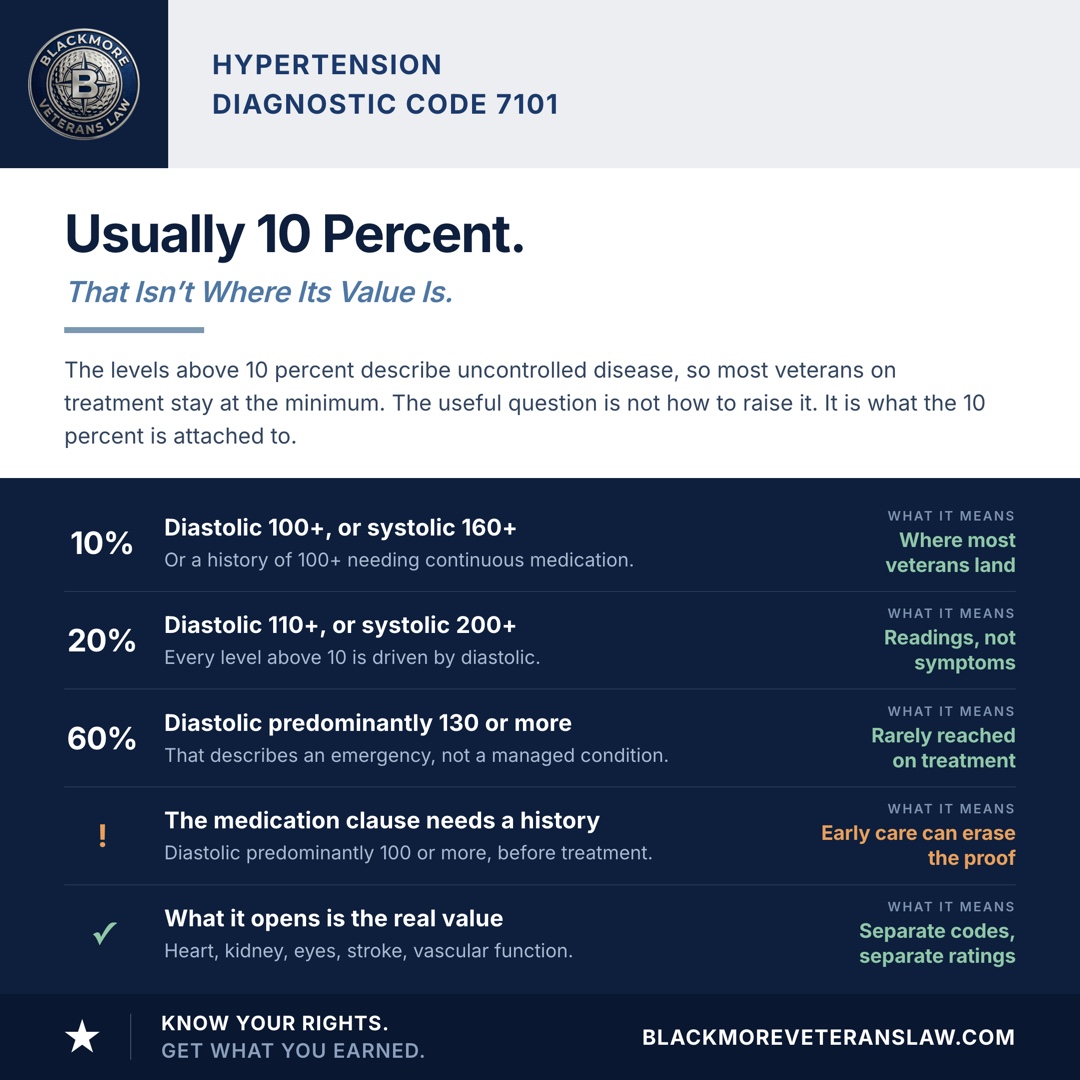
The ladder
38 C.F.R. § 4.104, diagnostic code 7101:
- 60 percent. Diastolic pressure predominantly 130 or more.
- 40 percent. Diastolic pressure predominantly 120 or more.
- 20 percent. Diastolic pressure predominantly 110 or more, or systolic pressure predominantly 200 or more.
- 10 percent. Diastolic pressure predominantly 100 or more, or systolic predominantly 160 or more, or a minimum evaluation for someone with a history of diastolic pressure predominantly 100 or more who requires continuous medication for control.
Notice what happens above 10 percent. Every level is driven by diastolic numbers, and they climb fast. A diastolic reading predominantly at 130 describes a medical emergency, not a managed condition.
Predominantly is not defined. It describes the pattern of your readings rather than any single measurement, and a few spikes in an otherwise controlled record will not satisfy it.
One procedural point that gets skipped: a note to this code requires hypertension to be confirmed by readings taken two or more times on at least three different days. A single examination is one day.
The medication clause, and the trap inside it
This is one of the few codes in the schedule that writes medication directly into the criteria, which makes it the exception to the rule covered in The Medication Is Working. Here, treatment is supposed to be part of the evaluation.
The minimum evaluation requires two things together:
- A history of diastolic pressure predominantly 100 or more, and
- A current requirement for continuous medication to control it.
Read the first one again, because it catches people. The clause does not ask what your pressure is now. It asks what it was. And a veteran whose hypertension was caught early and treated promptly may have been spared ever recording diastolic readings at 100, which means the record may not contain the history the criterion requires, even though the condition is entirely real and requires a pill every morning.
Good medical care can erase the evidence of the criterion.
If that describes you, the history is the thing to go looking for. Service treatment records, separation physicals, early private records, pre-treatment readings from any source. That is where the untreated baseline lives if it was ever written down.
How it gets service connected
Four routes come up most.
Directly, from service, where readings in service or at separation document it.
As a chronic disease within a year of separation, which carries its own presumption where the condition appeared to a compensable degree in that window.
As an Agent Orange presumptive. The PACT Act added hypertension to the conditions presumptively associated with herbicide exposure. For a veteran with qualifying service that removes the nexus element, though the other elements still apply, which is covered in ‘Presumptive’ Does Not Mean Automatic.
Secondary to something already connected. Hypertension is frequently claimed as secondary to service-connected mental health conditions and to sleep apnea, and it can follow from medication prescribed for a service-connected condition, covered in The Prescription Was for Your Knee. The framework is in our guide to secondary service connection.
What the 10 percent is attached to
Long-standing hypertension damages organs, and those conditions carry their own evaluations.
- Hypertensive heart disease is rated separately under its own diagnostic code. A note to 7101 says so directly.
- Kidney disease. Hypertension is among the leading causes of chronic kidney disease, and renal conditions have their own codes.
- Stroke and its residuals, which are rated on what they left behind.
- Eye conditions, including hypertensive retinopathy.
- Erectile dysfunction, whether from the vascular disease or from the medication treating it, which can support special monthly compensation even at a 0 percent rating, covered in SMC Isn’t a Rating.
None of that is pyramiding. These are distinct conditions with distinct manifestations under distinct codes, which is covered in Filing for a Related Condition Won’t Cost You the Rating You Have.
For many veterans the hypertension rating is modest and permanent, and the conditions downstream of it are where the file actually moves.
What to do with this
- Check whether your record contains untreated readings. If your diastolic was ever predominantly 100 or more before treatment, that history supports the minimum evaluation.
- Pull the old records specifically. Service treatment records, separation physical, the first private records after service. Recent records show a controlled condition and nothing else.
- Do not expect the higher levels on controlled pressure. The criteria above 10 percent describe uncontrolled disease.
- Ask which route fits. Direct, within a year of separation, herbicide presumptive, or secondary.
- Look downstream. Heart, kidneys, eyes, and vascular function. Those are separate claims with their own ratings.
- Keep taking the medication. Nothing here is a reason to stop, and stopping to produce a reading is dangerous.
Whether any particular claim succeeds depends on the records and the evidence. Nobody can tell you your outcome. But a 10 percent rating for hypertension is a door rather than a destination, and most of what is behind it never gets claimed.
Blackmore Veterans Law, P.C. is a solo practice representing veterans in VA disability claims and appeals. Contact us to discuss your situation.
This article is general information about VA disability law and is not legal advice for any individual case. Reading it does not create an attorney-client relationship. Attorney advertising.