
The question comes up in some version almost every time a second condition gets mentioned.
“If I file for my back, are they going to come after my knee?”
Somebody told them that claiming related conditions backfires. That VA will notice the overlap, decide it has been paying twice, and take something away. So the second claim never gets filed, and a condition that has been ratable for years sits there.
The rule they are thinking of is real. It is much narrower than what they were told.
What the rule actually says
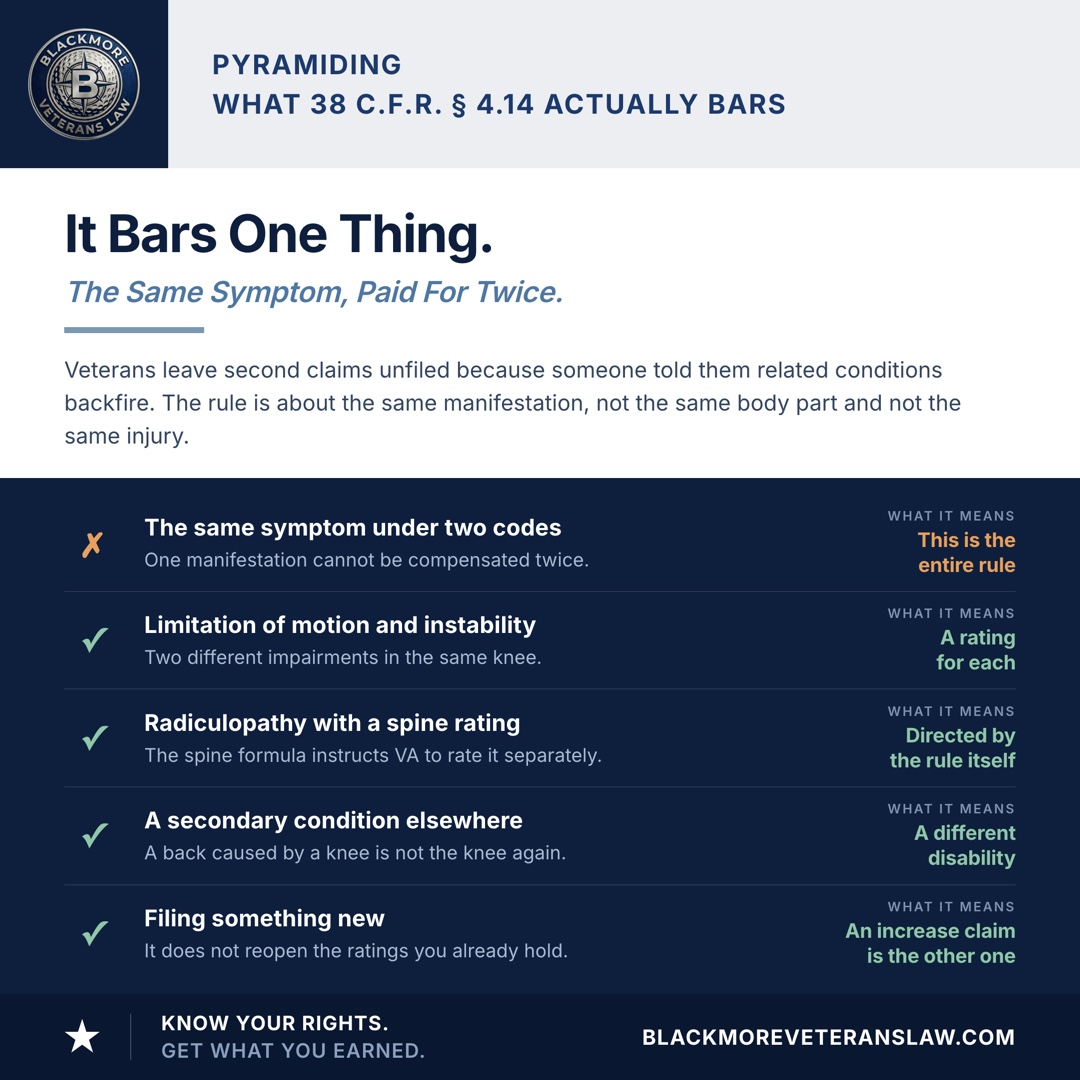
38 C.F.R. § 4.14 is short. The evaluation of the same disability under various diagnoses is to be avoided, and so is the evaluation of the same manifestation under different diagnoses.
Manifestation is the word doing the work. Not body part. Not underlying injury. Not region of the body. The symptom.
If the pain and limited motion in your knee are already being paid for under one diagnostic code, they cannot be paid for again under a second code that describes the same pain and the same limited motion. That is the prohibition, start to finish.
The regulation also bars something in the other direction, which gets less attention: VA cannot use manifestations that do not come from a service-connected condition to inflate a service-connected evaluation. The rule keeps the accounting honest in both directions.
What it does not bar
Separate impairments from one condition. A knee that is both limited in motion and unstable has two different problems. Limited motion is rated under the codes for flexion and extension. Instability is rated under its own code. A veteran with both can carry a rating for each, because each one pays for something the other does not. This is settled, and it is the single most common place a rating comes in too low.
Limitation of flexion and limitation of extension can likewise be rated separately when each is compensably limited. Two directions of movement, two separate losses.
Neurologic abnormalities alongside a spine rating. This one is not just permitted, it is instructed. The General Rating Formula for diseases and injuries of the spine in 38 C.F.R. § 4.71a carries a note telling VA to evaluate any associated objective neurologic abnormalities separately under an appropriate diagnostic code. Radiculopathy running down a leg is not the back condition being paid twice. It is the thing the note is talking about.
Scars and surgical residuals. The scar from the surgery is not the condition the surgery was for.
Secondary conditions. A lumbar spine condition caused by a service-connected knee is a different disability, in a different part of the rating schedule, with different symptoms. Rating it is not rating the knee again. This is the whole architecture of secondary service connection, and pyramiding has never been an obstacle to it.
The same condition on both sides. Two knees are two knees.
The fear underneath the question
Strip the pyramiding vocabulary away and the real worry is usually this: if I ask VA for something, will they take a second look at what I already have.
The honest answer has two halves, and they get conflated constantly.
Filing for a new condition does not reopen your existing ratings. It is a claim about something VA has not rated. It does not put your other evaluations in front of an adjudicator for reconsideration, and VA does not treat it as an invitation to review them.
Filing for an increase on a condition you already have is different. You are asking VA to look again at that condition, so VA will schedule an examination, and an examination can document improvement as easily as worsening. That is a real consideration, it applies only to the condition you asked about, and it is bounded by the protections that attach over time. Those are covered in The VA 5-Year, 10-Year, and 20-Year Rules.
Two different decisions. The second carries a consideration the first does not. Somewhere in the retelling they became one warning that stops people from doing either.
When VA gets pyramiding wrong
The word shows up in decisions where it does not belong. Patterns to look for:
Separate manifestations called one. A denial of a separate instability rating on the theory that the knee is already rated. Two impairments treated as one because they share a joint.
Radiculopathy denied as pyramiding, in the face of a rating formula that directs the opposite.
A secondary condition folded into the primary. A mental health condition secondary to chronic pain, denied or absorbed on the theory that pain is already being compensated. The physical rating pays for the physical impairment. Occupational and social impairment is rated under a different formula entirely, covered in VA Does Not Rate Your Diagnosis.
Pyramiding used to deny rather than to choose. When two codes could each describe the same manifestation, the rule means VA pays under one of them, and it should be the one producing the higher evaluation. It does not mean the claim gets denied.
If the word appears in your decision, the question to ask is specific: what exactly is the symptom VA says is being counted twice, and is it actually the same symptom? A decision that answers by naming the body part rather than the manifestation has not applied the rule it cited.
A realistic word about the math
None of this means a new rating will move your combined percentage the way you expect.
Combined ratings are not addition, and each new rating applies to the portion of you VA still considers undisabled. At 70 percent, a new 10 percent does not produce 80. The mechanics are in Understanding VA Disability Ratings.
That is a reason to understand the arithmetic before you predict an outcome. It is not a reason to leave a ratable condition unclaimed. A separate rating can matter for TDIU, for special monthly compensation, and for dependent benefits, in ways the combined percentage alone does not show.
What to do with this
- Look at what you are actually being paid for. Your rating decision lists each condition and the diagnostic code assigned to it. That is the list of manifestations already compensated.
- For each service-connected joint, ask whether there is more than one thing wrong with it. Motion and stability are different. Both directions of motion are different.
- If you have a service-connected spine condition and numbness, tingling, or weakness running into a limb, look for a separate neurologic rating. If there is not one, ask why.
- Stop treating a new claim and an increase claim as the same decision. They carry different considerations, and only one of them involves VA re-examining something you already hold.
- If a denial used the word pyramiding, find the symptom it says is duplicated. If the decision names a body part instead of a symptom, it did not do the analysis.
Whether any particular claim succeeds depends on the evidence, the diagnoses, and how the file is built. Nobody can tell you your outcome. But “they will take away what I have” is not what § 4.14 says, and a condition nobody ever rated is not being paid for twice.
Blackmore Veterans Law, P.C. is a solo practice representing veterans in VA disability claims and appeals. Contact us to discuss your situation.
This article is general information about VA disability law and is not legal advice for any individual case. Reading it does not create an attorney-client relationship. Attorney advertising.