
Yesterday’s post was about proving the event: what a marker is in a military sexual trauma claim, where markers actually live, and the notice VA owes before it denies.
Say that part goes well. Service connection is granted. Then the decision letter arrives and the rating is 30 percent, and you have not held a steady job in four years.
That gap between what happened to you and the number on the letter is a separate problem with a separate rule behind it, and it is worth understanding on its own terms. The rule is 38 C.F.R. § 4.130.
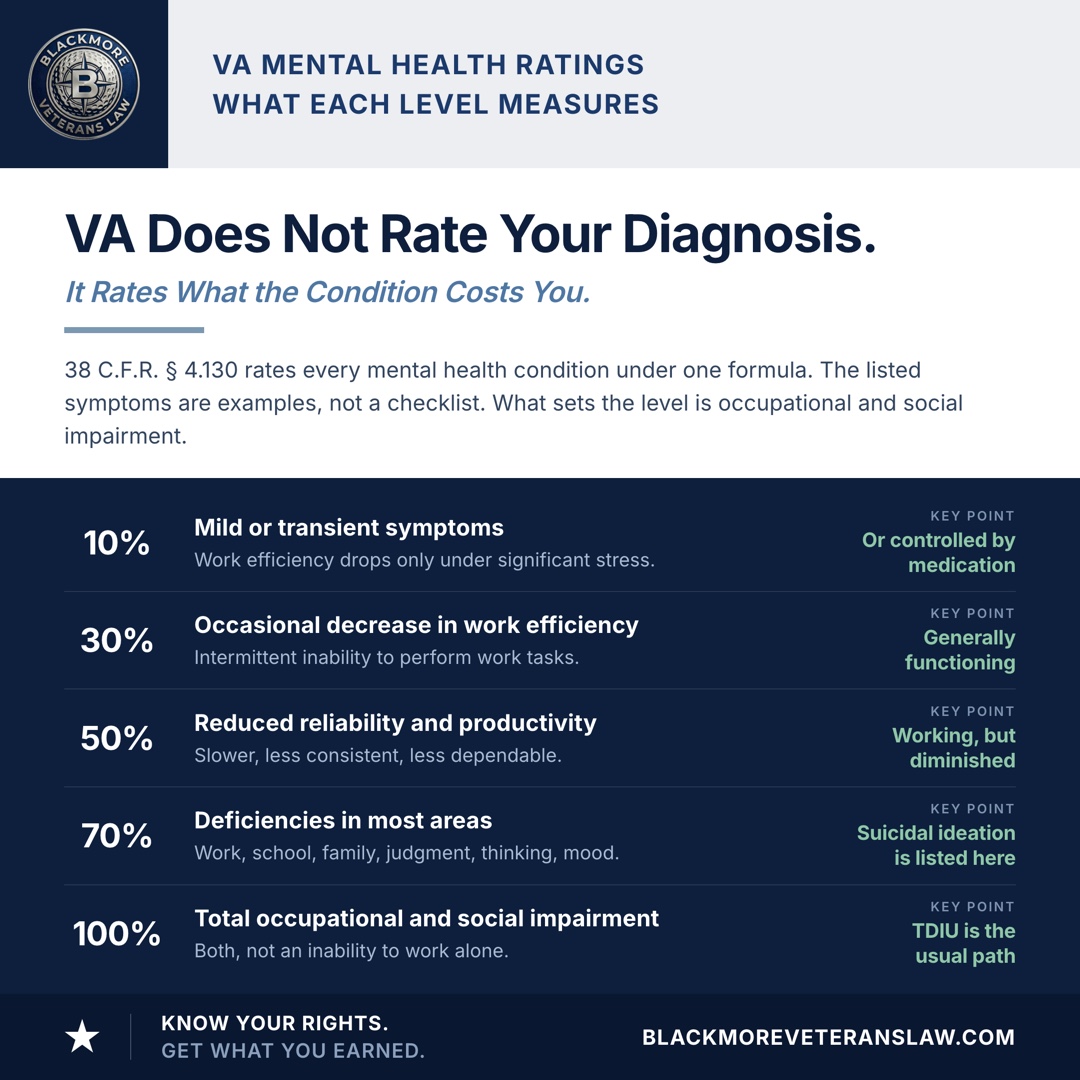
One formula, one rating
Every mental health condition VA rates, with one exception noted below, is rated under the same set of criteria: the General Rating Formula for Mental Disorders.
PTSD, major depressive disorder, generalized anxiety disorder, panic disorder, bipolar disorder, insomnia disorder, adjustment disorder, and the neurocognitive disorders all run through the same six percentages. The diagnostic code changes. The criteria do not.
Two consequences follow, and they surprise people in opposite directions.
The first is that the diagnosis does not set the level. There is no rating that PTSD gets and depression does not. An adjudicator who grants service connection for PTSD is looking at exactly the same criteria they would use for anxiety.
The second is that multiple diagnoses produce one rating, not several. Section 4.14 prohibits rating the same disability under more than one code, and where mental health symptoms overlap, VA rates them together. Getting a second diagnosis added to the claim does not raise the percentage. Showing more impairment does.
There is a related rule that works in your favor. Where symptoms cannot be separated between a service-connected condition and a nonservice-connected one, they are all attributed to the service-connected condition. A file containing depression from service and depression the examiner attributes to a later civilian event does not get carved in half when no clinician can actually draw the line.
The exception to the single formula is eating disorders. Anorexia nervosa and bulimia nervosa, diagnostic codes 9520 and 9521, are rated under their own formula built around incapacitating episodes and weight loss. That matters in trauma claims more often than people expect.
The six levels, in plain terms
The formula has six evaluations and no others. There is no 20, no 40, no 60, no 80, no 90 percent for a mental disorder. The steps are wide by design.
0 percent. A condition is diagnosed, but the symptoms are not severe enough to interfere with work and social functioning or to require continuous medication.
10 percent. Mild or transient symptoms that decrease work efficiency only during periods of significant stress, or symptoms controlled by continuous medication.
30 percent. Occasional decrease in work efficiency and intermittent periods of inability to perform occupational tasks, while generally functioning satisfactorily, with routine behavior, self-care, and conversation normal.
50 percent. Occupational and social impairment with reduced reliability and productivity.
70 percent. Occupational and social impairment with deficiencies in most areas: work, school, family relations, judgment, thinking, or mood.
100 percent. Total occupational and social impairment.
Read those six lines again and notice what is missing. Not one of them names a diagnosis, a symptom count, or a treatment history. Every level is written in terms of function. The question the regulation asks is what the condition does to your ability to work and to be around other people.
The checklist error
Under each percentage, the regulation lists example symptoms after the phrase “due to such symptoms as.” Flattened affect, panic attacks more than once a week, and impaired judgment sit under 50 percent. Suicidal ideation, neglect of personal appearance and hygiene, and difficulty adapting to stressful circumstances sit under 70 percent.
Those lists are examples. The courts that review VA decisions have held so for more than twenty years. No particular listed symptom is required for any level, and the lists are not exhaustive.
The most common error in a mental health rating decision is treating them as a checklist anyway. It shows up in decision language like this: the veteran did not exhibit obsessional rituals, illogical speech, spatial disorientation, or impaired impulse control, so the criteria for 70 percent are not met.
That reasoning is backwards. It counts symptoms the veteran does not have instead of measuring the impairment the veteran does have.
The rule cuts both ways, and the second half is the part that gets left out of most online explanations. Symptoms alone do not carry a level either. For 70 percent, the evidence has to show symptoms of the kind and severity the list describes and resulting deficiencies in most of those areas. Naming a symptom is not enough. What the symptom does to your work, your family, your judgment, or your mood is the finding that matters.
Strong evidence does both jobs in the same breath. Not “panic attacks,” but panic attacks that ended a shift and cost a job. Not “irritability,” but the reason a marriage ended and a supervisor started documenting incidents.
Where the 50 and 70 line gets drawn
Most contested mental health ratings sit on this line, and the two standards are genuinely different.
Fifty percent is reduced reliability and productivity. You are working, or could work, but you are slower, less consistent, and less dependable than you were.
Seventy percent is deficiencies in most areas. The regulation names six: work, school, family relations, judgment, thinking, and mood. Most, not all. Deficiency does not mean total loss of the area. It means the area is compromised.
Two points about this level get argued constantly.
Suicidal ideation is listed at 70 percent, and passive ideation counts. Thoughts of being better off dead, without a plan and without intent, are suicidal ideation. VA cannot require a plan, an intent, or a hospitalization before the symptom means anything. A decision that reasons “no suicidal ideation with plan or intent” is measuring against language the regulation does not contain.
And where the evidence leaves a genuine question about which of two evaluations applies, 38 C.F.R. § 4.7 directs VA to assign the higher one if the disability picture more nearly approximates its criteria. Close calls are supposed to go up.
One hundred percent, and why TDIU usually gets there first
Total occupational and social impairment means both. Not unable to work. Unable to work and unable to maintain social relationships, at a level the examples describe: gross impairment in thought processes, persistent delusions or hallucinations, disorientation to time or place, memory loss for the names of close relatives.
A veteran who cannot hold a job and still talks to their kids does not meet that standard, and it is not a close question.
That is why the ordinary path to compensation at the 100 percent rate for a mental health condition is not a 100 percent schedular rating. It is total disability based on individual unemployability under 38 C.F.R. § 4.16. TDIU pays at the 100 percent rate when service-connected conditions prevent substantially gainful employment, and a single condition rated 70 percent satisfies the schedular threshold by itself. VA Form 21-8940 is the application. More on how that works is in What Is TDIU and Do You Qualify?.
If you cannot work because of a service-connected mental health condition, TDIU is the claim to be looking at, whether or not anyone at VA has mentioned it to you.
The exam is one day. The rating is not.
Section 4.126(a) is short and does more work than almost any other line in the mental health rules.
It requires the rating agency to consider the frequency, severity, and duration of symptoms, the length of remissions, and your capacity for adjustment during those remissions. Then it requires the evaluation to rest on all the evidence of record that bears on occupational and social impairment, rather than solely on the examiner’s assessment of the level of disability at the moment of the examination.
Most veterans hold it together for the length of a C&P exam. Decades of training and a lifetime of not wanting to look weak in front of a stranger do not switch off in a clinic room. Then the examination report says cooperative, well groomed, normal speech, and the rating comes back at 30 percent.
Section 4.126(a) is the answer to that, and it means the rest of the file has to say something. What belongs in it:
- Treatment records read for pattern, not for a single visit. Frequency of appointments, medication changes, dose increases, therapy that started and stopped, urgent care or emergency visits.
- Work history in specifics. Jobs held and lost, absences, write-ups, accommodations you asked for, accommodations you never asked for because you left first.
- Statements from people who see you on the bad days. A spouse, a grown child, a roommate, a former supervisor. VA Form 21-10210 is the form, and the useful statements describe events and dates rather than adjectives.
- Your own statement about the worst weeks, not the average ones. The regulation asks about frequency, severity, and duration. Nobody but you can supply the duration.
Two related pieces of § 4.126 are worth knowing. Under paragraph (b), VA considers social impairment but cannot assign an evaluation on social impairment alone, so occupational evidence has to be in the file even when you are not working. Under paragraph (c), neurocognitive disorders are rated under the same formula, and neurologic deficits from the same cause, such as a head injury, are rated separately and combined.
Two rules with their own timing
A discharge caused by the condition. Section 4.129 applies when a mental disorder develops in service as a result of a highly stressful event and is severe enough to bring about release from active service. In that situation VA assigns an evaluation of not less than 50 percent and schedules an examination within six months after discharge to decide whether the level should change. If your separation was driven by the condition and your initial rating came in below 50 percent, that regulation is worth checking against your file.
Reductions. Mental health ratings get reduced, and the protections are real but specific. A rating in effect for five years or more cannot be reduced on the strength of one examination showing improvement. VA has to show sustained improvement under the ordinary conditions of life. That and the other protection rules are covered in The VA 5, 10, and 20 Year Rules.
About the proposed rewrite
VA published a proposed rule in February 2022 that would replace this formula with five domains of functional impairment, each scored on its own scale, and would change how mental disorders are evaluated across the board.
It is still a proposal. It has not been finalized and it has no effective date. Every claim decided today is decided under the formula described above, and articles that present the domain model as current are describing something that has not happened.
What to do with this
- Read your decision for the reasoning, not just the percentage. If the explanation lists symptoms you do not have and stops there, the decision counted a checklist instead of measuring impairment.
- Write down what a bad week actually looks like, with dates and consequences, before anyone asks you for it.
- Get lay statements from people who were there for the events you cannot document yourself, using VA Form 21-10210.
- If you cannot work, file for TDIU on VA Form 21-8940 rather than waiting for a 100 percent schedular rating that the criteria were not written to produce.
- Check the timing rules. A separation caused by the condition implicates § 4.129. A proposed reduction of a long-standing rating implicates the protection rules.
Whether any particular rating changes depends on the evidence and how the file is built, and nobody can tell you your outcome. But a rating that came back lower than your life looks is usually a question about impairment evidence, not about your diagnosis.
If you are in crisis, the Veterans Crisis Line is available 24/7. Call 988 and press 1, text 838255, or chat at VeteransCrisisLine.net.
Blackmore Veterans Law, P.C. is a solo practice representing veterans in VA disability claims and appeals. Contact us to discuss your situation.
This article is general information about VA disability law and is not legal advice for any individual case. Reading it does not create an attorney-client relationship. Attorney advertising.