
Two sentences come up in nearly every conversation about a military sexual trauma claim.
“I never reported it.”
“So there’s nothing in my file.”
Both are usually true. Neither one decides the claim. VA has a regulation written for exactly this situation, and the reason it exists is that the agency already knows most MST is never reported and almost never appears in a service treatment record.
Here is what that regulation actually requires, and what to look for in a decision that got it wrong.
The one element that makes these claims different
Service connection for PTSD comes down to three things: a current diagnosis, an in-service stressor, and a link between them.
For most claims, element two is the easy one. A vehicle rollover, a mortar attack, a training accident. Something was written down somewhere, or the circumstances of service make it obvious.
For MST, element two is where the claim usually lives or dies. The assault happened in a building with no incident report, no witness statement, and no medical entry, because reporting it carried a cost the person weighing that decision understood better than anyone reviewing the file twenty years later.
VA’s answer to that problem is 38 C.F.R. § 3.304(f)(5).
What the regulation says
Three things, and each one matters.
First, evidence from sources other than your service records may corroborate your account of the stressor. The regulation lists examples: records from law enforcement, rape crisis centers, mental health counseling centers, hospitals or physicians; pregnancy tests or tests for sexually transmitted diseases; and statements from family members, roommates, fellow service members, or clergy.
Second, evidence of behavior changes following the assault is one type of relevant evidence that may be found in those sources. The listed examples: a request for transfer to another military duty assignment, deterioration in work performance, substance abuse, episodes of depression, panic attacks, or anxiety without an identifiable cause, and unexplained economic or social behavior changes.
Third, and least known, VA will not deny a PTSD claim based on in-service personal assault without first advising you that this kind of evidence may serve as credible supporting evidence, and giving you an opportunity to provide it or to tell VA where to find it.
Both lists are examples, not a checklist. The regulation says “include, but are not limited to.” A denial that treats the listed items as the only qualifying markers is applying the rule more narrowly than it is written.
Markers usually are not in your medical records
This is the practical point that changes the most claims.
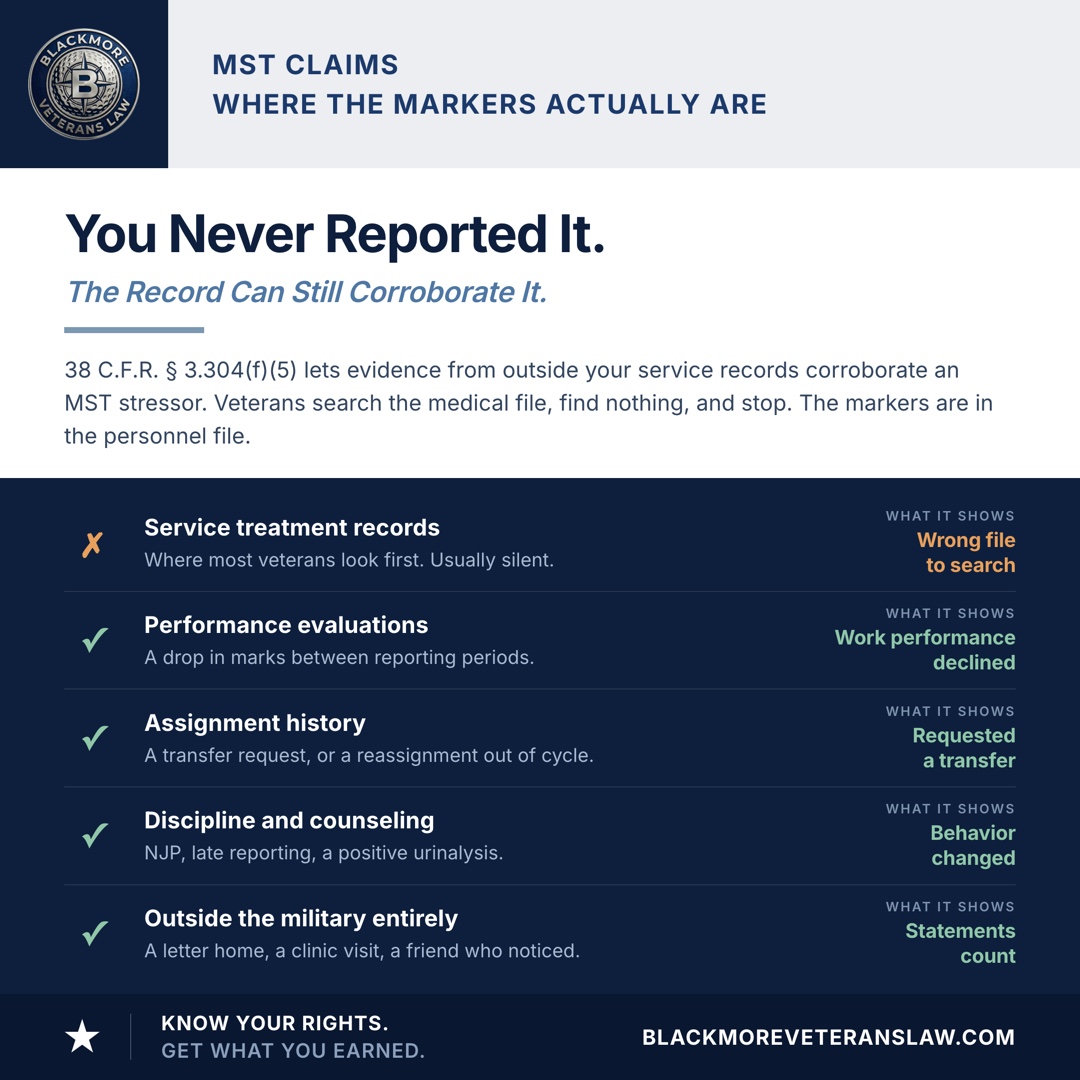
Veterans go looking for markers in their service treatment records, find nothing, and stop. Service treatment records are the wrong file. The markers the regulation describes are personnel events, and they live in your official military personnel file.
What to pull and read line by line:
- Performance evaluations. Evals, fitness reports, NCOERs, counseling statements. A drop in marks, a change in tone from one reporting period to the next, or a comment about attitude or reliability that appears out of nowhere is a documented deterioration in work performance.
- Assignment history. A transfer request, a sudden reassignment, a school or deployment you dropped from, a change of duty station that does not match the normal rotation.
- Disciplinary records. Nonjudicial punishment, counseling for late reporting or missed formations, a positive urinalysis, an alcohol incident. Adjudicators sometimes read these as reasons to doubt a veteran. The regulation reads them as markers.
- Administrative separation or discharge paperwork, including anything about a pattern of misconduct or failure to adapt.
- Physicals and dental records showing weight change, or a request for pregnancy or sexually transmitted disease testing with no other explanation.
- Anything from outside the military entirely. A letter or email home, a diary, a call log, a text message, a chaplain contact, a civilian clinic visit, a friend or family member who noticed the change when you came home on leave.
Ask VA for the complete personnel file rather than assuming what it already has. In these claims the personnel file frequently contains the strongest evidence in the case and frequently is not in the record VA decided on.
The notice VA skips
The third paragraph of § 3.304(f)(5) is a real procedural obligation, and it is the one most often missing from a denied MST file.
VA has to tell you, before it denies, that markers and outside sources can corroborate the stressor, and it has to give you a chance to produce them. A denial that says “the stressor could not be corroborated” without any sign that notice went out is not a clean decision.
That defect is worth knowing precisely, because of how it can and cannot be used.
A duty-to-assist failure is not clear and unmistakable error. It will not support a CUE motion, and a CUE motion filed on that theory will be denied. This is covered in more depth in our guide to CUE.
What it can support is different: a Higher-Level Review, where a senior reviewer can identify the error and return the claim for correct development, or a supplemental claim built around the markers VA never asked you for. Filed within one year of the decision, a supplemental claim keeps the effective date of the original claim, which is the difference between back pay to the filing date and back pay to today.
Medical opinions can reach the stressor here
In most VA claims, a clinician’s opinion speaks to diagnosis and to nexus. It does not establish that the in-service event occurred.
Personal assault claims are the exception written into the regulation. Section 3.304(f)(5) says VA may submit the evidence it receives to an appropriate medical or mental health professional for an opinion as to whether it indicates that a personal assault occurred.
A private evaluation can do the same work, and a strong one does three things at once: it diagnoses, it explains why the behavior changes in the personnel record are consistent with trauma of this kind, and it addresses the absence of a contemporaneous report directly rather than working around it. An opinion that ignores the missing report leaves the adjudicator to draw their own conclusion about it.
More on what separates an adequate opinion from an inadequate one is in The Exam Is the Appointment. The Opinion Is What Decides the Claim.
MST is not a diagnosis, and PTSD is not the only claim
VA uses “military sexual trauma” to describe an experience, not a condition. Nothing gets rated as MST.
What gets rated is what the trauma caused. That is often PTSD, and it is also often depression, anxiety, panic disorder, an eating disorder, insomnia, or substance use. Physical conditions can be connected as well, directly or as secondary conditions under 38 C.F.R. § 3.310.
Two things follow from that.
You are not required to have a PTSD diagnosis to have a claim. And the label you write on the application does not limit what VA can grant, because VA is required to read a claim for one mental health condition as a claim for whatever mental health condition the record actually supports.
Whatever the diagnosis, the rating is assigned under the general formula for mental disorders at 38 C.F.R. § 4.130, which measures occupational and social impairment rather than counting symptoms. Multiple mental health diagnoses from the same trauma produce one rating, not several.
What to do with this
If you are considering a claim, or looking at a denial:
- Request your complete official military personnel file, not just service treatment records, and read the evaluations and assignment history in date order against what you remember.
- Write your own statement while the details are available to you. VA Form 21-0781 is the form for describing the stressor. Confirm you have the current revision, since VA consolidated the older personal assault version into it.
- Get statements from people who saw the change, using VA Form 21-10210. A roommate who remembers you moving out, a supervisor who remembers your work falling off, a parent who remembers the phone calls stopping.
- If you were denied, read the decision for the notice. If VA never told you that markers could corroborate the stressor, and never obtained the personnel file, the denial rests on development that was never done.
Whether any particular claim succeeds depends on the evidence, the diagnosis, and how the file is built. Nobody can tell you your outcome. But “I never reported it” describes almost every MST claim VA has ever granted.
Care is available now, claim or no claim
Under 38 U.S.C. § 1720D, VA provides counseling and treatment for conditions related to military sexual trauma at no cost. It does not require a service-connected rating, a pending claim, a filed report, or documentation of the trauma. Every VA facility has an MST Coordinator who can arrange it, and asking for that care does not commit you to filing anything.
If you are in crisis, the Veterans Crisis Line is available 24/7. Call 988 and press 1, text 838255, or chat at VeteransCrisisLine.net.
Blackmore Veterans Law, P.C. is a solo practice representing veterans in VA disability claims and appeals. These claims are handled with complete confidentiality. Contact us to discuss your situation.
This article is general information about VA disability law and is not legal advice for any individual case. Reading it does not create an attorney-client relationship. Attorney advertising.