
Many veterans with service-connected disabilities find themselves in a frustrating situation: they have significant impairments, they cannot maintain meaningful employment, and yet their combined VA rating sits at 70%, 80%, or even 90%, not the 100% that would provide the highest level of tax-free compensation.
Total Disability based on Individual Unemployability, TDIU, exists precisely for this situation. If your service-connected disabilities prevent you from maintaining substantially gainful employment, you may be entitled to 100% VA compensation even if your combined rating is below 100%.
What TDIU Is (and What It Is Not)
TDIU is not a separate disability rating. It is a benefit that provides 100%-equivalent compensation when a veteran’s service-connected conditions, taken together, prevent them from engaging in substantially gainful employment.
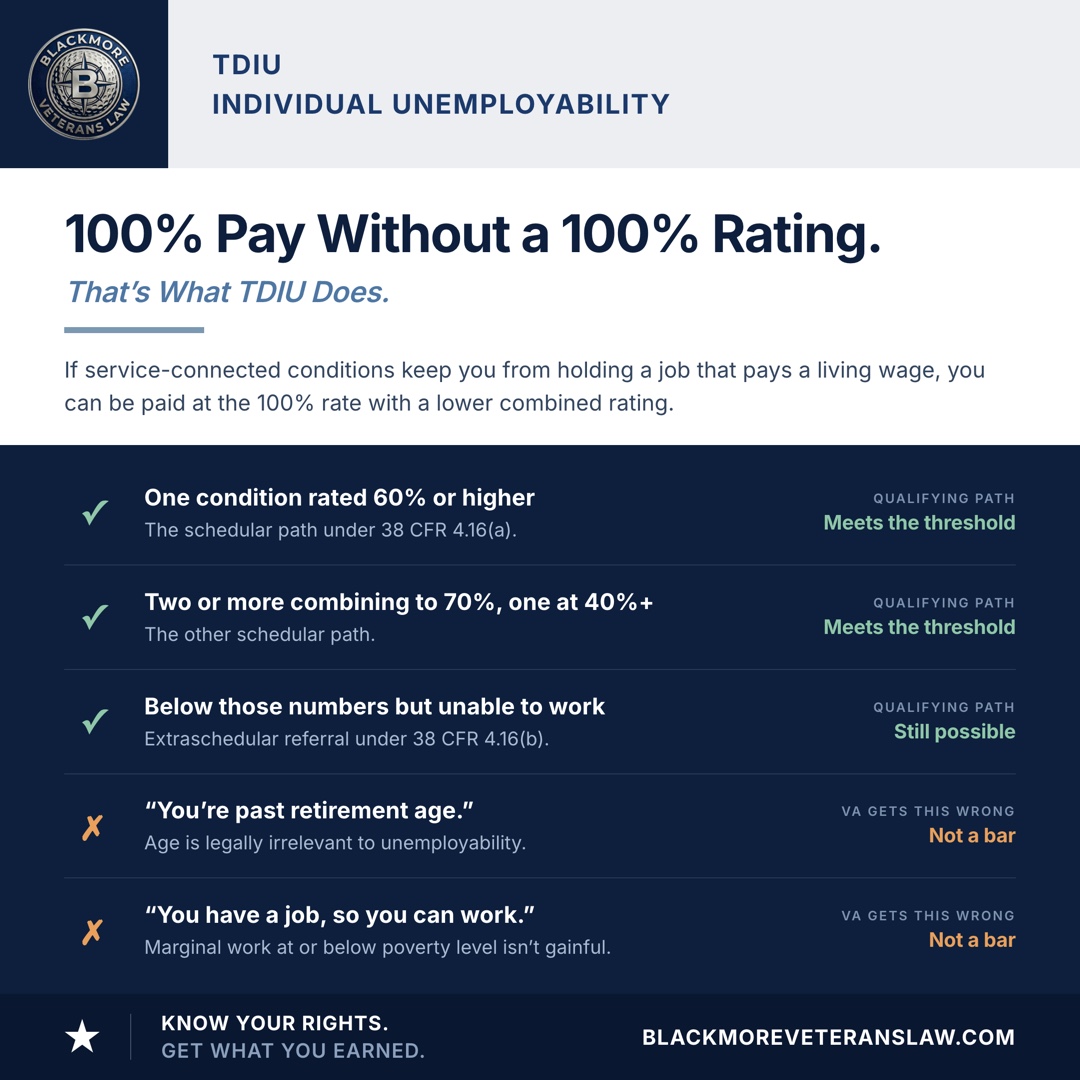
“Substantially gainful employment” means more than marginal employment. The VA defines marginal employment as earnings at or below the federal poverty threshold. If you can only work in a protected or sheltered environment, such as a family business that accommodates your limitations, that does not count as substantially gainful employment.
TDIU does not mean you cannot work at all. It means your service-connected disabilities render you unable to secure and follow work that provides a living wage.
Eligibility: The Schedular TDIU Criteria (38 CFR 4.16(a))
The most straightforward path to TDIU is meeting the schedular criteria under 38 CFR 4.16(a). You must have:
One service-connected condition rated at 60% or higher, OR
Two or more service-connected conditions that combine to 70% or higher, with at least one condition rated at 40% or higher
These are threshold requirements. Meeting them does not guarantee TDIU, you still must demonstrate that your service-connected disabilities prevent substantially gainful employment. But meeting the schedular criteria means your claim goes through a simpler administrative review.
Extraschedular TDIU (38 CFR 4.16(b))
What if you don’t meet the schedular criteria? You may still qualify for TDIU through the extraschedular pathway under 38 CFR 4.16(b).
Extraschedular TDIU requires referral to the Director of Compensation Service. It is granted when a veteran’s service-connected disabilities, even if they don’t meet the percentage thresholds, are shown to prevent substantially gainful employment. This pathway is more difficult and requires a stronger evidentiary showing, but it exists for a reason, to ensure that veterans who are genuinely unemployable due to service-connected conditions are not denied benefits solely because of a technical rating percentage.
Many veterans don’t know this pathway exists. If you’ve been told you don’t qualify for TDIU because your combined rating is below 70%, that may not be the final answer.
How to Prove Unemployability
Documentation is everything in TDIU claims. The VA will look at:
Your VA Form 21-8940 (Veteran’s Application for Increased Compensation Based on Unemployability). This form asks for a detailed employment history and the specific ways your service-connected disabilities affect your ability to work. Answer every question thoroughly. Vague or incomplete answers often lead to denials.
Medical evidence. Your treating physicians should document not just your diagnosis and symptoms, but specifically how those symptoms affect your functional capacity for work. A physician who notes only “back pain” provides far less support than one who documents “inability to sit for more than 20 minutes, inability to lift more than 10 pounds, significant concentration impairment due to chronic pain”, in language that tracks the VA’s evaluative criteria.
Employment records. W-2s, tax returns, and employer statements showing work history and the decline in employment can support the unemployment narrative.
Lay statements. Your own statement, and those of family members, coworkers, supervisors, or fellow veterans who can describe how your conditions affect your daily functioning and work capacity, carry real weight. Lay evidence about observable symptoms and functional limitations is legally sufficient to support a TDIU claim.
Vocational expert opinions. In some cases, a vocational expert can opine that, given your specific limitations, there are no jobs available in the national economy that you could perform on a consistent basis. This type of evidence can be powerful in contested cases.
Common Reasons TDIU Claims Are Denied
Misclassification of employment. The VA sometimes claims a veteran is engaged in substantially gainful employment when they are actually performing minimal work in a protected environment or earning below the poverty line. If you are working but earning little, provide documentation of your earnings.
Failure to connect unemployment to service-connected conditions. Veterans often have multiple health conditions, some service-connected and some not. The VA will argue that non-service-connected conditions are the real reason for unemployment. Your medical evidence must specifically tie the functional limitations causing unemployability back to the service-connected diagnoses.
Inadequate C&P exam. Like all VA claims, the C&P exam is often the pivotal moment. An examiner who doesn’t properly assess functional limitations for work purposes can doom a legitimate TDIU claim.
Age conflation. The VA sometimes inappropriately considers a veteran’s age as a factor in unemployability. It should not. If your service-connected disabilities are the proximate cause of your inability to work, age is legally irrelevant.
TDIU and Retirement Age
One important point: if you are over age 65 and receiving TDIU, you generally retain that benefit even after retirement age. The VA will not terminate TDIU solely because you have reached retirement age.
However, if you reach retirement age while your TDIU claim is still pending, the analysis can become more complicated. This is another area where having an attorney who understands the interplay between different VA regulations matters.
How to File for TDIU
-
File VA Form 21-8940 (Application for Increased Compensation Based on Unemployability). This can be filed as part of an original claim, a Supplemental Claim, or a Board Appeal.
-
Gather all medical records documenting your service-connected conditions and their functional impact.
-
Obtain a supporting opinion from your primary treating physician specifically addressing your work capacity.
-
If applicable, consider a private vocational expert opinion.
-
File a detailed lay statement describing, in your own words, how your service-connected disabilities prevent you from working.
The Stakes Are Significant
The financial difference between a 70% rating and TDIU (paid at the 100% rate) is substantial. As of 2025, a 70% single veteran receives approximately $1,716/month. The same veteran on TDIU receives approximately $3,737/month, a difference of over $2,000 per month, or $24,000 per year.
If you believe your service-connected disabilities have rendered you unable to work, a TDIU claim or appeal is worth pursuing seriously.
Bryan R. Blackmore is a veterans law attorney and former Attorney at the Board of Veterans’ Appeals. He served 24 years in the U.S. Coast Guard, including deployment to Baghdad during Operation Iraqi Freedom. Mr. Blackmore is licensed in California and Virginia and represents veterans through Blackmore Veterans Law, P.C.