
If you’ve recently received a VA disability rating decision and the number seems wrong, you’re not alone. Thousands of veterans receive ratings that don’t reflect the true severity of their service-connected conditions. Understanding how ratings work, and how the VA calculates them, is the first step in knowing whether you have a basis to appeal.
What Is a VA Disability Rating?
A VA disability rating is a percentage, from 0% to 100%, that represents how much a service-connected condition limits your ability to function. The VA assigns these ratings using the Schedule for Rating Disabilities (38 CFR Part 4), a detailed regulatory framework that assigns percentage values to hundreds of specific diagnoses and symptom levels.
A 0% rating means the VA acknowledges your condition is connected to your service, but finds it does not currently cause enough functional impairment to warrant monetary compensation. Higher ratings translate to higher monthly tax-free compensation payments.
Current monthly compensation rates (2025) range from approximately $175/month at 10% to over $3,700/month at 100%.
How Combined Ratings Are Calculated (and Why It’s Not Simple Addition)
Here’s where veterans are frequently confused and often shortchanged: the VA does not add percentages together.
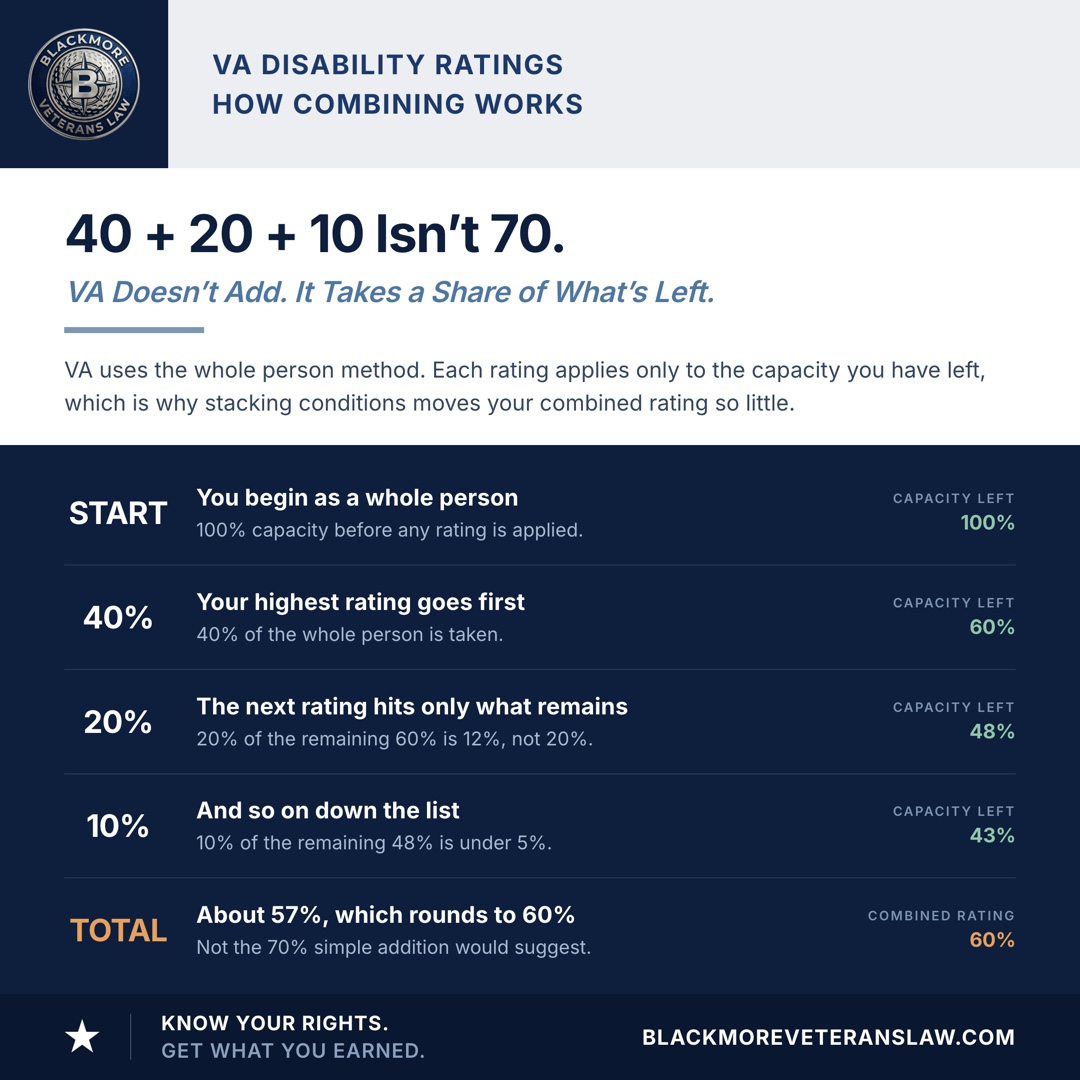
The VA uses what’s called the Whole Person Method. The calculation works like this:
- Start with 100% (representing your whole body).
- Apply your highest rating first. If your highest rating is 40%, you now have 60% remaining capacity.
- Apply the next rating to the remaining percentage. If your second rating is 20%, you apply 20% to the remaining 60%, which gives you 12%. Now your remaining capacity is 48%.
- Continue until all ratings are applied.
- Round to the nearest 10% for your final combined rating.
Example: A veteran with ratings of 40%, 20%, and 10% does not have a 70% combined rating. The actual math gives approximately 57%, which rounds to 60%.
This method means it is mathematically impossible to reach 100% through ratings alone unless a single condition is rated at 100%, or unless Total Disability based on Individual Unemployability (TDIU) is granted. This is why veterans with many service-connected conditions often find themselves stuck below 100% despite significant impairment.
Common Conditions and Typical Ratings
The VA assigns ratings based on the severity of symptoms documented in your medical records. Here are some frequently claimed conditions and how they are generally rated:
Tinnitus: 10% (this is one of the most commonly claimed conditions, there is a single 10% rating for tinnitus regardless of severity)
Lumbar spine conditions: Range from 10% (forward flexion 60-85 degrees) to 100% (incapacitating episodes requiring more than 6 weeks of bed rest per year). Many veterans receive low ratings for back conditions that significantly limit their daily lives.
PTSD: Ranges from 0% to 100%. The rating turns on the frequency, duration, and severity of symptoms and how much they impair social and occupational functioning. Ratings of 30% and 70% are common breaking points.
Sleep apnea with CPAP: Automatically rated at 50% if you require continuous treatment with a CPAP device. This is often underrated when the VA doesn’t have adequate documentation.
Hearing loss: Calculated through a complex VA audiological formula. Many veterans are rated at 0% or 10% despite significant real-world hearing impairment.
Knee conditions: Ratings range from 10% to 60%+ depending on range of motion, instability, and whether the condition requires bracing or surgery.
Why Your Rating Might Be Too Low
The most common reasons veterans receive inadequate ratings include:
Inadequate Compensation and Pension (C&P) exam. The C&P exam is performed by an examiner contracted by the VA. These exams are often brief, sometimes as short as 15 minutes, and the examiner may not have access to your full records. If the examiner’s report minimizes your symptoms or contains factual errors, your rating will suffer.
Failure to apply all diagnostic codes. The VA is required to rate every separate and distinct condition. If your condition has secondary symptoms, for example, a back injury that causes radiculopathy down your leg, each manifestation may warrant a separate rating. Many veterans don’t realize they can claim these secondary conditions.
Ignoring VA regulations on the benefit of the doubt. Under 38 U.S.C. § 5107, if there is an approximate balance of evidence for and against the claim, the VA must resolve that doubt in the veteran’s favor. In practice, many rating decisions don’t apply this standard correctly.
Outdated medical evidence. Your condition may have worsened since the last rating decision. The VA is not required to update your rating automatically. You need to file for an increase.
What to Do If Your Rating Seems Too Low
Step 1: Request your rating decision and C&P exam report. You have the right to receive a copy of everything the VA relied on to make its decision. Read it carefully. Note any factual errors or symptoms that were not captured.
Step 2: Get a private medical opinion. A treating physician or independent medical examiner can provide a nexus letter or a Disability Benefits Questionnaire (DBQ) that documents your symptoms more thoroughly than a typical C&P exam.
Step 3: Understand your options. Under the Appeals Modernization Act, you have three lanes for challenging a rating decision:
- Supplemental Claim, submit new and relevant evidence
- Higher-Level Review, a senior VA adjudicator reviews the same record
- Board Appeal, take the case to the Board of Veterans’ Appeals
Each lane has different requirements and strategic advantages. The right choice depends on your specific situation.
Step 4: Act within one year. If you appeal within one year of the rating decision, you can preserve your effective date, meaning if you win, you receive back pay to the original claim date.
When to Get an Attorney
Veterans law is complex. The regulations fill multiple volumes. The VA adjudication system is designed to be veteran-friendly in theory, but in practice the adversarial nature of the appeals process, especially at the BVA and beyond, means having professional representation matters.
An accredited veterans law attorney can:
- Identify rating errors and secondary conditions you may have missed
- Obtain and submit private medical nexus opinions
- Prepare a comprehensive legal brief for the Board
- Cross-examine VA examiners and challenge inadequate opinions
- Handle CAVC appeals if the BVA decision is wrong
Most veterans law attorneys, including this firm, work on a contingency basis, you pay nothing unless you win. There is no financial risk to seeking a consultation.
If your rating doesn’t reflect the reality of your service-connected conditions, you owe it to yourself to have it reviewed by someone who knows how the system works from the inside.
Bryan R. Blackmore is a veterans law attorney and former Attorney at the Board of Veterans’ Appeals. He served 24 years in the U.S. Coast Guard, including a deployment to Baghdad during Operation Iraqi Freedom. Mr. Blackmore is licensed in California and Virginia and represents veterans through Blackmore Veterans Law, P.C.