
Most veterans who have this claim have never heard of it.
You got hurt in service. The knee, the back, the shoulder. It got rated. And for the next fifteen or twenty years, the answer to the pain was a prescription. Eight hundred milligrams of ibuprofen, then naproxen, then meloxicam when the first two stopped working. You took what they gave you, because that was the treatment.
Now there is something wrong with your stomach. Reflux most nights, or gastritis on a scope, or the ulcer they found when you finally went in about the pain.
Nobody ever told you that is a claim. It is.
The rule reaches the treatment, not just the condition
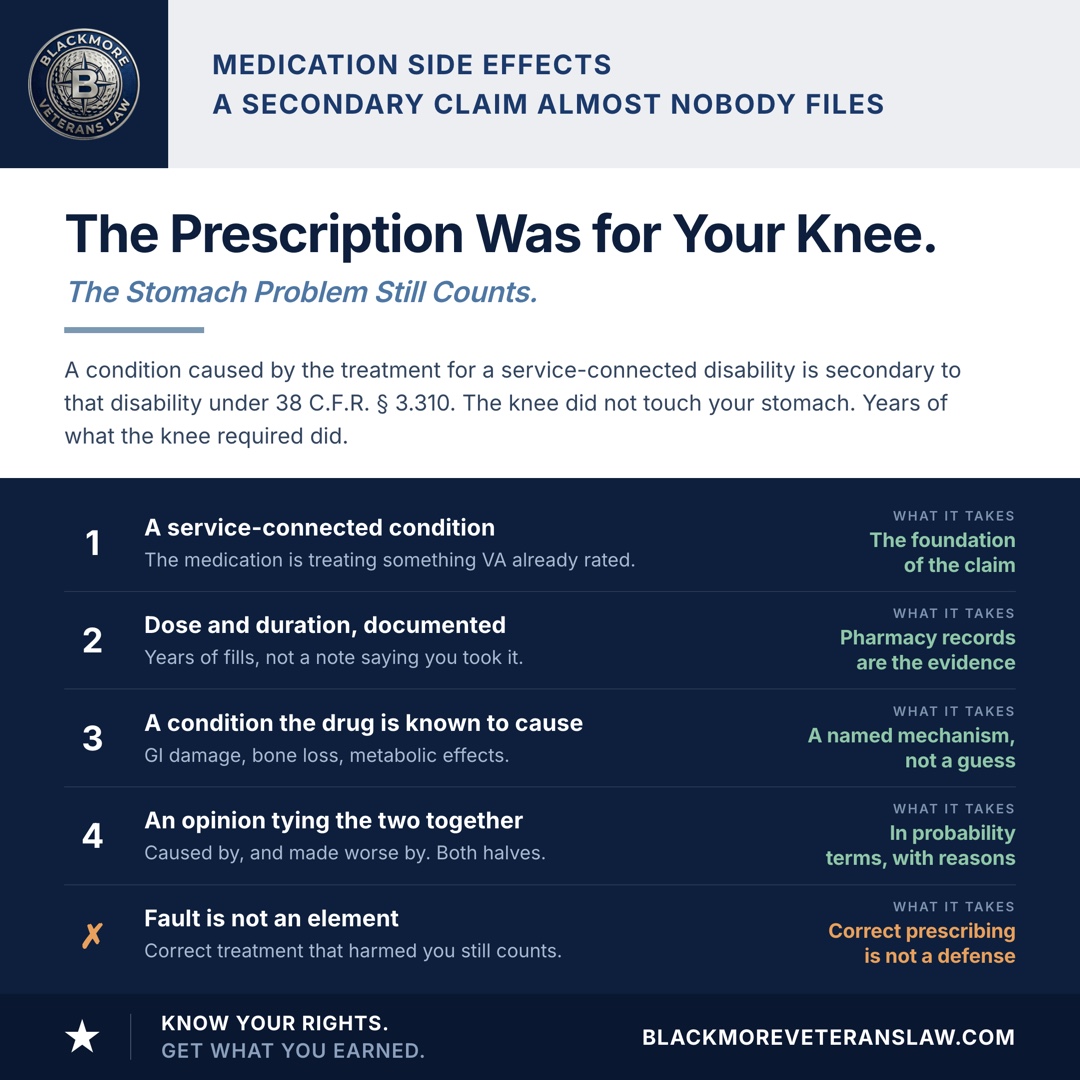
38 C.F.R. § 3.310 service connects a disability that is proximately due to or the result of a service-connected disease or injury. The full breakdown of how that works is in our guide to secondary service connection.
The part that matters here is what counts as a link in the chain. It does not have to be the service-connected condition itself doing the damage. The treatment that condition required is part of what the service-connected disability produced.
So the claim is not that your knee caused the reflux. Your knee did not touch your stomach. The claim is that your knee required years of a drug class that damages stomach lining, you took it because that was the treatment, and the damage followed.
Stated that way, it is a short causal chain with a well-documented mechanism, which is better than most secondary claims start out.
Nobody has to have done anything wrong
Veterans hear about a side effect claim and assume it turns on proving somebody was careless. It does not.
A secondary claim under § 3.310 has no fault element. The prescription can have been correct. The dose can have been appropriate. The provider can have done everything right, including warning you about the risk. The condition still gets service connected if the medication caused it.
None of that is a defense, because none of it is what the regulation asks about. The only question is whether the treatment for your service-connected condition caused or worsened something else. A drug that did exactly what it was supposed to do for your knee, and damaged your stomach on the way, fits the rule as squarely as one that did not.
It also does not matter who wrote the prescription. What matters is that the medication was treating a service-connected condition, so a prescription from a private doctor supports the claim the same way a VA one does.
If you have been told you need to show that someone made a mistake, that advice was about something else.
The chains that come up
These are patterns, not conclusions. No pairing decides an individual claim.
- Anti-inflammatory medication for a service-connected musculoskeletal condition. Gastritis, reflux, peptic ulcer disease, gastrointestinal bleeding. Kidney effects with long enough exposure. This is by far the most common version.
- Psychotropic medication for a service-connected mental health condition. Metabolic effects and weight gain, which can open their own secondary chains. Sexual dysfunction.
- Long-term corticosteroids. Bone density loss, cataracts, high blood sugar, avascular necrosis.
- Opioid treatment for service-connected pain. Gastrointestinal effects and endocrine effects.
- Any medication that drives significant weight gain, which can act as a step toward conditions like sleep apnea. That mechanism is covered in the sleep apnea post.
One of those deserves a specific note. Sexual dysfunction secondary to psychiatric medication is recognized and rarely filed. Even where erectile dysfunction rates at 0 percent because there is no penile deformity, a grant can support special monthly compensation for loss of use of a creative organ under 38 U.S.C. § 1114(k). That is a separate monthly payment that sits on top of the combined rating rather than inside it, so a 0 percent rating is not the end of the inquiry.
Dose and duration are the whole case
An opinion saying a drug caused a condition is only as good as the record showing how much you took and for how long.
This is where these claims are won and lost, and it is almost always fixable. Pharmacy records are the evidence. Not the treatment notes, which may mention a prescription once. The fill history, showing the drug, the dose, and the refills stretching back years.
Request them from every VA pharmacy that ever filled anything for you, and from private pharmacies too. A chain pharmacy can usually print a multi-year history at the counter. If you used a mail-order benefit, that is a separate record.
A file that documents twelve years of continuous high-dose anti-inflammatory use is a different file from one that says the veteran reports taking ibuprofen for a long time.
What the opinion has to say
The clinician needs to address three things:
- The mechanism. How this drug class damages this system. Not a conclusion, an explanation.
- This veteran’s exposure. The dose and duration actually in the record, and why that exposure is sufficient.
- Both halves of § 3.310. Whether the medication caused the condition, and whether it aggravated a condition that was already there. An opinion that answers only causation leaves the aggravation question undecided, which is covered in You Had It Before.
What separates an adequate opinion from an inadequate one is in The Exam Is the Appointment. The Opinion Is What Decides the Claim.
Where these get denied
The examiner answered the wrong question. “The Veteran’s gastroesophageal reflux disease is less likely than not caused by the service-connected right knee disability.” That is true and irrelevant. The knee is not the alleged cause. The treatment is.
The side effect was called a known risk. Decisions sometimes note that the condition is a recognized complication of the drug, or that the veteran was warned about it, as though that answers something. A known side effect is precisely what the claim is about.
“The medication was appropriately prescribed.” This appears in denials as though it resolves something. Under § 3.310 it resolves nothing.
No duration in the record. The opinion asserted long-term use that the file does not document.
Aggravation was never addressed. As usual.
If your denial rests on any of those, the decision may have answered a question you did not ask, which is the subject of Your Secondary Claim Was Denied Under the Wrong Test.
What to do with this
- Write down every medication you have taken for a service-connected condition, including the ones you stopped years ago.
- Request your complete pharmacy fill history, VA and private, going back as far as the system holds it.
- List what has gone wrong since, especially in the digestive system, bone density, blood glucose, and sexual function.
- Say what the claim is when you file it. File the new condition as secondary to the service-connected condition the medication treats, and name the medication. A claim that lists only the new diagnosis invites development as a direct claim.
- Make sure the opinion addresses dose and duration, not just the existence of a prescription.
- File when you notice, not when it becomes unbearable. The effective date is generally the date of the claim, which is covered across the effective date posts here.
Whether any particular claim succeeds depends on the evidence, the records that exist, and how the file is built. Nobody can tell you your outcome. But a condition caused by the treatment for a service-connected disability is not a coincidence VA gets to ignore, and nobody has to have done anything wrong for it to count.
Blackmore Veterans Law, P.C. is a solo practice representing veterans in VA disability claims and appeals. Contact us to discuss your situation.
This article is general information about VA disability law and is not legal advice for any individual case. Reading it does not create an attorney-client relationship. Attorney advertising.