
The word does more damage than almost anything else in this area, and it does it by sounding like good news.
A veteran hears that their condition is presumptive. They understand that to mean the claim is a formality. Then the denial arrives, and nothing in it makes sense, because they were told this one was automatic.
A presumption is not a grant. It removes one element out of three.
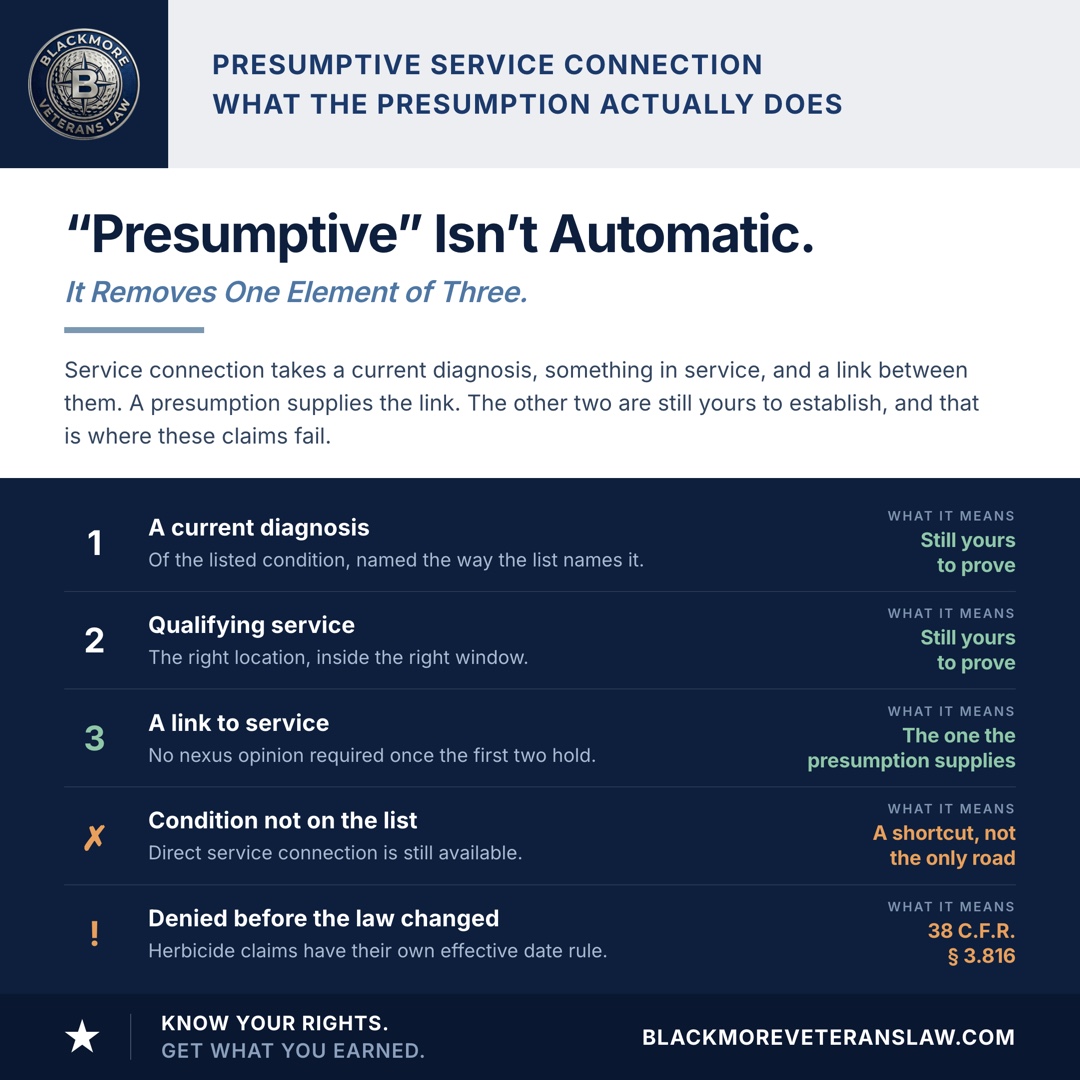
The three elements, and which one gets supplied
Service connection ordinarily requires a current diagnosis, an in-service event or exposure, and a medical link between them. That structure is covered in our guide to secondary service connection, which deals with a different shortcut around the same three elements.
A presumption operates on the third one. Where a veteran has a listed condition and qualifying service, VA presumes the connection. No nexus opinion required, no medical expert needed to explain the mechanism.
What the presumption does not do is supply the other two.
You still have to have the diagnosis, and it has to be the listed condition. Lists are written in specific diagnostic terms, and a record describing something adjacent is not the same thing. This is a routine reason presumptive claims fail.
You still have to have the qualifying service. Presumptions are built on location and time. If VA cannot verify that you were in a covered location during a covered period, the presumption never attaches, no matter what condition you have.
Two presumptions, frequently collapsed into one
It helps to separate them, because a claim can satisfy one and fail the other.
Presumed exposure. VA accepts that you were exposed to something based on where and when you served, rather than requiring you to prove the exposure. Herbicide exposure in Vietnam is the oldest example. The PACT Act extended presumed exposure to burn pits and other airborne hazards for service in specified locations and periods.
Presumed service connection. VA accepts that a particular condition is related to that exposure, because the condition is on a list tied to it.
A veteran with verified burn pit exposure and a condition that is not on the list has the first and not the second. A veteran with a listed condition whose service VA cannot place in a covered location has the second available in theory and cannot reach it.
What the PACT Act actually did
Three things, in plain terms.
It added conditions to the burn pit and airborne hazard list, including a group of respiratory conditions and a substantial number of cancers.
It expanded herbicide coverage, adding hypertension and monoclonal gammopathy of undetermined significance to the conditions presumptively associated with herbicide exposure, and adding locations where that exposure is presumed, including service in Thailand, Laos, Cambodia, Guam, American Samoa, and Johnston Atoll during specified periods.
It expanded the locations and periods for presumed toxic exposure tied to service in Southwest Asia and, for the post-2001 period, a further set of countries.
Two practical notes on the lists themselves. They are long, they are written in precise diagnostic language, and VA continues to add to them, so the authoritative version is the one VA publishes rather than any summary including this one. And the fact that a condition is absent today does not mean the claim fails today, for the reason in the next section.
Not on the list is not the end
This is the part that gets lost, and it costs claims.
A presumption is a shortcut. It is not the only route to service connection. Any condition can be service connected directly where the evidence supports it, which in an exposure case means a medical opinion explaining why this veteran’s exposure caused this veteran’s condition.
That route is harder. It requires an opinion that addresses the mechanism in probability terms, which is covered in The Exam Is the Appointment. The Opinion Is What Decides the Claim. But it exists, and a decision that denies a claim solely because the condition is not on a presumptive list has answered one theory and left the other undecided. Reading a denial for that kind of gap is the subject of Your Secondary Claim Was Denied Under the Wrong Test.
If you were denied before the law changed
A prior denial on a condition that is now presumptive is not the end of the matter.
A supplemental claim is available at any time on new and relevant evidence, and a change in law creating a presumption can support one. Filed within a year of a decision, a supplemental claim protects the effective date of that earlier claim.
For herbicide exposure claims there is an additional rule that matters a great deal and almost never comes up in conversation. Under 38 C.F.R. § 3.816, when a condition is added to the herbicide presumptive list, certain previously denied claims can be awarded with an effective date running back to the earlier claim rather than to the new filing. For a veteran denied decades ago, that is the difference between benefits from this year and benefits from the year they first asked.
If you were ever denied for a condition now on the herbicide list, that rule is one to ask about by name.
Camp Lejeune is two different processes
These get conflated constantly, and they are not the same thing.
A claim for VA disability compensation based on Camp Lejeune water exposure runs through VA, under VA rules, decided by VA.
A civil action under the Camp Lejeune Justice Act is a lawsuit, with its own filing requirements, its own deadlines, and its own decision makers.
They are separate. Pursuing one is not pursuing the other, and the deadlines do not track each other.
Where these claims get denied
The diagnosis is not the listed one. The record says something close, and close does not attach the presumption.
Service could not be verified in a covered location. Personnel records are thin, the unit history is not in the file, and nobody went looking for deck logs or travel orders.
Only the presumptive theory was decided. The decision says the condition is not on the list and stops, without reaching direct service connection.
The claim was filed for the exposure rather than the disability. Exposure is not a disability and is not rated. What gets rated is the condition it produced.
What to do with this
- Check the listed name against your records. If your diagnosis is described differently than the list describes it, that gap is fixable with a treating provider before it becomes a denial.
- Prove where you were. Personnel file, orders, unit assignment history, deployment records. For presumptions, location and dates are the whole ballgame, and the file VA decides on is often missing them.
- If the condition is not on a list, ask about the direct route rather than treating the list as the boundary of what is possible.
- If you were denied before the law changed, look again, and for herbicide claims ask specifically about the effective date rule at § 3.816.
- File when the condition appears. The window that allowed backdating to the statute’s enactment has closed, and effective dates now generally run from the claim.
Whether any particular claim succeeds depends on the evidence, the records, and how the file is built. Nobody can tell you your outcome. But a presumption was never a promise that the claim would be easy. It was a promise about one element, and the other two are still yours to establish.
Blackmore Veterans Law, P.C. is a solo practice representing veterans in VA disability claims and appeals. Contact us to discuss your situation.
This article is general information about VA disability law and is not legal advice for any individual case. Reading it does not create an attorney-client relationship. Attorney advertising.