
A veteran takes the medication the way they were told to. They show up to the examination on the scheduled day, having taken it that morning, because that is what responsible people do.
The examiner writes down what is in front of them. Someone managing.
The rating comes back lower than the condition is, and nobody can explain why, because on paper nothing went wrong. The exam was accurate. It described a person on medication.
The rule
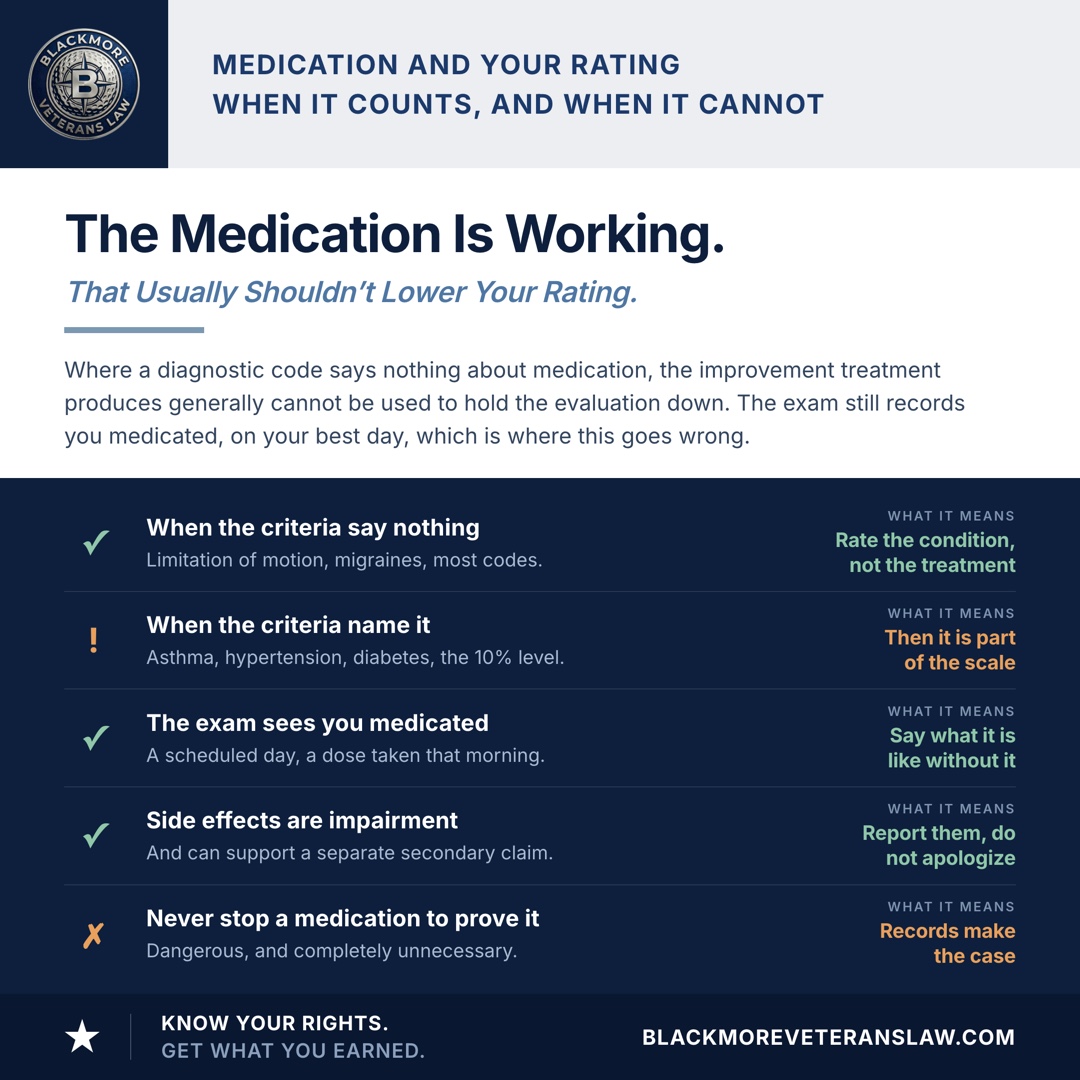
Where the rating criteria for a condition say nothing about medication, VA generally may not use the improving effects of medication to deny or reduce the evaluation. The courts that review VA decisions settled this. You are rated on the disability, not on the disability as modified by treatment.
Put plainly: if the diagnostic code does not mention medication, the fact that your medication helps is not a reason to rate you lower.
That sounds obvious when stated. It is routinely not what happens, because the examination records current function and the rating follows the examination.
When medication does count
The rule has a clear boundary, and it matters as much as the rule.
Where the rating criteria themselves contemplate medication, medication is part of the evaluation. Several do, by name:
- Asthma. The criteria reference inhalational and bronchodilator therapy, and daily inhalational or oral corticosteroid use.
- Hypertension. The criteria reference a history of particular diastolic readings in a person who requires continuous medication for control.
- Diabetes. The criteria reference insulin, oral hypoglycemic agents, and restricted diet.
- Mental health, at the 10 percent level. The general rating formula expressly covers symptoms controlled by continuous medication.
In those, treatment is written into the scale. A veteran whose hypertension is controlled on medication is being evaluated under a criterion that anticipated exactly that.
Where the criteria are silent
Most codes say nothing, and the list of what is not mentioned is long.
Limitation of motion. A knee that moves through a restricted arc moves through a restricted arc. Pain controlled by medication does not restore the degrees.
Migraines. The code turns on the frequency and character of prostrating attacks. It does not mention abortive or preventive medication.
Mental health above 10 percent. The higher levels of the general formula measure occupational and social impairment and say nothing about medication, which is covered in VA Does Not Rate Your Diagnosis.
In each of those, a veteran functioning better on treatment is still entitled to an evaluation of the underlying disability.
Why this goes wrong at the exam
Nothing in the process is built to capture it.
The examination happens on an appointed day. You take your medication that morning, as you should. The Disability Benefits Questionnaire asks the examiner to record findings, and the findings are what is in the room. No form asks what this condition looks like without treatment.
So the gap has to be filled deliberately, by you, out loud:
- What the condition is like when a dose is late or missed, without ever making that happen on purpose.
- What it was like before this medication, and before the one before it.
- What the medication does not fix.
- What the medication costs you. Sedation, cognitive slowing, nausea, the hours after a dose.
That last one is doubly relevant, because functional loss from side effects is part of the disability picture and because a condition caused by treatment can be separately service connected, covered in The Prescription Was for Your Knee.
Preparing for the appointment generally is covered in The C&P Exam Is Short.
Never stop your medication to prove a point
This has to be said directly, because the logic of everything above leads somewhere dangerous if followed without care.
Do not stop a prescribed medication before an examination. Not to demonstrate severity, not to make a point, not on anyone’s advice. For some conditions it is dangerous and for some it is life-threatening, and it is also unnecessary.
The case is made with records, with an accurate account of your unmedicated baseline, and with the documented history of what treatment has and has not accomplished. It is never made by being unwell on purpose on a Tuesday.
The history is the evidence
A single medicated snapshot understates a condition. The treatment history corrects it.
- Dose escalations over months or years.
- Medications abandoned because they stopped working or could not be tolerated.
- The gaps between a medication failing and the next one taking hold.
- Combination therapy, where one drug stopped being enough.
- Specialty referrals, which usually mean the first approach did not succeed.
None of that appears in a one-day examination. All of it is in your records, and it describes a condition far better than a good morning does.
What to do with this
- Find your diagnostic code and read the criteria, looking for any mention of medication, therapy, or treatment. That single question decides which rule applies to you.
- If the criteria are silent, say so plainly when the rating comes back low because you are managing well on treatment.
- Describe your unmedicated baseline at the exam, and ask that it go in the report.
- Report side effects as impairment, not as a complaint you are apologizing for.
- Assemble the treatment history, especially escalations and failures.
- Keep taking your medication. Always.
Whether any particular rating is correct depends on the criteria, the evidence, and the record. Nobody can tell you your outcome. But a rating that is low because the treatment is working, under a code that never mentioned treatment, is a rating built on something the criteria did not ask about.
Blackmore Veterans Law, P.C. is a solo practice representing veterans in VA disability claims and appeals. Contact us to discuss your situation.
This article is general information about VA disability law and is not legal advice for any individual case. Reading it does not create an attorney-client relationship. Attorney advertising.