
Take out your most recent rating decision and look at the combined percentage. Whatever it says, that number has nothing to say about the benefit this post is about.
Special monthly compensation is not a rating. It does not raise your percentage, it does not show up inside it, and it is calculated on its own. Which means a veteran can read a decision that says exactly what they expected it to say and have no way of knowing that a separate monthly payment was never considered at all.
That is the whole reason it gets missed.
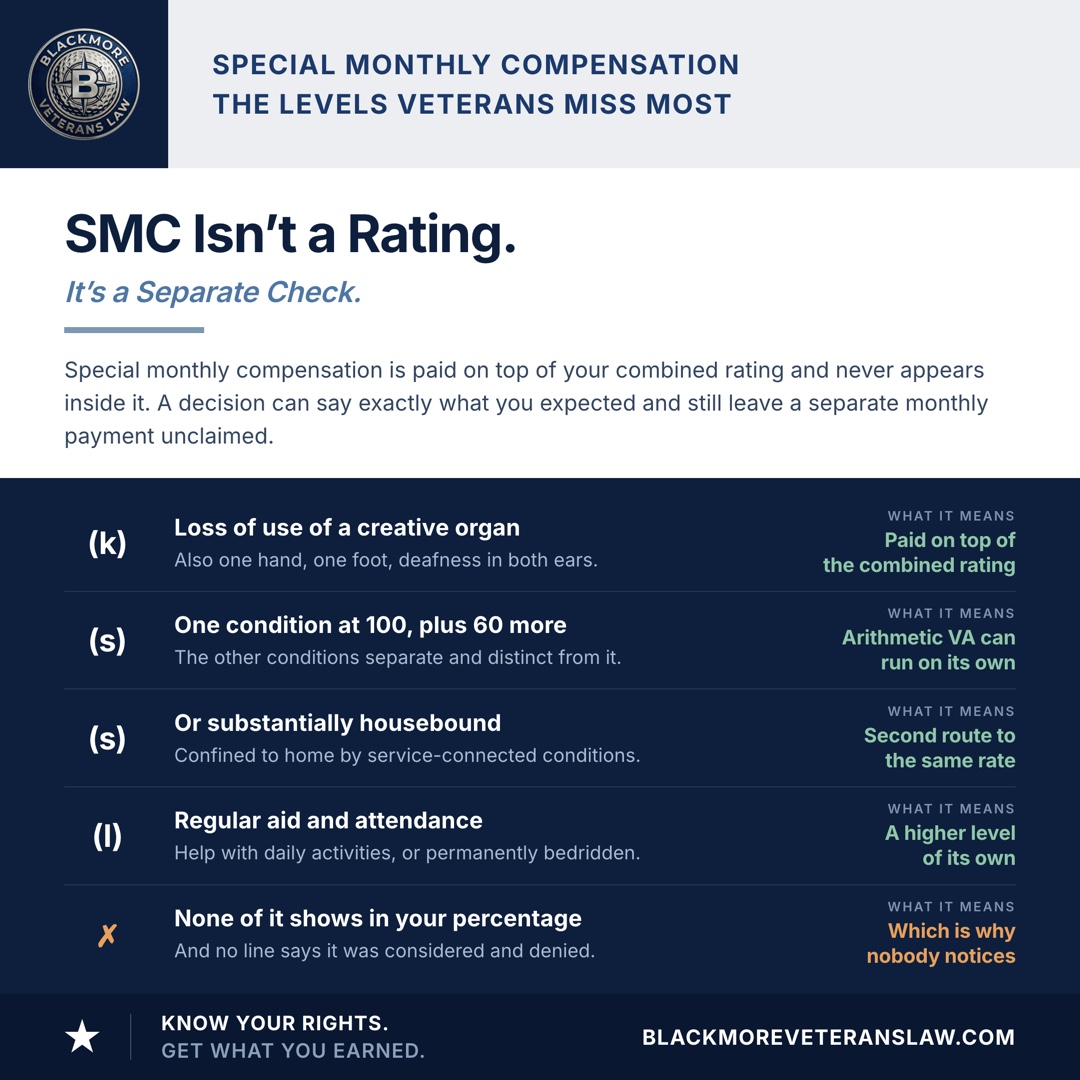
What SMC is
38 U.S.C. § 1114 and 38 C.F.R. § 3.350 set out additional compensation for specific losses and specific situations that the ordinary rating schedule does not capture well.
The levels are lettered. Subsection (k) is a flat add-on. Subsections (l) through (o) are progressive levels based on combinations of serious loss, with intermediate rates between several of them. Subsection (s) is the housebound rate. Subsections (r) and (t) sit at the top for the highest levels of aid and attendance and for certain traumatic brain injury cases.
Two of those account for most of what veterans are entitled to and never claim.
SMC(k), the one that follows a 0 percent rating
SMC(k) is paid for anatomical loss or loss of use of a creative organ, loss of use of one hand or one foot, deafness in both ears with absence of air and bone conduction, complete organic aphonia, and certain losses of breast tissue.
It is a flat monthly amount, paid in addition to your regular compensation. More than one can be paid where more than one qualifying loss exists.
That list matters more than it looks. Loss of use of a creative organ includes erectile dysfunction, and erectile dysfunction is frequently rated at 0 percent because there is no penile deformity. A veteran can get a grant, see a 0 percent rating, conclude nothing came of it, and never learn that the grant supports a separate monthly payment that has nothing to do with the percentage.
The same situation arises constantly with medication side effects, which is covered in The Prescription Was for Your Knee.
SMC(s), the arithmetic nobody runs
SMC(s) is the housebound rate, and the name is misleading, because you do not have to be housebound to qualify.
There are two routes.
The statutory route. A single service-connected disability rated 100 percent, plus additional service-connected disability or disabilities independently ratable at 60 percent or more, separate and distinct from the 100 percent disability and involving different anatomical segments or bodily systems.
Read that again with your rating sheet in hand, because it is arithmetic. One condition at 100. Everything else, combined on its own, reaching 60. If that describes your file, you may have qualified years ago without anyone saying a word about it.
The factual route. Being permanently and substantially confined to your home and immediate premises by service-connected disabilities, with reasonable certainty that the confinement will continue for life.
One more piece that turns a lot of files: a TDIU award based on a single service-connected disability can satisfy the 100 percent element. So a veteran whose rating sheet shows no 100 anywhere, but who is paid at the total rate because one condition made them unemployable, can still meet the statutory criteria if the rest of the conditions combine to 60.
SMC(l), aid and attendance
SMC(l) sits at a higher level and covers anatomical loss or loss of use of both feet, of one hand and one foot, certain degrees of blindness, being permanently bedridden, or being so helpless as to need the regular aid and attendance of another person.
That last category is broader than people assume. It does not require a nursing home or a full-time caregiver. It reaches a veteran who needs regular help with ordinary activities, dressing, bathing, eating, managing medication, or who cannot protect themselves from the ordinary hazards of daily life.
Aid and attendance is a large subject with its own evidence problems, and it deserves separate treatment rather than a paragraph here.
Why nobody tells you
Three reasons, and none of them is that you failed to ask correctly.
It is invisible in the percentage. Everyone in this process, veterans, families, and often the people advising them, thinks in combined ratings. SMC is outside that number entirely.
There is no line saying it was denied. A rating decision lists the conditions and the evaluations. Nothing on it says special monthly compensation was considered and found not warranted, so there is nothing to appeal and nothing to notice.
VA is supposed to raise it, and frequently does not. VA is required to maximize the benefits the evidence supports, which means where the record raises entitlement to SMC, it should be addressed as part of the claim already pending. That obligation is real and it is unevenly honored.
None of that stops you from raising it yourself, and raising it in writing is the safer course than relying on the file to speak for itself.
What to do with this
- Look for the statutory housebound pattern. One service-connected condition at 100 percent, or TDIU based on a single condition, plus other service-connected conditions combining to 60 percent or more. If that is your sheet, ask about SMC(s) specifically, by letter.
- Look for a 0 percent grant that involves loss of use of a creative organ. The percentage is not the point. The separate payment is.
- Ask whether anyone helps you get through the day. Dressing, bathing, medication, getting to appointments, keeping you safe at home. If the answer is yes and the reason is service connected, aid and attendance is a conversation.
- Raise it in writing rather than waiting. Name the subsection you think applies and say why.
- Do not quote yourself a dollar figure from an article. The rates change every year with the cost of living adjustment. VA publishes current special monthly compensation rate tables.
Whether any particular veteran qualifies depends on the ratings, the medical evidence, and how the file is built. Nobody can tell you your outcome. But SMC is the one benefit in this system that can be sitting there fully earned, fully documented, and entirely unpaid, because the number everyone looks at was never going to show it.
Blackmore Veterans Law, P.C. is a solo practice representing veterans in VA disability claims and appeals. Contact us to discuss your situation.
This article is general information about VA disability law and is not legal advice for any individual case. Reading it does not create an attorney-client relationship. Attorney advertising.