
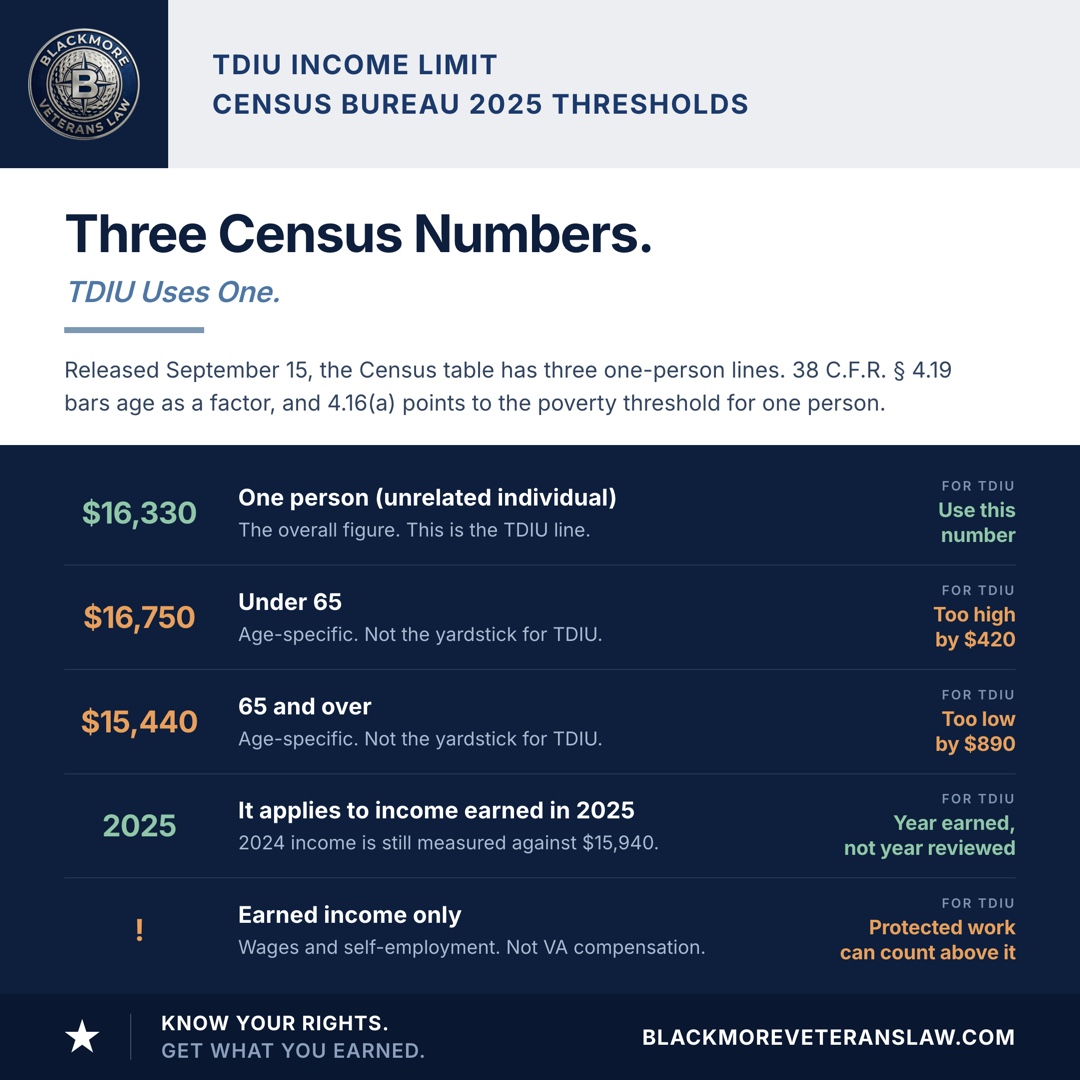
$16,330. That is the Census Bureau’s 2025 poverty threshold for one person, released September 15. It is the number that decides how much a veteran on TDIU can earn from work before VA has grounds to look at the rating.
It applies to income earned in 2025, and it is $390 higher than the 2024 figure of $15,940.
Which Number Is It
The Census Bureau does not publish one poverty threshold for a single adult. The table has three lines:
- One person (unrelated individual): $16,330
- Under 65: $16,750
- 65 and over: $15,440
The regulation ties marginal employment to “the poverty threshold for one person,” and VA’s manual uses the same wording. The overall one-person figure is the top line, $16,330.
It is tempting to grab the under-65 number instead, on the theory that most TDIU claimants are of working age. That would put the line $420 too high. Age cannot be a factor in evaluating service-connected disability (38 C.F.R. § 4.19), and it does not become one here. A 45-year-old veteran and a 72-year-old veteran on TDIU are measured against the same figure.
If you are reading a website, an article, or a claim worksheet that gives a different one-person number, check which line of the Census table it took the number from. Several published figures are the under-65 line.
What the Threshold Does
TDIU pays at the 100 percent rate when service-connected conditions keep a veteran from securing or following substantially gainful employment, even when the combined schedular rating is lower. The dividing line between gainful and not is marginal employment.
Under 38 C.F.R. § 4.16(a), marginal employment generally exists when a veteran’s earned annual income does not exceed the poverty threshold for one person. Work at that level does not count as substantially gainful, and TDIU stays intact.
Two details matter:
The test is earned income. Wages and self-employment earnings count. VA compensation does not count as earnings from work.
A protected work environment can be marginal even above the threshold. The regulation says marginal employment may also exist, on a facts-found basis, when a veteran works in a protected environment such as a family business or sheltered workshop. That is a judgment about the job, not a formula, so it depends on documentation: who set the hours, what accommodations exist, whether an ordinary employer would have kept you on.
How VA Checks
VA no longer sends every TDIU recipient an annual employment questionnaire. It verifies earnings through Social Security Administration and IRS income records. When those records show earnings above the poverty threshold for 12 months, VA generally sends a notice proposing to reduce or end TDIU, along with VA Form 21-4140, the Employment Questionnaire. You generally have 60 days to respond.
That form is not a formality. Your answers are compared against SSA records, and the two need to agree. A veteran who reports less work or less income than the records show creates a credibility problem on top of the earnings question.
Which Year’s Number VA Uses
VA applies the threshold that matches the year the income was earned, not the threshold in effect on the date VA reviews the claim. Census finalizes each year’s figure about nine months after the year ends, which is why the 2025 number arrives in September 2026. Income you earned in 2025 is measured against $16,330. Income you earned in 2024 is still measured against $15,940.
That means the new figure does not help or hurt earnings from earlier years, and it does not apply to 2026 earnings until Census publishes the 2026 threshold next September.
What Crossing the Line Does and Does Not Do
Crossing the line does not automatically end TDIU. Earnings over the threshold give VA a reason to ask questions and, after 12 months, to propose a reduction. A short attempt at work is different from steady, substantially gainful employment, and VA generally cannot reduce TDIU because of employment unless it has lasted 12 consecutive months (38 C.F.R. § 3.343(c)(2)).
The reverse is also true. Earning under the threshold protects the rating only while the work stays marginal.
What to Do
Know your own earnings, in the calendar year. The threshold is an annual figure. Add up everything you earned from work for the year, including self-employment income, and compare it to the number.
Keep the records that show what your work looks like. Pay stubs, tax returns, and your SSA earnings statement. If you work in a protected environment, keep whatever shows why: the accommodations, the reduced duties, who employs you.
Answer a 21-4140 accurately and on time. If one arrives, do not ignore it and do not guess. Report what the records will show.
If VA proposes to reduce or terminate TDIU, act inside the deadline. You generally have 60 days, and the notice states the date. A proposal is the point at which evidence about the nature of your work is most useful. See how to appeal a VA denial for what follows a final decision.
If you are on TDIU and thinking about work, talk to someone first. Whether a particular job fits inside marginal employment depends on how the job is structured, not just the pay. Part-time and self-employed work in particular need to be looked at before you start, not after the wage match.
For more on the benefit itself, see What Is TDIU and Do You Qualify? For how the same threshold affects an earlier effective date, see Your TDIU Effective Date Probably Isn’t the Day You Filed the 8940.
The Same Number Every Year, Different in September
The rule has not changed. The number underneath it moves each September, and VA checks earnings whether or not anyone is watching the figure. A veteran whose work income sits near the line should know the current threshold and where their own year is landing against it.
Blackmore Veterans Law, P.C. is a solo practice representing veterans in VA disability claims and appeals. Contact us to discuss your situation.
This article is general information about VA disability law and is not legal advice for any individual case. Reading it does not create an attorney-client relationship. Attorney advertising.