
A VA denial letter is not the end of the road. In fact, the majority of veterans who pursue appeals, particularly at the Board of Veterans’ Appeals, are able to obtain at least a partial grant of benefits. But the appeals process is complicated, deadlines matter, and the strategic choices you make early will determine the outcome.
This guide walks through the three appeal lanes created by the Appeals Modernization Act (AMA), what each option means, critical deadlines, and how to maximize your chances of winning.
Why Veterans Get Denied
Before diving into the appeals process, it’s worth understanding why denials happen, because the reason for your denial will shape the best path forward.
The most common reasons for VA denials include:
No nexus established. The VA concluded that your condition is not connected to your military service. This is often because the C&P examiner provided a “negative nexus opinion”, stating that it is less likely than not that your condition is related to service.
Condition not found. The VA determined that the records don’t show the claimed condition actually exists, or is below the minimum threshold for a compensable rating.
Insufficient service records. Service treatment records (STRs) from decades ago may be lost, incomplete, or simply don’t document the in-service event or injury.
Secondary conditions not recognized. The VA failed to connect a secondary or residual condition to an already-service-connected disability.
Understanding which of these applies to your case will help you and your attorney choose the right appeal lane and build the most effective strategy.
The Three Appeal Lanes Under AMA
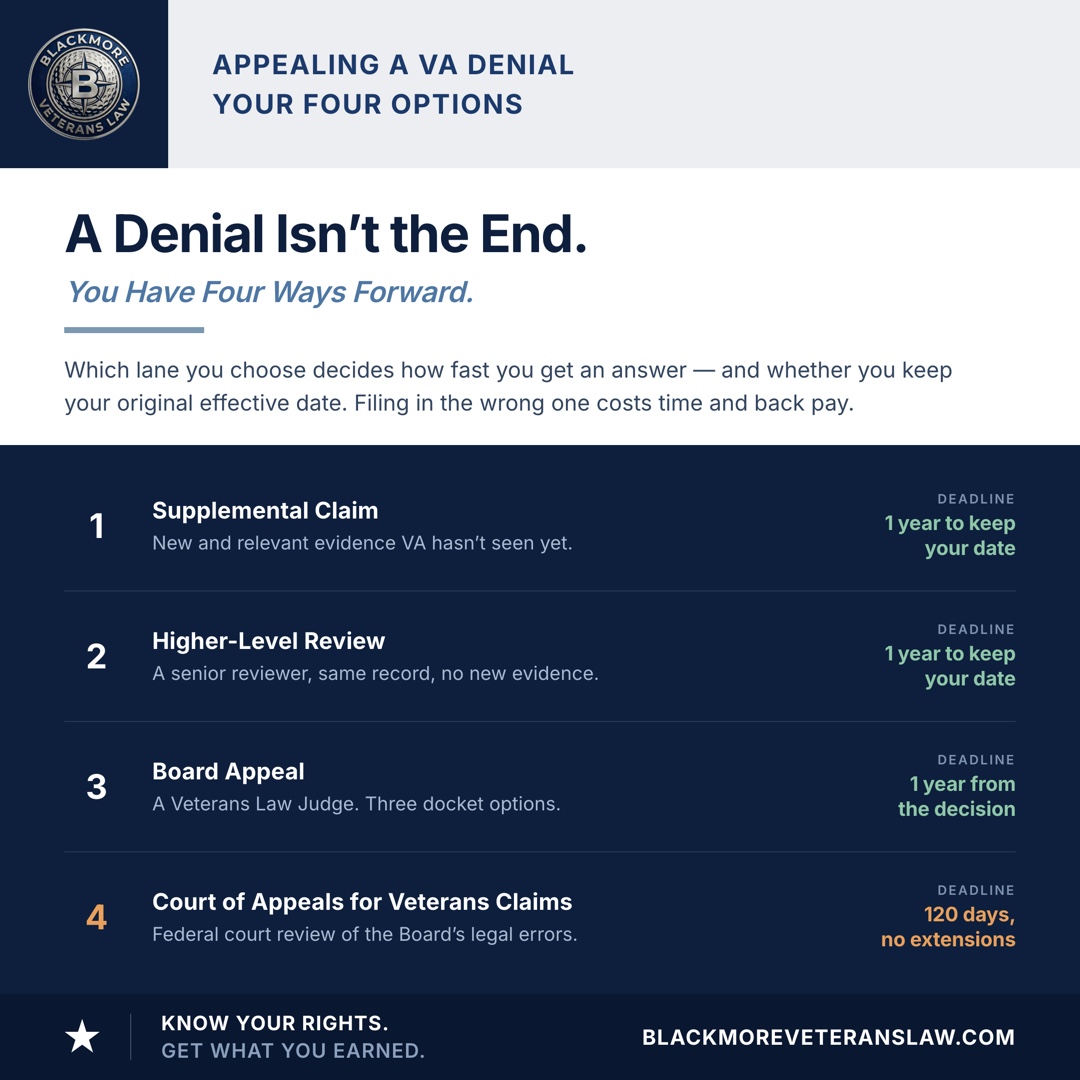
Since the 2019 implementation of the Appeals Modernization Act, veterans have three distinct paths to challenge a denial. Choosing the wrong lane, or missing a deadline, can cost you months or years and potentially valuable back pay.
Lane 1: Supplemental Claim
Best for: Cases where you have new evidence that wasn’t before the VA when it made its decision.
A Supplemental Claim allows you to submit new and relevant evidence. The VA is required to process Supplemental Claims within 125 days (though this timeline is often not met). If you win a Supplemental Claim, your effective date goes back to the original claim date, preserving your right to back pay.
Common types of new and relevant evidence include:
- Private medical nexus opinions or DBQs from your treating physician
- Buddy statements from fellow service members who can corroborate in-service events
- Newly obtained service records or military operational records
- Updated medical treatment records showing increased severity
Key deadline: There is no strict deadline for a Supplemental Claim, but the longer you wait, the more back pay you may lose. If filed within one year of the original denial, you preserve the original effective date.
Lane 2: Higher-Level Review (HLR)
Best for: Cases where the original decision contained a clear legal or factual error, and you are not adding new evidence.
In an HLR, a senior VA adjudicator reviews the same record that was before the original decision-maker. You cannot submit new evidence. However, you can request an informal conference with the HLR adjudicator, a phone call where you or your representative can identify specific errors in the rating decision.
HLRs are most effective when:
- The C&P exam was clearly inadequate and this is apparent from the existing record
- The VA failed to apply the benefit of the doubt rule
- The VA applied the wrong diagnostic code
- The decision contains a math error or other clear mistake
Key deadline: File within one year of the rating decision to preserve your effective date.
Lane 3: Board of Veterans’ Appeals
Best for: Complex cases, cases where you want a hearing with a Veterans Law Judge, or cases where the legal issues require detailed briefing.
A Board Appeal goes directly to the Board of Veterans’ Appeals in Washington, D.C. This is where I spent years working as an Attorney, drafting decisions and working directly with Veterans Law Judges. I know exactly what the Board looks for, and what it takes to build a record that wins.
When filing a Board Appeal, you have three docket options:
Direct Review Docket: The Board decides based on the existing record only. No new evidence, no hearing. Fastest option.
Evidence Submission Docket: You can submit new evidence without a hearing. Takes longer than direct review.
Hearing Request Docket: You request a video conference or in-person hearing with a Veterans Law Judge. This is typically the longest option, but for certain cases, particularly credibility-dependent claims or complex medical issues, a hearing can be decisive.
Key deadline: File within one year of the rating decision. Missing this deadline is serious, you lose the right to appeal that specific decision and must start a new claim.
BVA Appeals: What You Need to Know
The Board of Veterans’ Appeals receives tens of thousands of cases per year. The wait time for a hearing on the hearing docket can be 24-36 months or more. Even the direct review docket often takes 12-18 months.
This is not a system designed for self-representation. The BVA operates under formal legal procedures. The Board’s attorneys, I was one of them, research the law and apply it strictly. Veterans who appear without representation, or with only VSO assistance, often leave significant benefits on the table because they don’t know what legal arguments to make or how to respond to a defective C&P exam.
An accredited veterans law attorney can:
- File a comprehensive Written Argument (legal brief) laying out the applicable regulations, the evidence, and the legal basis for the grant
- Challenge inadequate C&P opinions by pointing to established case law
- Request a VA-ordered medical opinion when the existing medical evidence is insufficient
- Identify whether a remand (sending the case back for more development) is more likely than a straight grant, and build a strategy accordingly
- Argue for an earlier effective date, which can be worth tens of thousands of dollars in back pay
After the BVA: The Court of Appeals for Veterans Claims
If the BVA denies your claim, your next step is the U.S. Court of Appeals for Veterans Claims (CAVC), a federal Article I court. CAVC appeals must be filed within 120 days of a final BVA decision.
CAVC appeals are pure legal proceedings, they do not accept new factual evidence. The court reviews the BVA decision for legal error: did the Board apply the correct legal standard? Did it adequately explain its reasoning? Did it address all the issues the veteran raised?
CAVC representation by an attorney is strongly advisable. If you win at CAVC, your case is typically remanded to the BVA for a new decision applying the correct legal standard.
What if the deadline already passed?
If a decision went final years ago and you never appealed it, the options above are closed. There is one narrow exception: a decision that contained a clear and unmistakable error can be revised no matter how old it is, and the effective date moves back with it. The standard is demanding and most arguments don’t meet it. See Clear and Unmistakable Error (CUE): A Plain-English Guide for Veterans for what qualifies and what doesn’t.
What Makes a Winning Appeal
After working at the BVA and now representing veterans in the appeals process, I’ve seen what separates winning appeals from losing ones:
1. A solid nexus opinion. In most service-connection denials, the core issue is medical nexus, was the condition caused or aggravated by service? A well-reasoned nexus letter from a qualified physician, specifically addressing the “at least as likely as not” standard, is often the difference-maker.
2. A complete and well-organized claims file. The BVA decides based on what’s in the record. Gaps in the record hurt veterans. Before filing a Board Appeal, make sure your file contains every treatment record, lay statement, and piece of evidence that supports your claim.
3. Strong legal argument. The BVA is a legal adjudicatory body. Citing the correct regulations, pointing to the controlling case law from CAVC and the Federal Circuit, and framing the issues clearly, these things matter enormously.
4. Acting promptly. The one-year deadline to appeal is not just administrative, it protects your effective date and your right to back pay. Every month of delay on a 70% rating, for example, is roughly $1,900 in foregone compensation.
Your Next Step
If you’ve received a denial or a rating you believe is too low, the first step is to have your case reviewed by someone who understands the system. A free, confidential consultation with an accredited veterans law attorney costs you nothing, and can help you understand exactly what your options are, what evidence you need, and what the realistic outcome looks like.
You earned your benefits through your service. Don’t let a VA denial be the final word.
Bryan R. Blackmore is a veterans law attorney and former Attorney at the Board of Veterans’ Appeals. He served 24 years in the U.S. Coast Guard, including deployment to Baghdad during Operation Iraqi Freedom. Mr. Blackmore is licensed in California and Virginia and represents veterans through Blackmore Veterans Law, P.C.