
The letter grants TDIU. The percentage is right, the monthly amount is right, and the effective date says the day VA received your 21-8940.
That last part is where the money is, and it is wrong more often than most veterans realize.
TDIU claims are frequently dated to the application form. The law does not tie them to the form, and the gap between those two dates is sometimes years of back pay.
TDIU Is a Claim for an Increase
Start with what TDIU is in legal terms, because everything about the effective date follows from it.
TDIU is not a separate benefit sitting in its own category. It is a way of paying a veteran at the 100% rate based on the effect of conditions that are already service connected. That makes a TDIU claim a claim for an increased rating.
Two consequences follow.
First, the effective date rules for increases apply, including the one-year lookback. VA can pay from the earliest date within the year before your claim when it is factually ascertainable that you became unemployable. That rule is worth understanding on its own, and it is covered in detail in the one-year lookback.
Second, and more useful in practice, TDIU does not always need its own claim to exist.
The 8940 Is Evidence, Not the Claim
This is the point that moves effective dates.
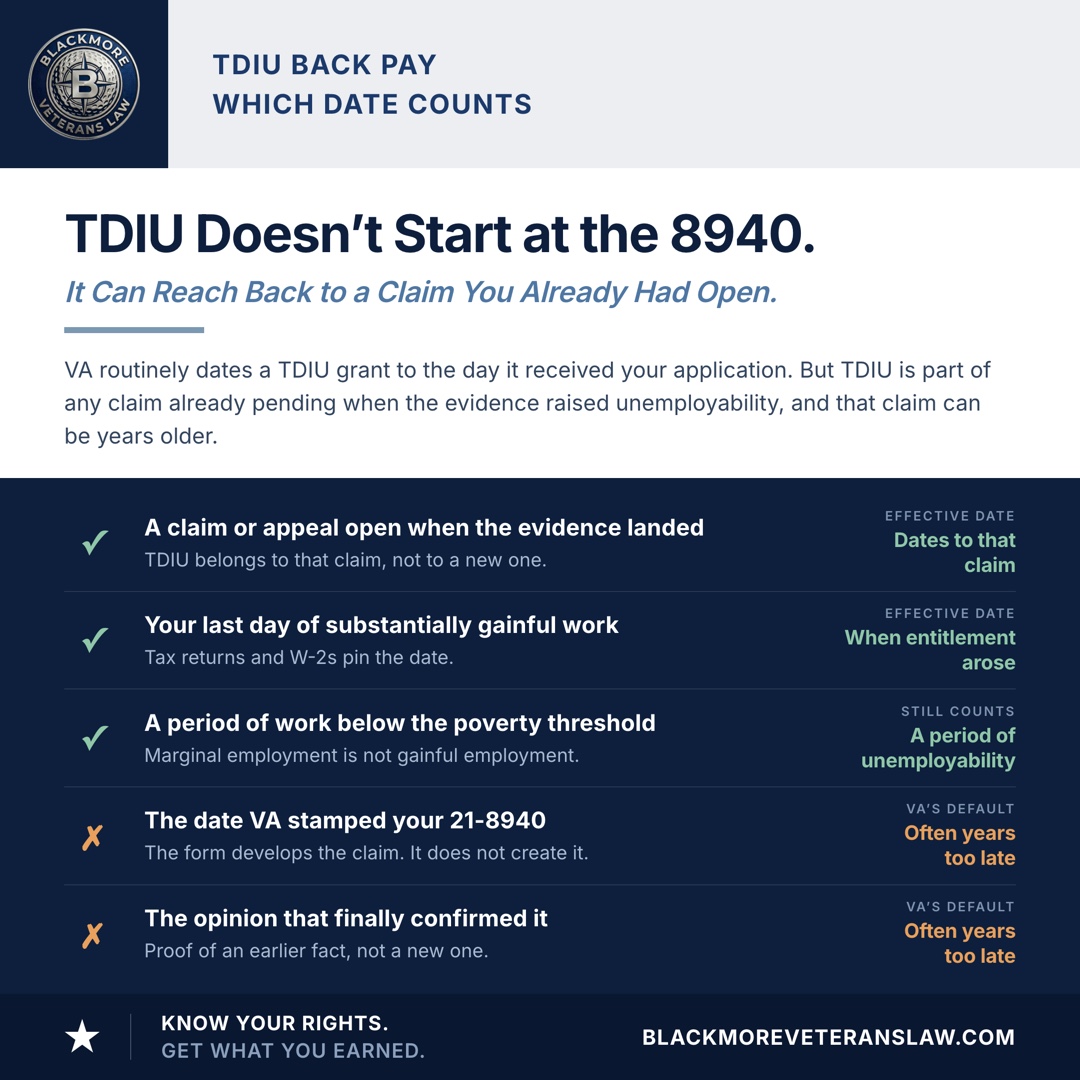
When you have a claim or appeal pending for an increased rating, and the evidence in the record raises the question of whether you can work, TDIU is part of that claim. It is not a new claim that starts the day you get around to filing the application. It has been on the table since the record raised it.
The 21-8940 is the form VA uses to develop the issue. It gathers your work history and earnings in the format VA wants. It is genuinely useful and you should file it. But filing it is not what creates the claim, and the date stamped on it is not automatically your effective date.
The practical version: if you filed for an increased rating in 2021, and somewhere in that file was evidence that your conditions had ended your ability to work, then submitted the 21-8940 in 2026 when someone finally told you TDIU existed, the correct effective date may be 2021.
What counts as raising the issue is broader than veterans expect. A treatment note recording that you had to leave your job. A C&P examiner writing that your symptoms would preclude employment. Your own statement that you cannot hold work. An employer letter about accommodations that stopped being enough. None of these have to say the word “unemployability” to put the question in front of VA.
When Entitlement Actually Arose
The second half of the effective date is the date entitlement arose, and VA tends to read this too narrowly as well.
Entitlement to TDIU generally arises when your service-connected conditions made you unable to secure or follow substantially gainful employment. In most cases the strongest marker for that is your last day of substantially gainful work, not the date some later document confirmed what was already true.
VA sometimes assigns the date of the vocational assessment, or the date of the medical opinion that finally tied your limitations to work capacity. Those documents are evidence about a condition that already existed. An opinion written in March describing why you have been unable to work since a layoff two years earlier is proof of the earlier date, not the creation of a new one.
Your tax returns, W-2s, and Social Security earnings record are usually the cleanest evidence of when the earnings stopped.
Low Earnings Are Not a Break in the Chain
A common obstacle is a stretch of part-time or reduced work between leaving a career and filing for TDIU. VA sees earnings in that period and treats it as proof you were employable.
Marginal employment is not substantially gainful employment. Earnings at or below the federal poverty threshold do not count against you, and neither does work in a protected or sheltered setting, such as a family business that carries you or a job with accommodations no ordinary employer would provide.
If your earnings during a period were below the threshold, that period can still be part of your TDIU award. Pull the actual numbers rather than accepting a general characterization that you were working.
TDIU for a Past Period
TDIU does not have to run from a date to the present. VA can grant it for a closed period: a defined stretch when you were unemployable, ending when you returned to substantially gainful work.
This matters for veterans who went through a bad few years, could not hold a job during them, and eventually recovered enough to work again. The fact that you are employed now does not erase entitlement for the period when you were not. The back pay for that stretch is still owed.
When a Long Appeal Works in Your Favor
Most of what a long VA appeal does to a veteran is bad. This is the exception.
If unemployability was raised by the record while an increased rating claim was pending, TDIU remains part of that claim as long as the claim stays open. An appeal that has been moving between the regional office and the Board for six years is a claim that has been pending for six years. When TDIU is finally granted, the effective date can reach back to the beginning of it.
Veterans in that position sometimes accept an effective date matching the most recent step in the appeal, when the correct date is the start of the whole thing.
What to Do
Find your last day of substantially gainful work and document it. Tax returns, W-2s, a Social Security earnings statement, a separation letter. This single date does more work than anything else in a TDIU effective date argument.
Look for the first point unemployability appears in your file. Not the first time you filed the 8940. The first time anything in the record indicated you could not work. That is the date to argue from.
Check whether a claim or appeal was open at that time. If one was, TDIU likely belongs to it.
Pull your earnings for any period VA called employment. If the numbers are at or below the poverty threshold, that period was marginal employment and should not have counted against you.
Read the effective date paragraph, not just the award amount. A grant with an effective date later than the law supports is a partial denial. It is appealable on that basis alone, and the deadline runs from that decision like any other. See how to appeal a VA denial.
The Bottom Line
A TDIU grant with the wrong effective date still looks like good news, which is why the date so often goes unexamined. The monthly payment is correct going forward, and nothing in the letter suggests anything is missing.
What is missing is the back pay for the period you were already unemployable and VA already had reason to know it. If your TDIU award is dated to the day you filed the application, that date deserves a second look before you accept it.
Blackmore Veterans Law, P.C. is a solo practice representing veterans in VA disability claims and appeals. Contact us to discuss your situation.
This article is general information about VA disability law and is not legal advice for any individual case. Reading it does not create an attorney-client relationship. Attorney advertising.