
Two sentences in the same section of VA’s adjudication manual do not sit comfortably together.
The first: “the threshold for ordering an examination is low.” The second: “a generalized statement merely asserting a conclusion that a condition is secondary to an SC disability is not sufficient to satisfy the Element 3 standard for requesting an examination.”
Both are accurate. The difference between them is what separates a secondary claim that gets an exam from one that does not. A veteran writes one line saying a new condition is secondary to an old one, VA reads it as a conclusion with nothing behind it, no exam is ordered, and the claim can be denied on a record nobody developed.
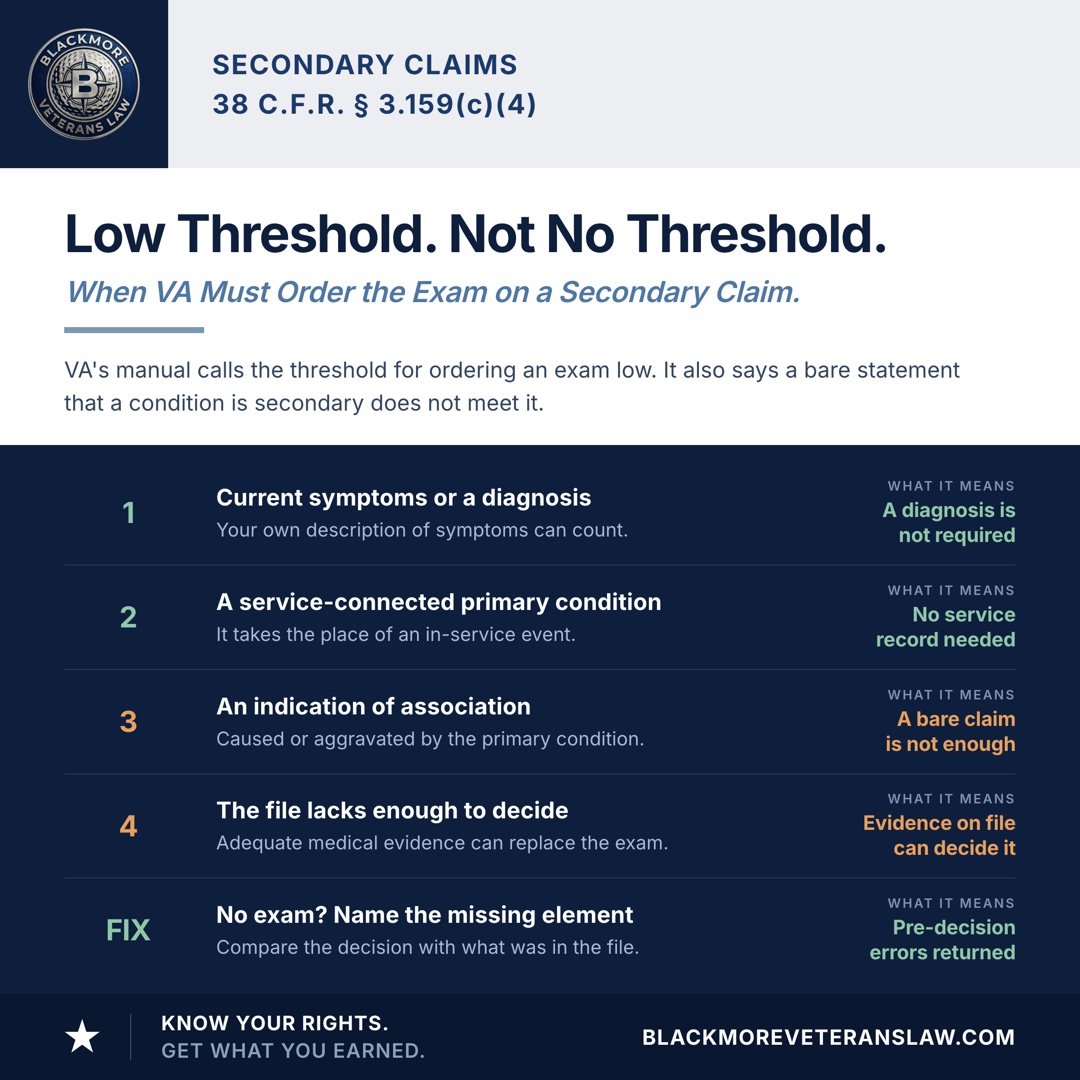
The test, with one swap
VA’s duty to assist includes providing an examination or opinion when one is necessary to decide a disability compensation claim (38 U.S.C. § 5103A(d)). The regulation, 38 C.F.R. § 3.159(c)(4)(i), says an exam is necessary when the record lacks enough competent medical evidence to decide the claim but contains:
- competent lay or medical evidence of a current diagnosed disability or persistent or recurrent symptoms of disability;
- evidence that the veteran suffered an event, injury, or disease in service; and
- an indication that the claimed disability or symptoms may be associated with that in-service event, injury, or disease, “or with another service-connected disability.”
That last phrase is the secondary claim. The general rule for direct claims is covered in The VA Decided My Claim and I Never Got an Exam. Is That Allowed?. For a secondary claim, VA’s manual (M21-1, Part IV, Subpart i, 1.B.1.e) states the same three elements with the second one swapped:
- Lay or medical evidence of a current disability or symptoms.
- Evidence of a service-connected primary disability, which “substitutes for the in-service event, injury, or disease.”
- An indication that the claimed condition may be associated with the primary disability, or may have been aggravated by it.
The manual says this applies to claims for secondary service connection “including on the basis of aggravation.” It also says examinations are not provided automatically in all cases, and that some judgment is used in deciding whether the threshold is met.
Element 2 is already done
If the primary condition is service connected, the second element is met. Nothing in this test asks whether the new condition appears in the service treatment records, or whether anything happened in service that relates to it.
That matters because secondary denials sometimes reason as though it did. A decision that says the service treatment records are silent for the claimed condition, and denies without an exam, has applied the test for a different kind of claim. Your Secondary Claim Was Denied Under the Wrong Test covers how to spot it.
Element 1 is lower than most veterans expect
A diagnosis is not required to get an exam. The manual says competent lay or medical evidence of current, persistent, or recurrent symptoms can be enough, calls the threshold “lower than the threshold required to establish SC,” and says a medical diagnosis up front is not always required to show the disability or its link to the service-connected condition.
Two points work in the veteran’s favor. If the evidence is contradictory on whether a disability or symptom is present, the manual tells adjudicators not to weigh it and to treat the element as met. And lay evidence of symptoms counts, because a veteran is competent to describe what they experience.
The limits are real. The statement still has to be credible, and the manual says there is no presumption of credibility at this stage. Some conditions need a medical diagnosis, and a lay description of symptoms does not supply one. The manual’s own example is a claim of hypertension secondary to a service-connected back condition, with normal blood pressure readings in the records for three years and no diagnosis. The manual says a veteran can describe dizziness or headaches but cannot diagnose hypertension, and treats element 1 as not met.
Element 3 is where claims fail
The threshold is low, but it is a threshold. The manual says “a generalized statement merely asserting a conclusion that a condition is secondary” does not satisfy it, and tells the adjudicator to look at “the specificity of the claimant’s statement and other evidence of record.”
It lists four kinds of evidence that can give credibility to the claim:
- medical evidence showing a relationship between the primary disability and the claimed secondary condition
- the veteran’s lay statement describing the symptoms present and how they are related to the primary disability
- a medical treatise establishing a known relationship between the two conditions
- a VA regulation or procedure that defines a relationship between them, such as the ones in 38 C.F.R. § 3.310(c) and (d)
The manual then runs two examples that show where the line is.
In the first, a veteran claims stomach problems secondary to a service-connected heart condition, and the statement says that since starting prescribed medication for the heart condition two years ago, the veteran has had constipation, pain, and indigestion. There is no diagnosis. The manual’s analysis: the statement “is not sufficient to ultimately prove the claim,” but it is sufficient to warrant an exam, because the veteran is competent to describe symptoms and a possible association, and the statement is credible on the record. That is the pattern in The Prescription Was for Your Knee. The Stomach Problem Is Still Service Connected.
In the second, the hypertension claim above, the veteran offers only the conclusion, with no discussion or evidence tying the blood pressure to the back condition. The manual finds element 3 not met and no exam warranted.
The difference between them is not a diagnosis, and it is not a medical opinion. It is whether the statement says what happened and in what order.
Aggravation is part of the same test
The manual says secondary service connection on the basis of aggravation can be claimed specifically or considered as part of a secondary claim. The same three elements decide the exam question, and the third asks whether the claimed condition may have been aggravated by the primary disability as well as caused by it.
A claim statement that describes only causation, or an exam request that asks only about causation, leaves half of 38 C.F.R. § 3.310 undecided. That is covered in You Had It Before. A Service-Connected Condition Made It Worse. That’s Still a Claim.
When no exam was ordered
An exam is necessary only if the record does not already contain enough medical evidence to decide. If adequate medical evidence is on file, VA can decide without an exam, and VA refrains from assistance where there is no reasonable possibility it would substantiate the claim (38 C.F.R. § 3.159(d)). Both determinations can be reviewed.
So read the decision for which element VA says is missing:
- No current disability or symptoms. Compare the decision with the lay statements and treatment records in the file.
- No in-service event. That is the wrong test for a secondary claim, as above.
- No evidence linking the two. Compare the decision with what the claim said about symptoms and timing, and with any provider notes.
If a required exam was skipped before the decision, that is a duty to assist error, and the review lanes treat it differently from a disagreement about the medicine. The duty to assist runs until the claimant receives notice of the decision, and it does not apply in higher-level review or at the Board (38 U.S.C. § 5103A(e)). What those reviewers do is correct errors that occurred before the decision. A higher-level adjudicator must return the claim for correction (§ 5103A(f)(1); 38 C.F.R. § 3.2601(g)), and the Board must remand (§ 5103A(f)(2); 38 C.F.R. § 20.802(a)), in each case unless the maximum benefit can be granted on the existing record.
A supplemental claim works differently. The exam duty applies to it only if new and relevant evidence is presented or secured (38 C.F.R. § 3.159(c)(4)(iv)). The comparison of the lanes is in How to Appeal a VA Disability Claim Denial.
What to do with this
- Name both conditions in the claim, the service-connected one and the new one.
- Describe the symptoms of the new condition, not only its name.
- Say when they started in relation to the primary condition or its treatment, including any medication started for it. Keep it accurate.
- Include anything that links them: a treating provider’s note, medical literature, or a regulation that defines the relationship.
- Raise aggravation as well as causation if the new condition was already there before it got worse.
- If a decision came back with no exam, find which element it says is missing and compare that against the file.
- Count one year from the decision date. It governs every option you have.
Whether VA had to order an exam in a particular claim depends on what was in the file when it decided. Nobody can tell you your outcome from an article. But a one-line statement and a specific one are not treated the same, and the manual says so.
Blackmore Veterans Law, P.C. is a solo practice representing veterans in VA disability claims and appeals. Contact us to discuss your situation.
This article is general information about VA disability law and is not legal advice for any individual case. Reading it does not create an attorney-client relationship. Attorney advertising.