
You filed. You waited. Months went by. Then a decision letter showed up, and somewhere in it was a denial.
And the whole time, nobody ever called you to schedule an exam.
That is one of the most common questions we hear, and it usually comes with a fair amount of frustration behind it. How can the VA decide whether your back is service connected without ever looking at your back?
The short answer: sometimes the VA is allowed to do that. Sometimes it is not. The difference comes down to one regulation, and it is worth understanding, because a missing exam is one of the more fixable problems in a claim.
The VA does not owe every veteran an exam
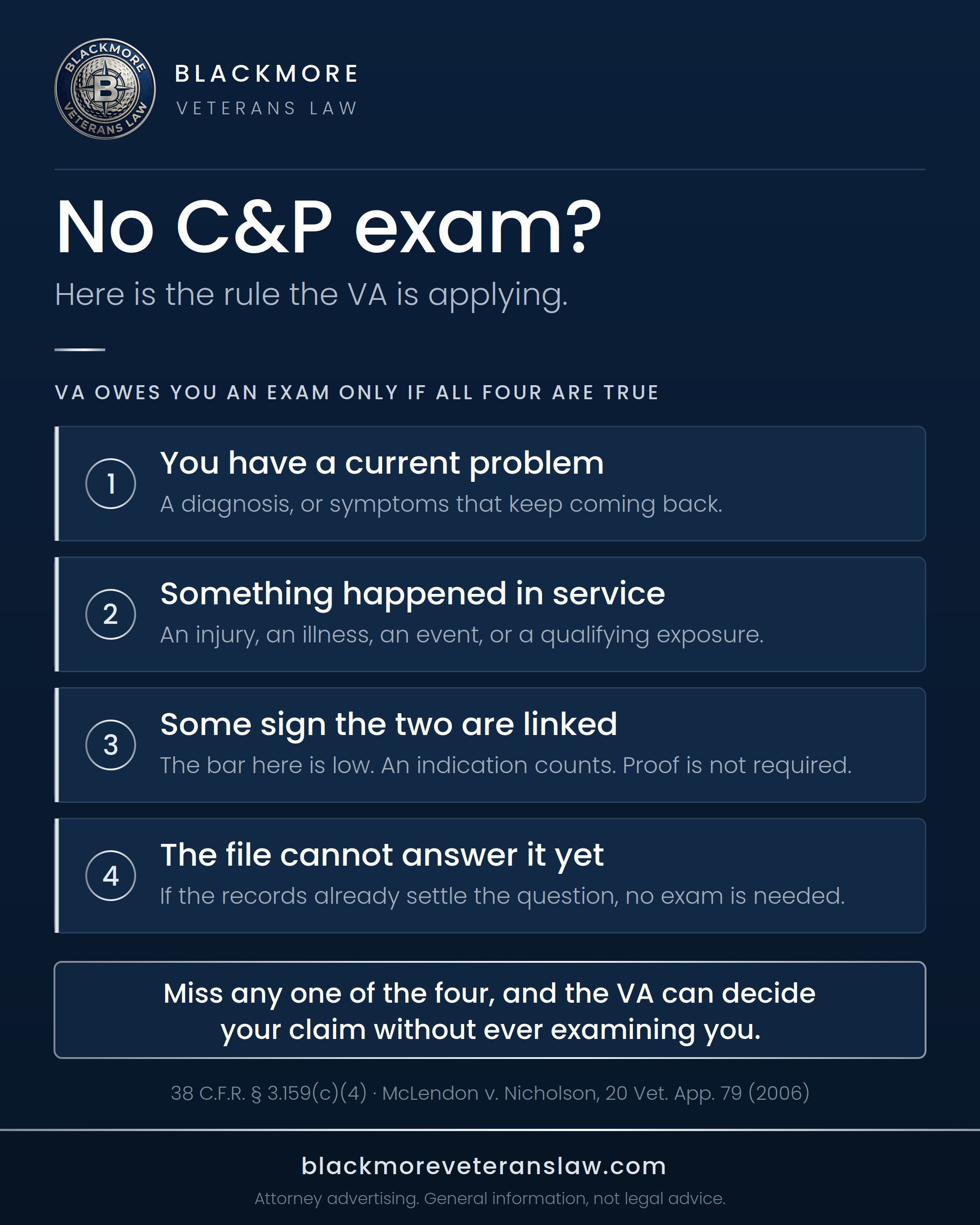
There is a widespread belief that filing a claim automatically gets you a Compensation and Pension exam. It does not. The VA’s duty to assist includes providing a medical examination or opinion only when one is actually necessary to decide the claim, and there is a four-part test for that (38 C.F.R. § 3.159(c)(4); McLendon v. Nicholson, 20 Vet. App. 79 (2006)).
The VA has to order an exam when all four of these are true:
1. There is evidence of a current problem. A diagnosis works. So do symptoms that keep showing up or keep coming back. Your own statements about what you feel can count here.
2. There is evidence something happened in service. An injury, an illness, an event, or exposure that qualifies under one of the presumptive rules.
3. There is some indication the two might be connected. Read that word again: indication. Not proof. The Court has described this as a low threshold, and it exists precisely so the VA develops the evidence instead of denying for the lack of it.
4. The file does not already contain enough to decide. If the records on hand answer the question, an exam adds nothing.
Miss any one of the four, and the VA can decide your claim without ever examining you.
Where claims usually fall apart
In our experience, element three is where most of these denials happen, and it is also where the VA gets it wrong most often.
Element three is supposed to be easy to satisfy. Post-service treatment for the condition can do it. So can a symptom history that lines up with something in your service records. So can a treating provider saying the two could be related. The bar is low on purpose.
What does not clear it, according to the Federal Circuit, is a bare statement that service caused the condition with nothing behind it (Waters v. Shinseki, 601 F.3d 1274 (Fed. Cir. 2010)). Saying “my knees hurt because of the Marine Corps” and stopping there gives the adjudicator nothing to work with. Saying “I was treated twice for knee pain in 2009, here is the sick call entry, and I have been seeing a doctor for the same knee since 2014” is a different situation entirely.
The problem is that the low threshold gets applied like a high one. A rating decision will say there was no indication of a relationship to service when the file actually contained a treatment record, a buddy statement, or a symptom pattern that should have triggered development. That is not a judgment call the VA gets to make in place of an examiner. That is the VA deciding a medical question it is not supposed to decide on its own.
Other reasons there was no exam
Element three is not the only explanation. A few others come up regularly:
You filed a Higher-Level Review. The duty to assist does not operate in that lane. The reviewer works from the record as it stood when the earlier decision issued and cannot order new development. What the reviewer can do, and must do, is check whether the VA botched the duty to assist before the decision under review. If a required exam was skipped, the claim gets returned for correction (38 C.F.R. § 3.2601(g)). That is often the whole point of choosing HLR.
You filed a Supplemental Claim without new and relevant evidence. The duty to assist attaches to a substantially complete supplemental claim, but the exam obligation specifically applies only if new and relevant evidence is presented or secured (38 C.F.R. § 3.159(c)(4)(iv)). A supplemental claim that repeats what was already in the file can come back decided without an exam.
The VA says it had enough already. Sometimes this is right. If the record supports a grant, or supports the maximum benefit available, an exam serves no purpose. The VA also refrains from assistance where there is no reasonable possibility it would help substantiate the claim (38 C.F.R. § 3.159(d)). That determination is reviewable.
An exam was scheduled and you did not appear. This one catches people. Notice goes to the address of record, which is not always the address you live at. If a veteran does not report without good cause, the VA can decide the claim on the evidence in the file, and in some cases must deny it outright (38 C.F.R. § 3.655). If you moved, changed carriers, or never saw a letter, that is worth raising rather than accepting.
You did get an exam and did not know it. Not every VA medical opinion involves a room and an examiner. The VA can obtain an opinion by record review. It counts as development even though nobody touched you. If your decision references an opinion you never sat for, that is likely what happened.
Why this matters more than it sounds like it does
When the VA should have ordered an exam and skipped it, that is a duty to assist error. It is a procedural failure, not a disagreement about the medicine, and the review system treats those two things differently.
A duty to assist error is exactly what a Higher-Level Review is built to catch. It is also grounds for the Board to remand. Identifying one does not mean the claim gets granted, and nobody can tell you it will. But it does mean the question gets decided on a developed record instead of an empty one, which is a materially different position to be in.
How to figure out what happened in your case
Pull out your decision letter and read two sections carefully.
The evidence list tells you what the VA actually considered. If records you submitted are not on that list, the VA may not have had them.
The reasons for decision section tells you what the VA concluded and why. Look for language about no evidence of an in-service event, no relationship to service, or no indication of a connection. Then compare that against what is genuinely in your file. Those two things do not always match.
If they do not match, the gap between them is the argument.
Where to go from here
A skipped exam is not a small technicality, and a denial that rests on one is not the end of the claim. Which review option makes sense depends on what is in your file and what the decision actually says, and those are things that have to be looked at directly rather than answered in general terms.
If you got a decision with no exam and the reasoning does not line up with what you sent in, that is worth a second set of eyes.
And if the outcome is that an exam finally gets ordered, treat the appointment as the evidence it is. Preparing for a C&P exam walks through what to do before you go, and why you shouldn’t skip your C&P exam covers what happens if you miss it.
Blackmore Veterans Law, P.C. is a solo practice representing veterans in VA disability claims and appeals. This article is general information about how the VA claims process works. It is not legal advice about any individual claim, and reading it does not create an attorney-client relationship. Attorney advertising.