
The VA schedules a Compensation & Pension exam to gather medical evidence for your claim. Missing it, showing up unprepared, or rescheduling too many times can lead to an automatic denial, even if your paperwork is otherwise strong.
Most veterans treat the C&P exam like a routine medical appointment. It isn’t. It is, for practical purposes, the most important event in your claim. The examiner’s report will directly shape your rating. What you say, how you say it, and whether you show up at all can determine the difference between approval and denial.
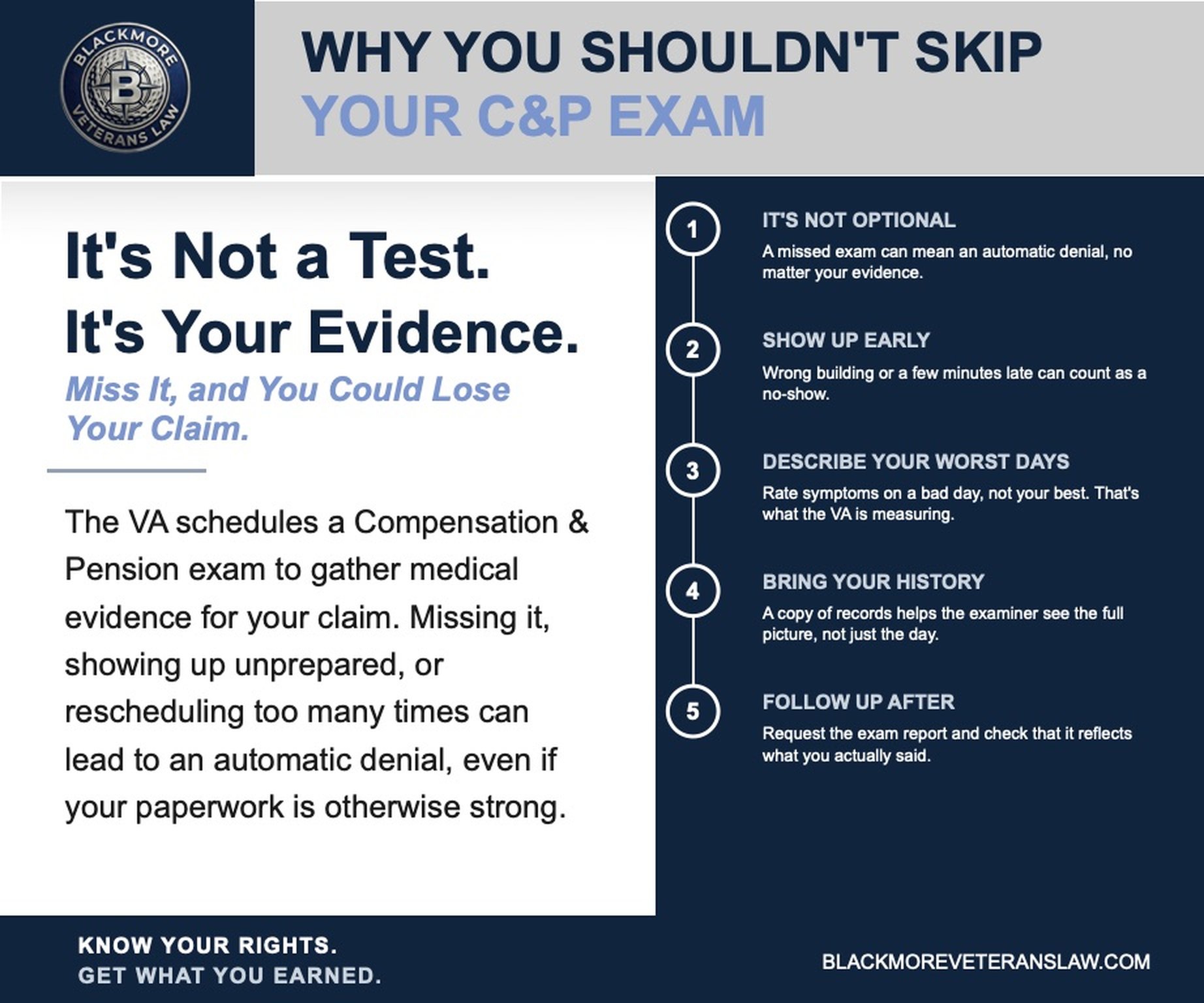
Here are five things every veteran needs to understand before walking into a C&P exam.
1. It’s Not Optional
A missed C&P exam can result in an automatic denial, no matter how strong the rest of your evidence is.
Under VA regulations, if you fail to report for a scheduled examination without good cause, the VA may decide your claim based on the evidence already in the file. For most claims, that means an unfavorable outcome. The VA doesn’t have to give you another chance before issuing a decision.
If you genuinely cannot attend a scheduled exam (due to a medical emergency, a conflict with work, or a logistical problem), contact the VA immediately and document your reason. A single rescheduling with proper notice is generally acceptable. Repeated no-shows or rescheduling without explanation will damage your claim.
If you miss an exam and receive an adverse decision as a result, you may be able to reopen the claim by showing good cause for the absence. But the better path is to make attending the exam a non-negotiable priority.
2. Show Up Early
Wrong building or arriving a few minutes late can count as a no-show.
VA medical centers are large. Examination suites are sometimes located in separate buildings or wings that aren’t clearly marked. Parking can be limited. If you arrive at the wrong entrance or spend ten minutes looking for the right office, you may miss your appointment window, and the VA’s records may show you as a no-show regardless of the reason.
Plan to arrive at least fifteen to twenty minutes early. Confirm the exact building, floor, and suite number when you receive your appointment notice. If the notice is unclear, call the VA medical facility directly. Bring a copy of your appointment letter with contact information in case you need directions on arrival.
3. Describe Your Worst Days
Rate your symptoms on a bad day, not your best. That’s what the VA is measuring.
This is one of the most common and costly mistakes veterans make. When an examiner asks how you’re doing, the natural human response is to put on a brave face: “I manage,” “I get by,” “some days are better than others.” That kind of answer, while honest, often produces a rating that reflects your best functioning rather than the reality of living with your condition.
VA disability ratings are designed to capture the average impairment caused by a condition, including its worst manifestations. The rating schedule for most conditions asks about frequency of flare-ups, periods of incapacitation, and the severity of symptoms at their worst.
Be specific and honest. If your back pain keeps you in bed two days a month, say so. If your PTSD causes you to avoid leaving the house during bad weeks, describe that. If your knee gives out without warning and you’ve fallen, tell the examiner. Document the bad days, not just the good ones.
4. Bring Your History
A copy of your records helps the examiner see the full picture, not just how you present on one day.
C&P examiners are working from a snapshot. They may have access to your VA medical records, but they may not have reviewed all of them before you walk in. Private medical records, records from non-VA facilities, and older service treatment records are frequently missing from the file the examiner sees.
Bring organized documentation to your exam:
- A list of all current medications and dosages
- Recent treatment records from private physicians
- Any prior C&P exam reports
- A personal statement describing how your condition affects daily life
- Buddy letters from family, friends, or coworkers if you have them
You cannot force the examiner to review everything on the spot, but having documentation with you demonstrates that you take your claim seriously, and if the examiner’s report later omits relevant history, you have a record showing you provided it.
5. Follow Up After
Request a copy of the exam report and check that it accurately reflects what you actually said.
After your C&P exam, you have the right to obtain a copy of the examiner’s report. Request it. Read it carefully.
C&P exam reports are not always accurate. Examiners may misrecord your statements, apply the wrong diagnostic criteria, omit symptoms you described, or reach a conclusion that isn’t supported by the evidence. These errors are common, and they can be fatal to a claim if left unchallenged.
If you find errors or omissions in your exam report, you can challenge the adequacy of the exam. Options include:
- Submitting a written statement correcting the record
- Obtaining a private medical opinion (a DBQ or nexus letter) that directly addresses the examiner’s errors
- Requesting a new exam by arguing the original was inadequate
- At the Board of Veterans’ Appeals, challenging the exam through legal argument
An inadequate C&P exam is not the final word, but catching the errors requires reading the report. Most veterans never do.
The Bottom Line
The C&P exam is not a formality. It is the foundation on which your rating is built. Veterans who understand this go in prepared, describe their symptoms honestly and completely, and follow up to make sure the record is accurate. Veterans who don’t often find themselves fighting a rating that doesn’t reflect reality.
If your exam is still ahead of you, showing up ready is only part of it. Preparing for a C&P exam covers the work that comes before the appointment: confirming the exam request covers every condition you claimed, reading the rating criteria the examiner will be scoring, and getting the record in the file while it can still be reviewed.
If you’ve already had a C&P exam and the result was a rating that seems too low, the exam report is the first place I look. A thorough private medical opinion can often overcome a deficient VA exam, but you need an attorney who knows how to use it.
Bryan R. Blackmore is a veterans law attorney, VA-accredited attorney, and former Attorney at the Board of Veterans’ Appeals. He served 24 years in the U.S. Coast Guard, including a deployment to Baghdad during Operation Iraqi Freedom. Mr. Blackmore is licensed in California and Virginia and represents veterans nationwide through Blackmore Veterans Law, P.C.