
Every PTSD claim has the same three elements. What changes from claim to claim is how the stressor gets proven. For some stressors, the veteran’s own account is enough. For others, VA wants records, or a statement from someone else who was there.
Which rule applies depends on what happened. VA’s manual says veterans will not generally know which category their stressor falls in, so it is the adjudicator’s job to work that out. That is also the reason to know the categories before you file.
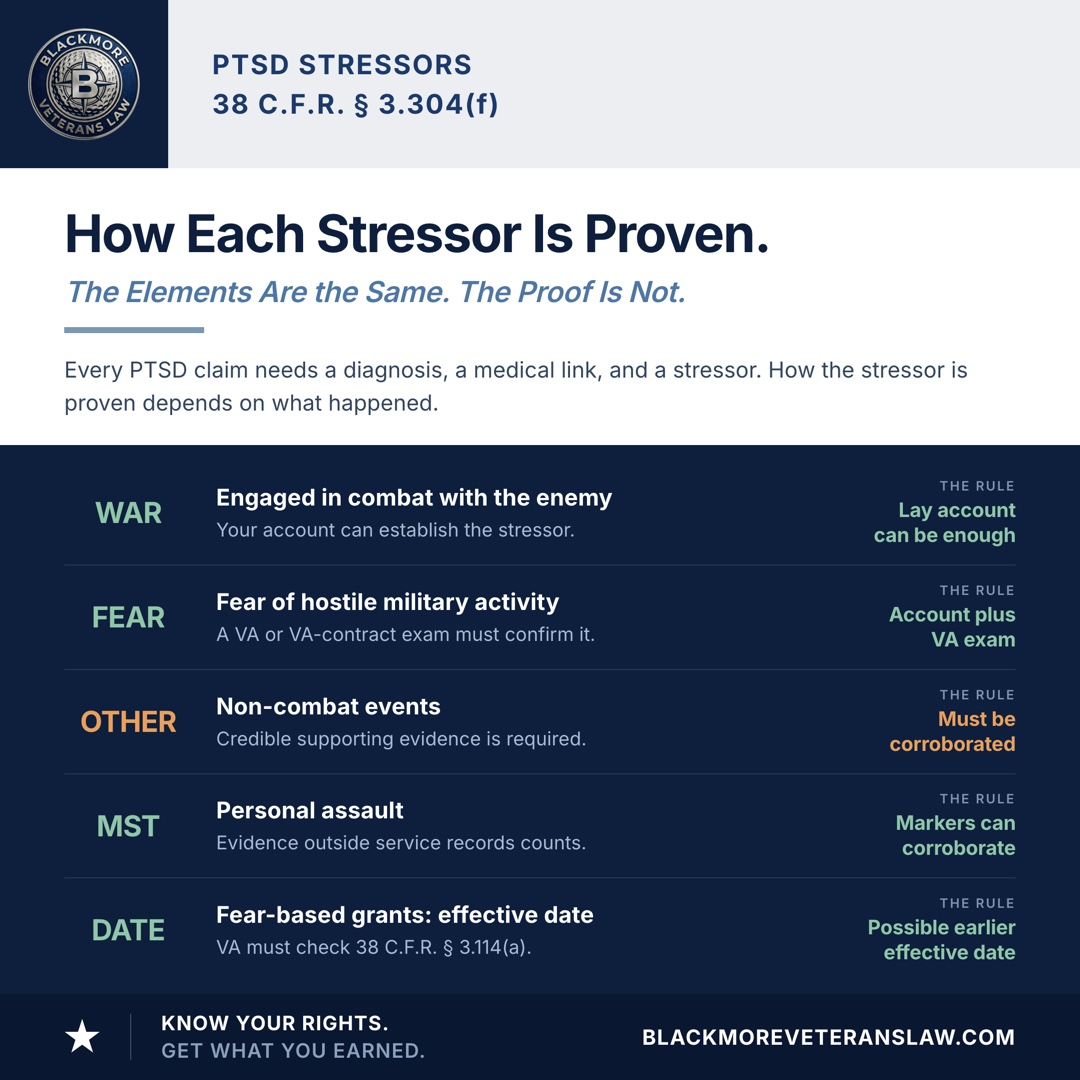
What every PTSD claim needs
38 C.F.R. § 3.304(f) says service connection for PTSD “requires medical evidence diagnosing the condition in accordance with § 4.125(a) of this chapter; a link, established by medical evidence, between current symptoms and an in-service stressor; and credible supporting evidence that the claimed in-service stressor occurred.”
Section 4.125(a) incorporates DSM-5 as the diagnostic standard. The diagnosis and the link between symptoms and the stressor are medical questions, and they are the same whatever the stressor was.
The third element is where the categories come in. VA’s manual (M21-1, Part VIII, Subpart iv, 1.A.1.b) says PTSD “has the same claim elements regardless of the type of stressor,” and that the distinction between types of claims is “based on how the stressor is verified or conceded.”
Four situations where your own account can be enough
Section 3.304(f) lists four. In each, the veteran’s lay testimony alone may establish that the stressor occurred, as long as there is no clear and convincing evidence to the contrary and the stressor is consistent with the veteran’s service.
- PTSD diagnosed during service, with a stressor related to that service. Paragraph (f)(1).
- Combat. The veteran engaged in combat with the enemy and the stressor is related to that combat. Paragraph (f)(2).
- Fear of hostile military or terrorist activity, if a VA psychiatrist or psychologist, or one VA has contracted with, confirms the stressor is adequate to support a PTSD diagnosis and that the symptoms are related to it. Paragraph (f)(3).
- Former prisoner of war, with a stressor related to that experience. Paragraph (f)(4). A former prisoner of war is defined in 38 C.F.R. § 3.1(y).
If a stressor does not fit one of these, or the assault paragraph below, the account alone is not enough. VA’s manual says a claimant’s lay testimony about those stressors “is not sufficient, by itself” and “must be corroborated by credible supporting evidence” (M21-1, Part VIII, Subpart iv, 1.D.2.g).
Combat
The statute behind the combat rule is 38 U.S.C. § 1154(b). For a veteran who engaged in combat with the enemy, VA accepts satisfactory lay or other evidence of service incurrence, if consistent with the circumstances, conditions, or hardships of service, even without an official record.
VA’s manual defines the term (M21-1, Part VIII, Subpart iv, 1.A.3.e). Engaging in combat with the enemy means “personal participation in events constituting an actual fight or encounter with a military foe or hostile unit or instrumentality.” It includes presence during such events as a combatant or as a service member performing duty in support of combatants, such as providing medical care to the wounded.
The manual lists decorations for which VA will presume the veteran engaged in combat, unless there is clear and convincing evidence to the contrary. They include the Combat Infantryman Badge, the Combat Action Badge, the Combat Action Ribbon, the Purple Heart, the Silver Star, and the Bronze Star Medal with “V” device. The manual also says a listed decoration “is not the only acceptable evidence” of combat, and that there are no limits on the type of evidence that can be used. Evidence from sources other than service records must be reviewed carefully for sufficiency.
Two limits. Showing combat does not by itself satisfy the diagnostic criteria for PTSD, so the diagnosis and the medical link are still required. And the manual notes that it may not be necessary to confirm combat at all if the evidence meets the lower threshold for fear of hostile military or terrorist activity.
Fear of hostile military or terrorist activity
Paragraph (f)(3) was added in 2010 for veterans whose service was not direct combat but who were exposed to hostile military or terrorist activity. VA said the amendment “eliminates the requirement for corroborating that the claimed in-service stressor occurred” when its conditions are met (75 Fed. Reg. 39843).
The regulation defines the term. It means the veteran “experienced, witnessed, or was confronted with an event or circumstance that involved actual or threatened death or serious injury, or a threat to the physical integrity of the veteran or others,” such as an actual or potential improvised explosive device, incoming artillery, rocket, or mortar fire, a grenade, small arms fire including suspected sniper fire, or an attack on friendly military aircraft. The veteran’s response has to have involved “a psychological or psycho-physiological state of fear, helplessness, or horror.”
The 2010 rule’s explanation adds several points about its scope:
- It has no geographic requirement and is not limited to a combat zone.
- The fear does not have to come from a single event. It can come from conditions the veteran was exposed to in service.
- The event does not have to be lethal, and it can involve civilians.
- The examples in the regulation are examples, not a closed list.
- VA adjudicators, not the examining psychiatrist or psychologist, decide whether the stressor is consistent with the veteran’s service.
- A service member who learned about hostile activity affecting others, but whose own service was not proximate in time and place to it, is not covered.
The confirming examiner has to be VA’s or VA’s contractor’s. The regulation names a VA psychiatrist or psychologist or one “with whom VA has contracted.” VA explained in 2010 that it was limiting the liberalization to examiners it knows are equipped to give forensic opinions, and it declined to include private practitioners. A private diagnosis and opinion can be evidence in the claim, but they do not replace that confirmation.
What evidence shows the places, types, and circumstances of service. VA’s manual tells adjudicators to concede a stressor when the veteran’s DD Form 214 or other service records show service in an area of potential hostile military or terrorist activity (M21-1, Part VIII, Subpart iv, 1.A.3.k). The key evidence it lists is the DD Form 214, deployments, relevant awards or decorations, and receipt of Combat, Imminent Danger, or Hostile Fire Pay (1.D.2.d).
The manual gives examples. Service along the Korean demilitarized zone has been a location of hostile military activity since 1953, while service on U.S. bases in the rest of South Korea generally has not been. Service aboard a ship in the offshore waters of Vietnam, or in Thailand, with the Vietnam Service Medal or Vietnam Campaign Medal is sufficient to establish service in a potentially hostile military environment. It treats the Iraq Campaign Medal and Afghanistan Campaign Medal as generally evidence of service in such an area, and the National Defense Service Medal and Global War on Terrorism Service Medal as generally not.
The manual says the fear-based criteria are not met by anticipating a future deployment, or by learning of the death of another person when that death occurred remote from the veteran.
The manual also covers armed drone aircraft crew members, such as the Predator and Reaper. It tells adjudicators to concede a stressor when the DD Form 214 or other service record shows service as an armed drone aircraft crew member.
Everything else: non-combat events
VA’s manual describes non-combat events as specific events other than combat or fear of hostile military or terrorist activity (M21-1, Part VIII, Subpart iv, 1.A.3.g). Its examples include natural disasters, duty on a burn ward, graves registration, witnessing the death or injury of another person not caused by the enemy, a ship sinking, explosion, or plane crash during routine drills, and friendly fire during a training mission.
For these, the manual says the stressor “must always be corroborated with credible supporting evidence,” and the veteran’s account, without other credible evidence, cannot verify it.
Credible supporting evidence, according to the manual, is evidence that:
- documents the veteran’s participation in the event,
- indicates the veteran served in the immediate area and at the particular time of the event, and
- supports the description of the event.
It does not have to come from service records. The manual lists service treatment and personnel records, private medical records, lay statements, police or insurance reports, and newspaper accounts. It says corroboration of every detail is not required, and that evidence may be enough if it implies the veteran’s personal exposure to the event. A statement from a fellow veteran counts if it is consistent with the time, place, and circumstances of service of both veterans (1.A.1.g).
When the records at hand do not establish the stressor, the claim can go to VA’s research channel. For that, the manual says the file needs a stressor that can be documented, the location, the approximate date within a two-month period, and the unit of assignment (1.A.3.o). For stressors not related to personal trauma, the manual tells adjudicators not to request the PTSD examination until credible supporting evidence of the stressor is of record (1.C.1.a).
The manual also says that a denial solely because of an unconfirmed stressor is improper unless VA’s research unit has confirmed there is no corroborating evidence, or the veteran has not provided the basic information required for research (1.D.2.i). The manual is VA’s internal guidance, not a regulation, but it shows what adjudicators are told to do.
Personal assault
Paragraph (f)(5) is a separate rule for PTSD based on in-service personal assault. Evidence from sources other than service records can corroborate the account, and behavior changes after the assault can be credible evidence. VA cannot deny these claims without first telling the claimant that this type of evidence may count and giving the opportunity to provide it. That paragraph is covered in You Never Reported It. VA Still Has to Look for the Markers.
The 2021 effective date change
Before 2021, VA did not treat the 2010 amendment as a liberalizing rule for effective-date purposes. VA’s manual says that on July 28, 2021, the U.S. Court of Appeals for the Federal Circuit held that adding paragraph (f)(3) in 2010 was a liberalizing regulatory change under 38 C.F.R. § 3.114(a) (M21-1, Part VIII, Subpart iv, 1.D.2.d).
Section 3.114(a) allows an effective date based on the liberalizing change if the claimant met all the eligibility criteria on the date of the change and continuously since. Where the request comes more than one year after the change, benefits may be authorized for the year before the date of the request.
The manual tells adjudicators that for PTSD claims granted under (f)(3), they “must determine if an effective date under 38 CFR 3.114(a)(3) is warranted.” Its example is a veteran who filed in 2009 with service in an area of hostile activity, was diagnosed by a VA examiner who confirmed the stressor was adequate to support the diagnosis, and was denied because the stressor could not be verified. A supplemental claim with new and relevant evidence was filed in May 2021 and decided after the July 2021 decision. The manual’s result is an effective date of one year before the date of that claim.
The manual also says decisions that became final before July 28, 2021, on VA’s interpretation at the time, are not clear and unmistakable error. Whether the change affects a particular claim depends on the dates, the service, and the record. It is a question for a claim where PTSD was granted on a fear-based stressor, or one that was denied because a stressor could not be verified.
What to do with this
- Work out which stressor type your claim is. Combat, fear of hostile military or terrorist activity, a non-combat event, or personal assault. The decision letter usually says how VA treated it.
- Pull the records that show where you were. The DD Form 214, personnel records, deployment orders, awards, and any record of hostile fire or imminent danger pay.
- For a non-combat event, gather what VA’s research needs. What happened, where, the approximate date within two months, and your unit.
- Ask who else was there. A statement from a fellow veteran that fits the time and place of both your service can corroborate.
- If you were denied because the stressor was not verified, look at what type VA treated it as, whether the fear-based paragraph was considered, and the dates.
- Count one year from the decision date. A supplemental claim or other review filed within one year keeps the effective date (38 C.F.R. § 3.2500(h)).
If the claim is granted, the rating is based on symptoms, not the diagnosis, which is covered in VA Does Not Rate Your Diagnosis. It Rates What the Condition Costs You. The exam matters at every step, and The C&P Exam Is Short. Preparing for It Shouldn’t Be. covers it. The lanes after a denial are in How to Appeal a VA Disability Claim Denial.
Which rule applies to a claim depends on what happened and what the records show. Nobody can tell you that from an article. But the categories are in the regulation, and VA’s own manual tells adjudicators to work out which one applies.
Blackmore Veterans Law, P.C. is a solo practice representing veterans in VA disability claims and appeals. Contact us to discuss your situation.
This article is general information about VA disability law and is not legal advice for any individual case. Reading it does not create an attorney-client relationship. Attorney advertising.