
Read diagnostic code 8100 and you will find your rating turns on two phrases.
Prostrating. And, at the top level, severe economic inadaptability.
Now go looking for what either one means. The rating schedule does not say. There is no definition in the regulation, no list of criteria, nothing that tells a veteran or an examiner where the line sits.
Claims are decided on those words every day.
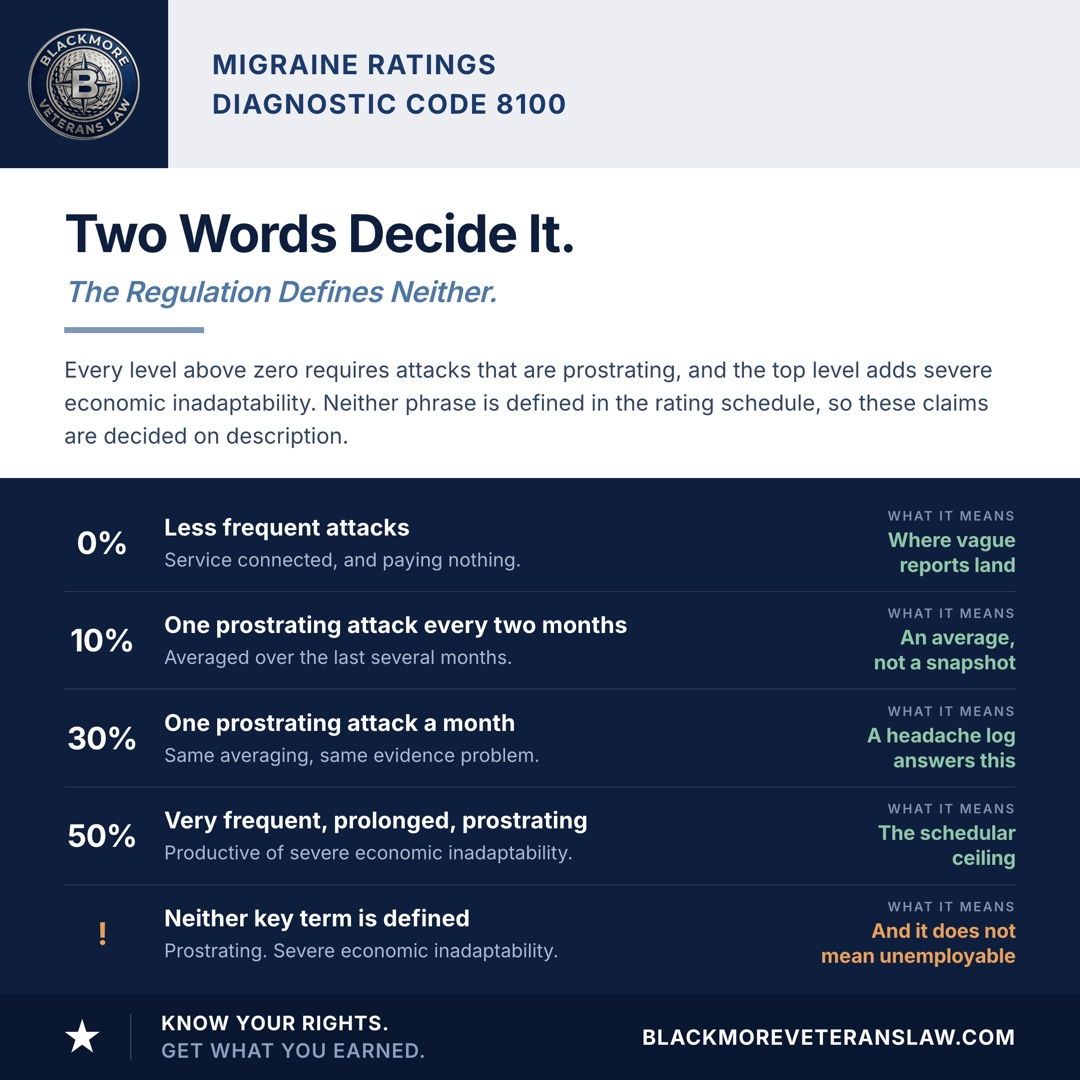
The ladder
38 C.F.R. § 4.124a, diagnostic code 8100:
- 50 percent. Very frequent completely prostrating and prolonged attacks productive of severe economic inadaptability.
- 30 percent. Characteristic prostrating attacks occurring on an average once a month over the last several months.
- 10 percent. Characteristic prostrating attacks averaging one in two months over the last several months.
- 0 percent. Less frequent attacks.
Two things to notice before the words themselves. Everything above zero requires attacks that are prostrating, so no rating is reached without it. And the frequency is expressed as an average over the last several months, not as a current snapshot.
Prostrating
The term is not defined in the schedule. It has been understood to describe an attack that renders a person powerless or incapable of productive activity. The practical picture is the one most people with migraine recognize immediately: the attack stops whatever you were doing, and you end up in a dark room waiting for it to pass.
What it is not is a headache you push through. A veteran who reports headaches without conveying what the attacks actually do tends to get rated as though they were headaches.
Because the word is undefined, the thing that settles it is description. Not “I get migraines three times a month,” but what the three times look like: the aura or warning, how long before you have to stop, what you have to do, how long you are out, and what the hours afterward are like.
Severe economic inadaptability
This is where the 50 percent level is most often misapplied, and the misapplication costs the most.
Adjudicators frequently read the phrase as a requirement that the veteran be unable to work. It has been held that it is not. The criterion asks whether the attacks are productive of severe economic inadaptability, meaning capable of producing it. A veteran who is still employed has not failed the criterion by virtue of being employed.
What counts toward it:
- Lost work time. Days missed, shifts cut short, leave used for attacks.
- Reduced capacity. Work that takes longer, output that falls, tasks reassigned.
- Accommodation. A darkened office, a schedule built around attacks, an understanding employer, a job chosen because it tolerates absences.
- Jobs lost or left, and the ones not applied for.
A veteran holding a job together with difficulty is describing the criterion, not defeating it.
The frequency problem
The criteria say average over the last several months. Examinations capture one day.
If the exam lands in a quiet stretch, the report reflects a quiet stretch. If the examiner asks how often you get them and you answer from the last few weeks, that is what goes in the record.
The fix is a headache log, and it is the single most useful document in these claims. Date, time the attack started, warning signs, what you had to stop doing, how long it lasted, what you took, and what the next day was like. Kept over months, it answers the exact question the criteria ask, in the form the criteria ask it.
A veteran is competent to report this. Frequency and symptoms are observable without medical training, and no rule requires a clinic visit for each attack. Treatment records help, and the absence of a record for every episode is not the gap examiners sometimes treat it as.
Preparing for the examination generally is covered in The C&P Exam Is Short.
Medication and this code
Diagnostic code 8100 says nothing about abortive or preventive medication.
Where a rating code is silent as to medication, the improvement treatment produces generally cannot be used to hold the evaluation down, which is covered in The Medication Is Working. A veteran whose triptan aborts some attacks is still entitled to be evaluated on the underlying condition.
The side of this that does belong in the record is what the medication costs. The hours lost to the drug rather than the attack, the rebound pattern, the limit on how many doses a month are safe.
Where migraines come from
Many migraine claims are secondary rather than direct.
- Traumatic brain injury. Post-traumatic headache is among the most common residuals, and it is frequently rated under 8100.
- Cervical spine conditions. Neck pathology drives headache through well-described mechanisms, and a service-connected neck is a route in.
- Mental health conditions. The relationship runs in both directions.
- Medication for a service-connected condition, which is its own chain, covered in The Prescription Was for Your Knee.
The framework for all of those is in our guide to secondary service connection.
Where the schedule runs out
Fifty percent is the ceiling under this code, and for some veterans it does not describe the disability.
Two routes exist beyond it. An extraschedular evaluation under 38 C.F.R. § 3.321(b) where the schedular criteria do not adequately contemplate the disability picture. And TDIU, where migraines combine with other service-connected conditions to make employment unsustainable.
Both are demanding. The 50 percent criterion itself is demanding, requiring attacks that are very frequent, completely prostrating, and prolonged. These are not levels that get assigned on a general description of frequent bad headaches.
What to do with this
- Start a headache log today. Months of entries beat any single appointment.
- Describe what an attack does, not how often it happens. The frequency is one number. The prostration is the whole case.
- Write down the work history. Days missed, accommodations, jobs that did not survive it. That is the 50 percent criterion in its own terms.
- Do not let employment be treated as an answer. Still working is not the test.
- Bring the longer pattern to the exam, because the appointment is one day and the criteria ask about several months.
- If the headaches followed a head injury, a neck condition, or a medication, ask about the secondary route.
Whether any particular rating is correct depends on the evidence and the record. Nobody can tell you your outcome. But a rating built on two undefined phrases is a rating built on description, and description is the part of this you can actually control.
Blackmore Veterans Law, P.C. is a solo practice representing veterans in VA disability claims and appeals. Contact us to discuss your situation.
This article is general information about VA disability law and is not legal advice for any individual case. Reading it does not create an attorney-client relationship. Attorney advertising.