
It gets said kindly, usually by someone who means well, and it closes the subject every time.
“Of course you’re down. You’ve been in pain for fifteen years. Anybody would be.”
All of that is true. It is also the reason a ratable disability sits unclaimed in tens of thousands of files. The sentence treats the depression as an understandable reaction, and understandable reactions are not things people file claims for.
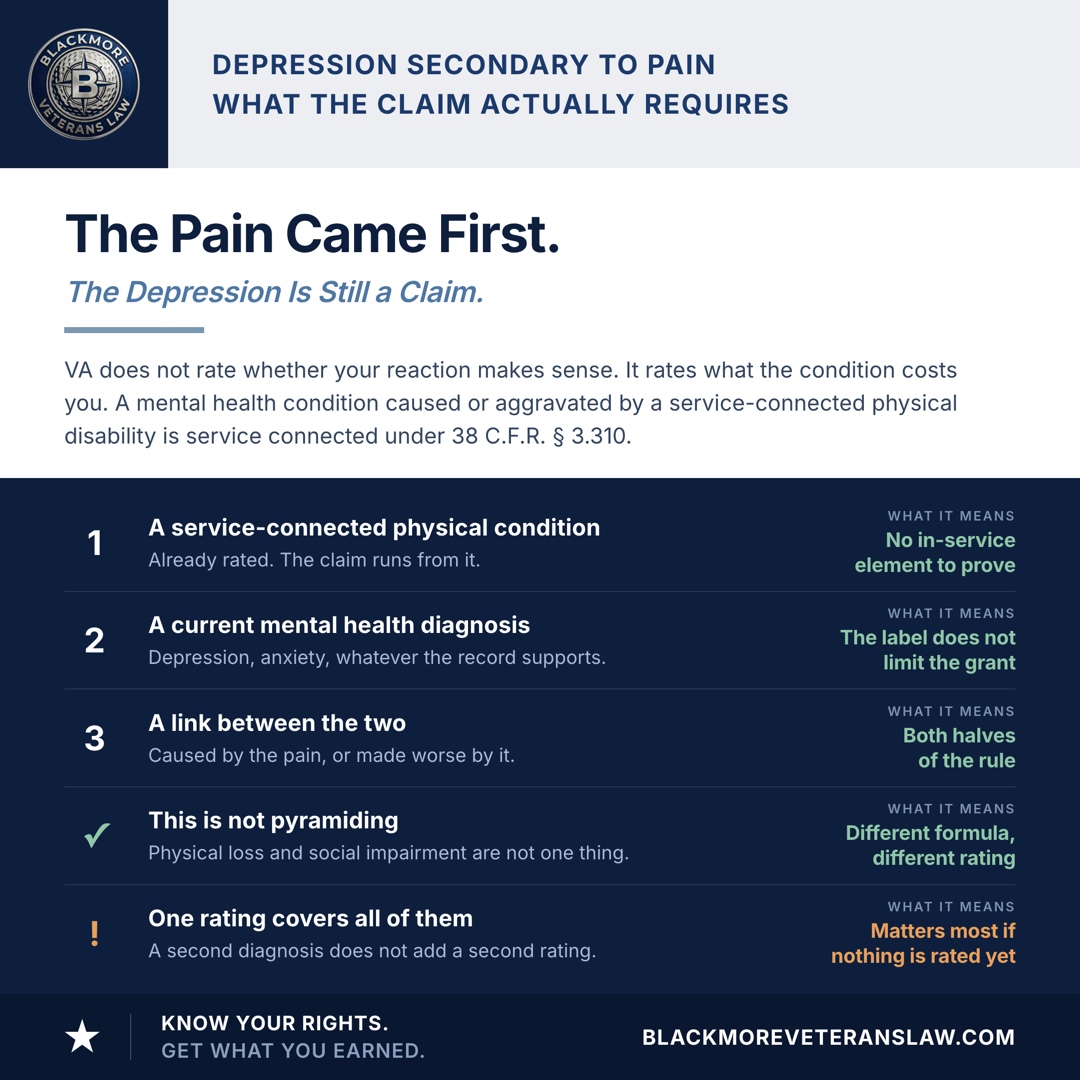
VA does not rate whether your reaction makes sense. It rates what the condition costs you.
What the claim actually is
38 C.F.R. § 3.310 service connects a condition caused or aggravated by a disability VA has already service connected. Three elements, none of which involve your service directly: a current diagnosis, an existing service-connected condition, and medical evidence linking them. The full framework is in our guide to secondary service connection.
Applied here, the chain is one most clinicians will recognize immediately. A service-connected back or knee produces chronic pain. Pain disrupts sleep. Poor sleep and constant pain erode mood and concentration. Activity narrows, then work narrows, then the roles a person had in their family and among their friends narrow with it. Somewhere along that line a diagnosable condition appears.
Nothing about the depression has to trace back to service on its own. The service-connected condition already did that work.
It is not pyramiding
This is the objection that stops these claims, and it is wrong for a specific reason.
38 C.F.R. § 4.14 bars paying twice for the same manifestation. A physical rating compensates physical impairment, which usually means limitation of motion, instability, or functional loss. Mental health conditions are rated under a completely separate formula at 38 C.F.R. § 4.130, which measures occupational and social impairment.
Those are different manifestations under different criteria. Pain in a knee and an inability to sustain concentration at work are not the same thing counted twice. More on where the rule actually applies is in Filing for a Related Condition Won’t Cost You the Rating You Have.
The caveat that decides whether this claim helps you
Every honest version of this post has to include the next paragraph, because for a large share of readers it is the answer.
All mental health conditions are rated together under one formula. Section 4.130 produces a single evaluation reflecting the total occupational and social impairment from every service-connected mental health condition combined. Adding a second or third diagnosis does not add a second or third rating.
So if you already have PTSD service connected at 50 percent, filing for depression secondary to your back will not produce a separate 30 percent on top of it. What can raise the evaluation is evidence that your total impairment is greater than the current rating reflects, which is a different claim with different evidence. That is covered in VA Does Not Rate Your Diagnosis. It Rates What the Condition Costs You.
This claim matters most when no mental health condition is service connected yet. In that situation it is not a marginal adjustment. It is a new rating in a category that frequently rates high, attached to a file that had nothing there before.
What the opinion has to address
The same defect sinks these claims over and over: the opinion answers whether the depression relates to your military service. That is not the question.
The question is whether the service-connected physical condition caused or aggravated it. An adequate opinion:
- Names the mechanism. Chronic pain, sleep disruption, functional loss, loss of role and independence. Not a conclusion that the two are related.
- States it in probability terms. At least as likely as not.
- Reaches aggravation, not just causation. If depression predates the pain, the increase in severity is still service connected under § 3.310(b), covered in You Had It Before.
- Handles the competing explanations directly rather than leaving them for the adjudicator.
What separates an adequate opinion from an inadequate one is in The Exam Is the Appointment. The Opinion Is What Decides the Claim.
The divorce and the job loss
The most common denial in this area reads roughly like this: the veteran’s depressive symptoms are more likely attributable to his divorce, financial stress, and job loss than to his service-connected lumbar spine disability.
Look at what that assumes. Chronic pain that stops someone working is not a bystander to the job loss. Years of pain, irritability, and withdrawal are not unrelated to the strain on a marriage. Where the service-connected condition helped produce the life events, those events are links in the chain rather than a competing explanation for it.
An opinion that lists stressors without asking where they came from has not finished the analysis, and a decision resting on it is one to look at closely. Reading a decision for that kind of defect is the subject of Your Secondary Claim Was Denied Under the Wrong Test.
Why it often changes TDIU
Physical restrictions answer what work a person can do. Lifting limits, standing limits, the need to change position.
Mental health impairment answers something harder: whether they can hold a job at all. Showing up reliably, sustaining concentration through a shift, tolerating supervision and coworkers, handling ordinary workplace stress.
Employers accommodate the first more often than the second. A file that documents both frequently supports TDIU where the physical limitations alone did not, and that is often the practical reason this claim matters more than its percentage suggests.
What to do with this
- Start with whether any mental health condition is already service connected. If none is, this claim can be significant. If one is, the useful question is usually whether the existing evaluation reflects your current impairment.
- Tell your treating providers what is actually happening. Not just pain scores. Sleep, mood, concentration, irritability, what you have stopped doing and who you have stopped seeing.
- Get an opinion aimed at the service-connected condition, not at your service.
- Get statements from people who knew you before. A spouse, an adult child, a friend of twenty years describing what changed. VA Form 21-10210.
- Write down the work history honestly. Jobs lost, hours cut, warnings, the days you could not make yourself go in.
Whether any particular claim succeeds depends on the evidence, the diagnoses, and how the file is built. Nobody can tell you your outcome. But “anybody would be depressed in your situation” describes the cause. It does not answer the claim.
If you are in crisis, the Veterans Crisis Line is available 24/7. Call 988 and press 1, text 838255, or chat at VeteransCrisisLine.net.
Blackmore Veterans Law, P.C. is a solo practice representing veterans in VA disability claims and appeals. Contact us to discuss your situation.
This article is general information about VA disability law and is not legal advice for any individual case. Reading it does not create an attorney-client relationship. Attorney advertising.