
Back claims produce more frustration than almost anything else in the rating schedule, and most of it comes from one feature of how the spine is rated.
The number is a measurement. An examiner asks you to bend forward, measures the degrees, and the degrees become the percentage. The diagnosis barely matters. Degenerative disc disease, spinal stenosis, a fusion, a strain that never resolved, all of them run through the same formula.
What gets missed is everything the formula leaves out, starting with the pain running down your leg.
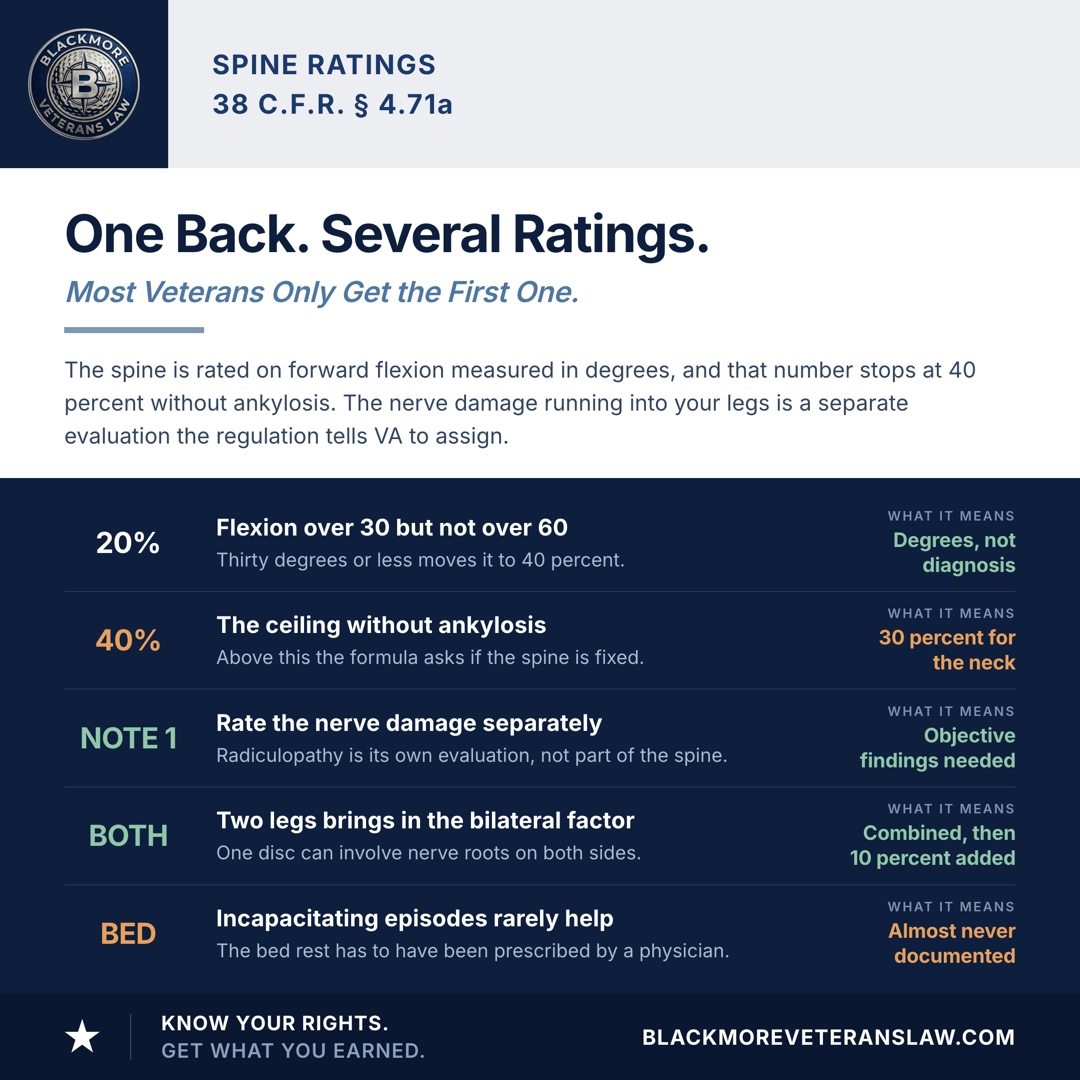
The formula, in degrees
38 C.F.R. § 4.71a contains a single General Rating Formula covering the spine diagnostic codes. For the thoracolumbar spine, meaning the lower and mid back:
- 10 percent: forward flexion greater than 60 degrees but not greater than 85; or combined range of motion greater than 120 but not greater than 235; or muscle spasm, guarding, or localized tenderness that does not produce an abnormal gait or abnormal spinal contour; or a vertebral body fracture with loss of 50 percent or more of height
- 20 percent: forward flexion greater than 30 degrees but not greater than 60; or combined range of motion not greater than 120; or muscle spasm or guarding severe enough to produce an abnormal gait or abnormal spinal contour
- 40 percent: forward flexion 30 degrees or less; or favorable ankylosis of the entire thoracolumbar spine
For the cervical spine, 10 percent is flexion greater than 30 but not greater than 40 degrees, 20 percent is greater than 15 but not greater than 30, and 30 percent is 15 degrees or less or favorable ankylosis of the entire cervical spine.
Normal forward flexion is zero to 90 degrees for the thoracolumbar spine and zero to 45 for the cervical spine. Normal combined range of motion is 240 degrees and 340 degrees respectively.
Why the spine rating stops where it does
Above 40 percent, the formula stops asking about motion and starts asking about ankylosis.
Fifty percent requires unfavorable ankylosis of the entire thoracolumbar spine. One hundred percent requires unfavorable ankylosis of the entire spine. Ankylosis means the spine is fixed in position and does not move.
Most veterans with severe, genuinely disabling back pain have a spine that still moves, painfully and not far. That means 40 percent is the practical ceiling for the lower back, and 30 percent for the neck, no matter how bad the pain is.
This is the source of most of the frustration, and it is a real limit rather than an adjudication error. A veteran whose back dominates their life, who cannot sit through a movie or lift their own child, receives 40 percent and is told that is the maximum. For the spine alone, it is.
The way the rating grows past that is not through the spine code.
The nerve damage is a separate rating
Note (1) to the General Rating Formula directs VA to evaluate any associated objective neurologic abnormalities, including but not limited to bowel or bladder impairment, separately under an appropriate diagnostic code.
Radiculopathy is the common one. When a disc presses on a nerve root, the result is pain, numbness, tingling, or weakness running into the leg or the arm. That is a neurologic abnormality associated with the spine condition, and the regulation says to rate it on its own.
For the sciatic nerve, 38 C.F.R. § 4.124a, Diagnostic Code 8520, rates incomplete paralysis at 10 percent for mild, 20 percent for moderate, 40 percent for moderately severe, and 60 percent for severe with marked muscular atrophy. Complete paralysis is 80 percent. Separate codes cover neuritis and neuralgia of the same nerve.
A veteran with a 40 percent thoracolumbar rating and nothing else, who has shooting pain and numbness down one leg documented in the treatment records, is missing an evaluation the regulation contemplates.
Two legs changes the arithmetic again
Radiculopathy frequently affects both legs, because a single disc problem at the lumbar level can involve nerve roots on both sides.
Two separately rated lower extremities are a bilateral pairing. The two sides are combined first, then 10 percent of that combined value is added before anything else is combined. We covered the mechanics of that in detail in the bilateral factor, and bilateral radiculopathy from one spine condition is the single most common place it goes unnoticed.
So the full picture for one back problem can be a spine rating, a left leg rating, a right leg rating, and the bilateral factor applied to the two legs. Veterans routinely have the first of those and none of the rest.
The limits, stated plainly
Separate ratings are not additional percentages added together. They are combined under the combined ratings table, so a 40 and a 20 and a 20 do not make 80.
Radiculopathy that is wholly sensory is capped low. The regulation provides that where the involvement is wholly sensory, the rating should be for the mild, or at most the moderate, degree. Numbness and tingling with no weakness, no atrophy, and no reflex loss is generally a 10 or a 20, not a 40. The higher levels require the kind of findings an examiner can observe and measure.
And the neurologic abnormality has to be objective. Note (1) says objective. Reported symptoms matter, but what moves these ratings is documentation: an examination finding diminished reflexes or reduced strength, an EMG, imaging showing nerve root involvement, a consistent clinical record.
The incapacitating episodes alternative, and why it rarely helps
Intervertebral disc syndrome can be rated instead on the total duration of incapacitating episodes over the previous 12 months: 10 percent for at least one week, 20 percent for at least two, 40 percent for at least four, and 60 percent for at least six.
That looks like a route past the 40 percent ceiling, and it almost never is, because of how the term is defined. An incapacitating episode is a period of acute signs and symptoms that requires bed rest prescribed by a physician and treatment by a physician.
Bed rest you took because you could not stand up does not count. It has to have been prescribed, and it has to appear in the records. Current medical practice rarely prescribes extended bed rest for back pain, so most veterans with severe disc disease have none of it documented and the alternative formula produces nothing.
Pain and the exam itself
38 C.F.R. § 4.59 provides that actually painful joints are entitled to at least the minimum compensable rating for the joint. It also sets out how joints are supposed to be tested: for pain on both active and passive motion, and in weight-bearing and nonweight-bearing conditions.
Range of motion in a back claim is one measurement taken on one day, usually a day you knew was coming. If the examination does not address what your back does during a flare-up, or record pain on motion, or test the way the regulation describes, the number it produces is not a complete picture of the disability.
What to do with this
Look at your rating decision and count the evaluations. If there is one line for the spine and nothing for your legs, and you have radiating symptoms in the records, that is the gap.
If you have radiating symptoms that are not documented anywhere, documentation is the first step rather than a filing. An evaluation needs findings to rest on.
If you are at 40 percent for the lower back and have been told that is the maximum, that is accurate for the spine code and not the end of the analysis.
How we can help
Spine claims are usually undervalued in the neurologic ratings rather than in the spine rating itself, and the separate evaluations the regulation contemplates are easy to miss on a code sheet. If your back is rated and the symptoms running into your legs or arms are not, or you have been told 40 percent is the ceiling, contact Blackmore Veterans Law, P.C. to discuss your situation.
Related reading: the bilateral factor, pyramiding and why some separate ratings get denied, and secondary service connection and the kinetic chain.