
Most veterans have never heard of the bilateral factor, which is reasonable, because nothing about the claims process announces it. It is not a benefit you apply for. It has no form. It appears, if at all, as a line on a code sheet most people never read.
It is a step in the arithmetic. When it gets skipped, nobody is told.
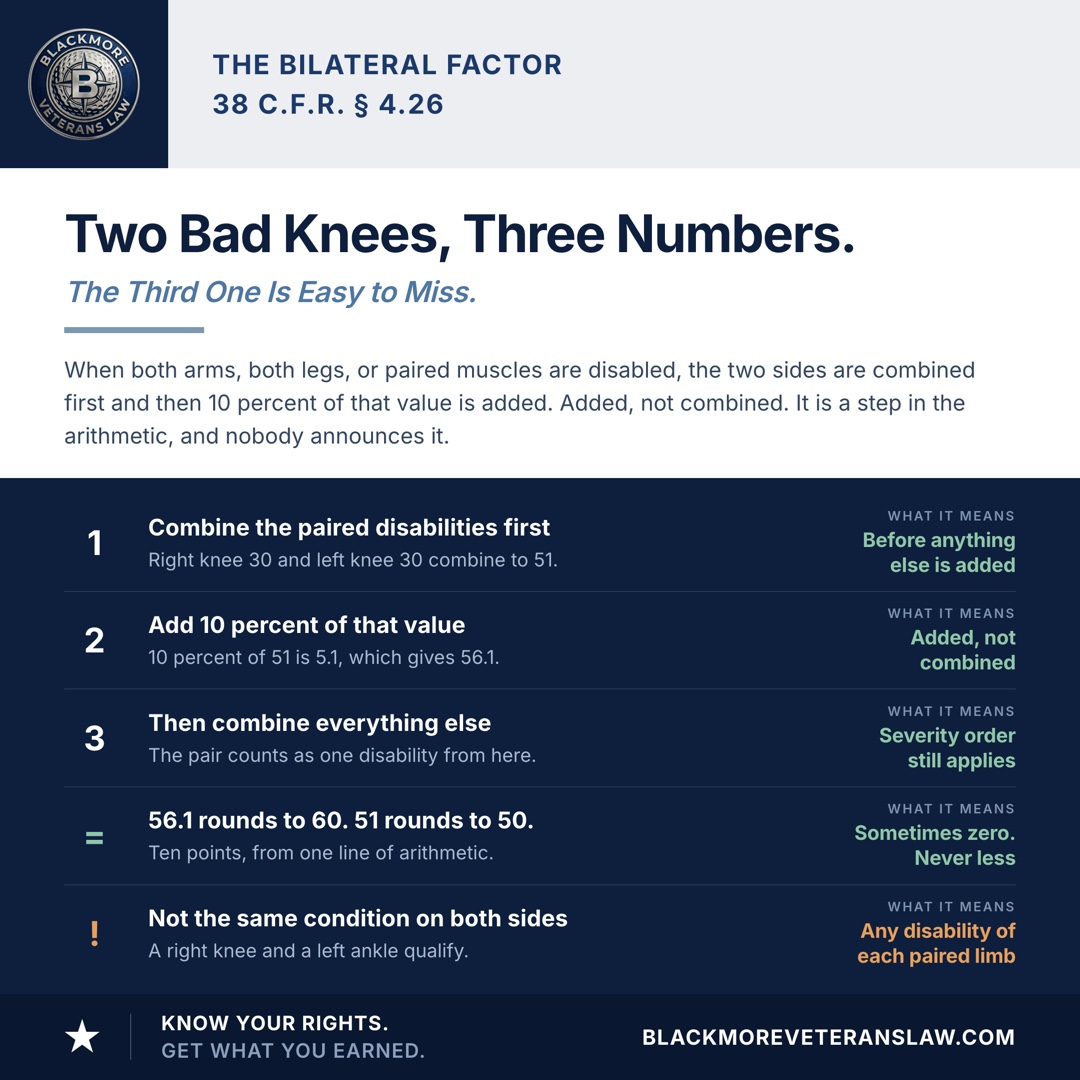
What the rule says
38 C.F.R. § 4.26 applies when partial disability results from disease or injury of both arms, both legs, or paired skeletal muscles.
When it applies, the ratings for the right and left sides are combined in the usual way, and then 10 percent of that combined value is added before anything else is combined.
Added, not combined. The regulation uses that word deliberately, and it is the part people get wrong when they try to run the math themselves.
The arithmetic, worked
Take a veteran with a service-connected right knee at 30 percent and a service-connected left knee at 30 percent.
Step one: combine the pair. Combined ratings are not addition. The first 30 percent leaves 70 percent of the person unaffected, and the second 30 percent applies to that remainder. Thirty, plus 30 percent of the remaining 70, is 21. Thirty and 21 give 51.
Step two: add the bilateral factor. Ten percent of 51 is 5.1. Added to 51, that gives 56.1.
Step three: combine everything else, treating the bilateral pair as a single disability from this point forward.
If those two knees are the whole file, the rating rounds to the nearest ten. 56.1 rounds to 60 percent.
Without that one step, 51 rounds to 50 percent.
Ten points, from a line of arithmetic nobody mentions. How combined ratings work generally is covered in Understanding VA Disability Ratings.
When it changes nothing
The factor does not always move the final number, and an accurate account has to say so.
Because the result gets rounded to the nearest ten, there are plenty of combinations where adding 10 percent of the combined value lands inside the same bracket and the rating comes out identical. A veteran with 10 percent in each knee combines to 19, picks up 1.9, and arrives at 20.9. Both 19 and 20.9 round to 20 percent.
So the question is never whether the bilateral factor was applied in the abstract. It is whether applying it would have crossed a boundary in your particular set of numbers. Sometimes it is worth ten points. Sometimes it is worth nothing. It is never worth less than nothing.
The misunderstanding that costs the most
Veterans hear the word bilateral and assume it means the same condition on both sides. Two knees. Two shoulders.
The regulation does not say that. It describes disabilities of both arms or of both legs. The conditions do not have to match, the diagnostic codes do not have to match, and the causes do not have to match.
A service-connected right knee and a service-connected left ankle are a bilateral pairing. So are a right shoulder and a left elbow. What matters is that there is a compensable disability of each of the paired extremities.
This catches people with bilateral radiculopathy in particular. A veteran with a service-connected spine condition who has separately rated radiculopathy in each leg has a disability of each lower extremity, and the pairing is frequently sitting there unnoticed.
What does not count is two disabilities of the same limb. A right knee and a right ankle are both on the right side, and there is no pairing.
And a condition that has no opposite side, like a spine or a mental health condition, cannot pair with anything. The spine condition in the example above does not participate. Only the two legs do.
Where to look
VA is supposed to apply this on its own. It is part of calculating a combined rating rather than something a veteran requests.
The place it shows up is the code sheet attached to your rating decision, which lists each disability, its diagnostic code, its percentage, and the calculation. When the bilateral factor has been used, there is a line for it.
If you have qualifying paired disabilities and no such line appears, that is a reasonable thing to ask about. It is also an unusually clean question, because it is arithmetic rather than medical judgment. Nobody has to weigh evidence to answer it.
Why the boundary matters beyond the number
Crossing from 50 to 60, or landing on 70, is not just a payment difference.
Several things in this system key off specific combined percentages. The schedular path to TDIU turns on them. So do some of the protections that attach over time, covered in The VA 5-Year, 10-Year, and 20-Year Rules.
A step in the arithmetic that moves a combined rating across one of those lines can change more than the monthly figure.
What to do with this
- Get the code sheet, not just the narrative decision. Ask for the rating decision with the code sheet attached if you do not have it.
- List your service-connected conditions by side. Right leg, left leg, right arm, left arm, everything else.
- Look for one on each side of a pair. Different conditions count. Different codes count.
- Check the code sheet for a bilateral factor line if you find a qualifying pairing.
- Do the arithmetic before you argue. Combine the pair, add 10 percent of that value, then combine the rest. If the result rounds to the same number either way, there is nothing to raise.
- If it crosses a boundary and the line is missing, that is a calculation question, and it is a good one to put in writing.
Whether any particular rating was calculated correctly depends on the conditions, the percentages, and the order of operations. Nobody can tell you your outcome. But this is one of the few places in VA law where you can check the work yourself with a calculator, and where being right is a matter of arithmetic rather than opinion.
Blackmore Veterans Law, P.C. is a solo practice representing veterans in VA disability claims and appeals. Contact us to discuss your situation.
This article is general information about VA disability law and is not legal advice for any individual case. Reading it does not create an attorney-client relationship. Attorney advertising.