
A veteran comes in to talk about a knee that was wrecked in 1998 and has been service connected ever since. Somewhere in the conversation, usually as an aside, the other knee comes up. Or the hip. Or the back that has been bothering them for a decade.
It gets mentioned the way people mention weather. Nobody told them it was part of the same story.
It usually is.
The rule is the easy part
38 C.F.R. § 3.310 service connects a condition caused or aggravated by a service-connected disability. No in-service element, no requirement that the second condition appear anywhere in your service records. That framework is covered in our guide to secondary service connection.
The rule is not what these claims fail on. They fail on mechanism, because the opinion in the file says the conditions are related and never explains how.
So this post is about the how.
What actually happens when a joint hurts
The body does not tolerate pain passively. It reorganizes around it, immediately and without being asked.
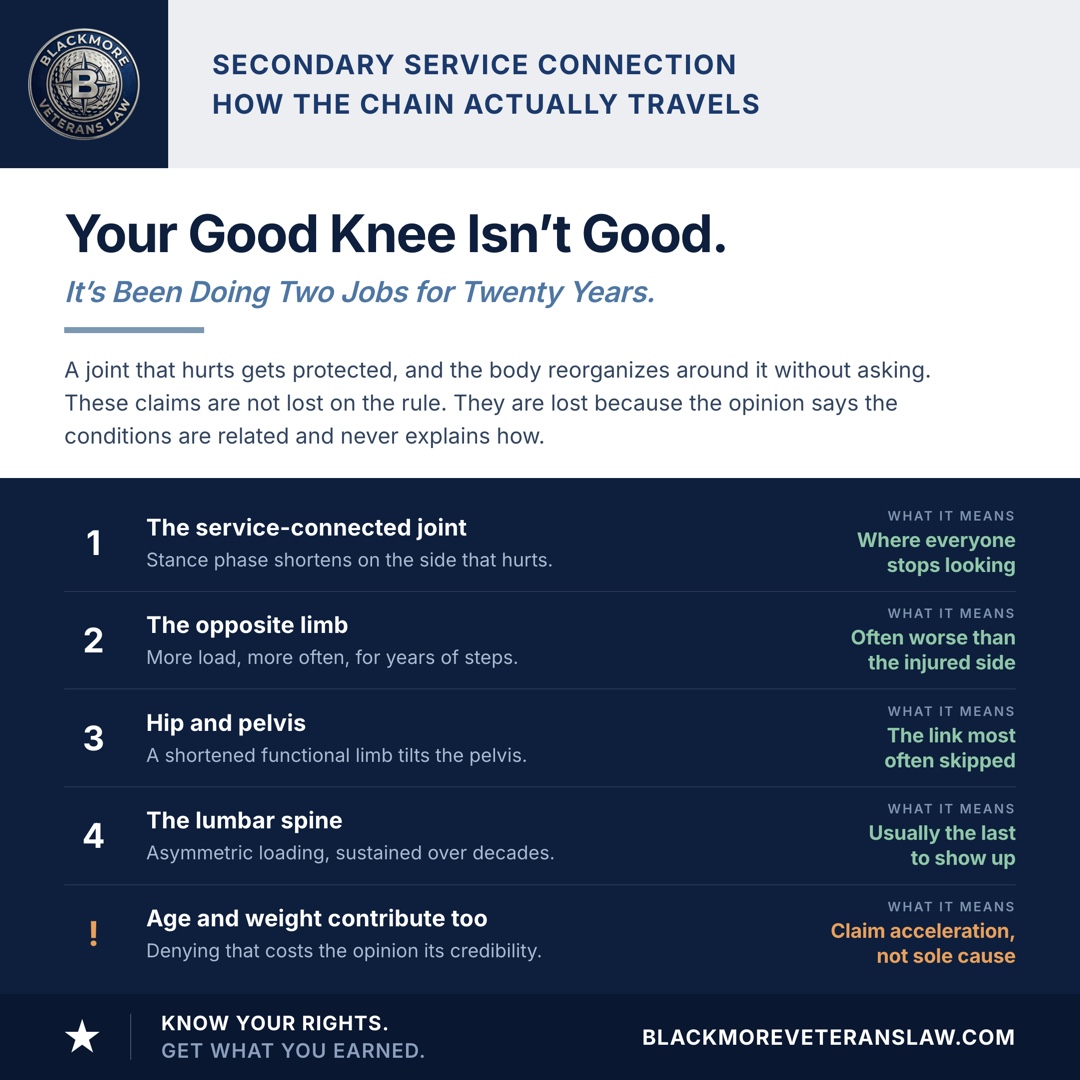
Stance phase shortens on the painful side. Walking is a cycle of loading and unloading each leg. When one side hurts, you spend less time bearing weight on it and more on the other. That is an antalgic gait, and most people develop one without noticing.
The opposite limb absorbs the difference. More load, more often, for longer, across every step for years. This is why the finding that surprises veterans most is so common: the uninjured side is frequently the one that has degenerated further. The service-connected knee gets protected. The other one does the work.
That asymmetry is not just a consequence. It is evidence. A joint that has deteriorated beyond what age alone would predict, on the side opposite a service-connected injury, is a finding that supports the mechanism rather than a coincidence to be explained away.
The chain keeps going up
The foot, ankle, knee, hip, pelvis, and lumbar spine are linked. A change at any one of them changes loading at the ones above.
Ankle to knee. Limited dorsiflexion from an ankle injury or fusion changes how the knee flexes and absorbs impact on every step.
Knee to hip. A knee that will not fully extend shortens the functional limb on that side, which tilts the pelvis and changes hip mechanics.
Hip and pelvis to spine. Pelvic obliquity changes lumbar curvature and makes spinal loading asymmetric. Years of that is how a knee injury ends up presenting as back pain.
Leg length discrepancy, whether structural or functional, does the same thing through a different door, and it often appears after surgery on a service-connected joint.
Compensatory muscle patterns develop on top of all of it. One side overworks and tightens, the other weakens and atrophies, and the imbalance generates its own pain.
It is not just legs
Shoulders. A service-connected shoulder shifts work to the other arm, which absorbs years of overhead reaching, lifting, and carrying it was not sharing before. The cervical spine participates in that too.
Assistive devices. A cane, crutches, or a wheelchair transfers load to joints that were never weight-bearing. Shoulders, elbows, and wrists take it. Conditions that arise from years of device use can be secondary to the condition that made the device necessary, and almost nobody files that claim.
Activity loss and weight. A condition that keeps you from moving produces weight gain, and additional weight loads every joint in the chain. The same mechanism opens other doors, covered in the sleep apnea post.
Chronic pain and mood. The chain is not just mechanical, and that end of it is covered in The Pain Came First.
Age and weight are real, and conceding it helps
Here is where these claims are usually lost, and where an overreaching argument does more harm than a modest one.
VA will say the back condition is degenerative, that the veteran is in their sixties, that body weight is a factor, and that degenerative disc disease is common in the general population. All of that is usually true. An opinion that denies it, or that claims the service-connected knee is the sole cause of a lumbar condition in a sixty-year-old, is not credible and will not be treated as credible.
The regulation does not require sole causation. It asks whether the service-connected condition caused the claimed condition or made it worse than it otherwise would have been. Acceleration is a claim the medicine can actually support.
That is the aggravation half of the rule, covered in You Had It Before. It is frequently the stronger theory in kinetic chain cases, and it is the one examiners are least often asked about.
What the opinion has to say
An adequate opinion in these cases does four things.
- Names the mechanism. Not that the conditions are related. How: shortened stance phase, increased contralateral load, compensatory pelvic tilt, asymmetric lumbar loading sustained over years.
- Ties it to this veteran’s record. The documented gait abnormality, the orthotic, the leg length finding, the imaging that shows one side worse than the other.
- Addresses aggravation as well as causation, in probability terms.
- Accounts for age and weight rather than ignoring them, and explains why the service-connected condition accelerated what those factors alone would have produced.
What separates an adequate opinion from an inadequate one generally is in The Exam Is the Appointment. The Opinion Is What Decides the Claim.
The records that prove it are usually already there
Most of this is documented before anyone goes looking, because treating clinicians write down what they observe.
- Physical therapy notes. PTs describe gait in detail as a matter of routine.
- Podiatry records and orthotic prescriptions. An orthotic is a documented response to altered mechanics.
- Surgical and post-operative notes, including any leg length change.
- Imaging across years, which can show asymmetric progression.
- Any assistive device prescription, with the date it started.
Those records establish the mechanism contemporaneously, which is more persuasive than reconstructing it afterward.
What to do with this
- Map your own chain. Start at the service-connected joint and work outward. The opposite limb, the hips, the low back, the neck if an upper extremity is involved.
- Ask which came first and when. The order and timing of onset is part of the argument.
- Pull the physical therapy and podiatry records, which are the most likely to describe gait and are the least likely to be in the file VA decided on.
- Ask for aggravation to be addressed, not just causation.
- Do not overclaim. An opinion that accounts for age and weight and still concludes the service-connected condition accelerated the decline is worth more than one that pretends those factors do not exist.
- Include the devices. If you have used a cane or crutches for years, the joints taking that load are part of this.
Whether any particular claim succeeds depends on the records, the imaging, and the opinion. Nobody can tell you your outcome. But the knee that was never injured, in the veteran who has limped since 1998, has been carrying a load it was never asked to carry, and that is a medical story with a regulation written for it.
Blackmore Veterans Law, P.C. is a solo practice representing veterans in VA disability claims and appeals. Contact us to discuss your situation.
This article is general information about VA disability law and is not legal advice for any individual case. Reading it does not create an attorney-client relationship. Attorney advertising.