
There is a particular way people say it, and it is usually the end of the conversation.
“I don’t qualify. I got an other than honorable.”
Somebody told them that, probably a long time ago, possibly at the separation briefing itself. They believed it, stopped asking, and in a lot of cases went on to spend twenty or thirty years without care or compensation they were eligible for the entire time.
The statute does not say you need an honorable discharge. It says the service has to have been under conditions other than dishonorable. Those are not the same sentence.
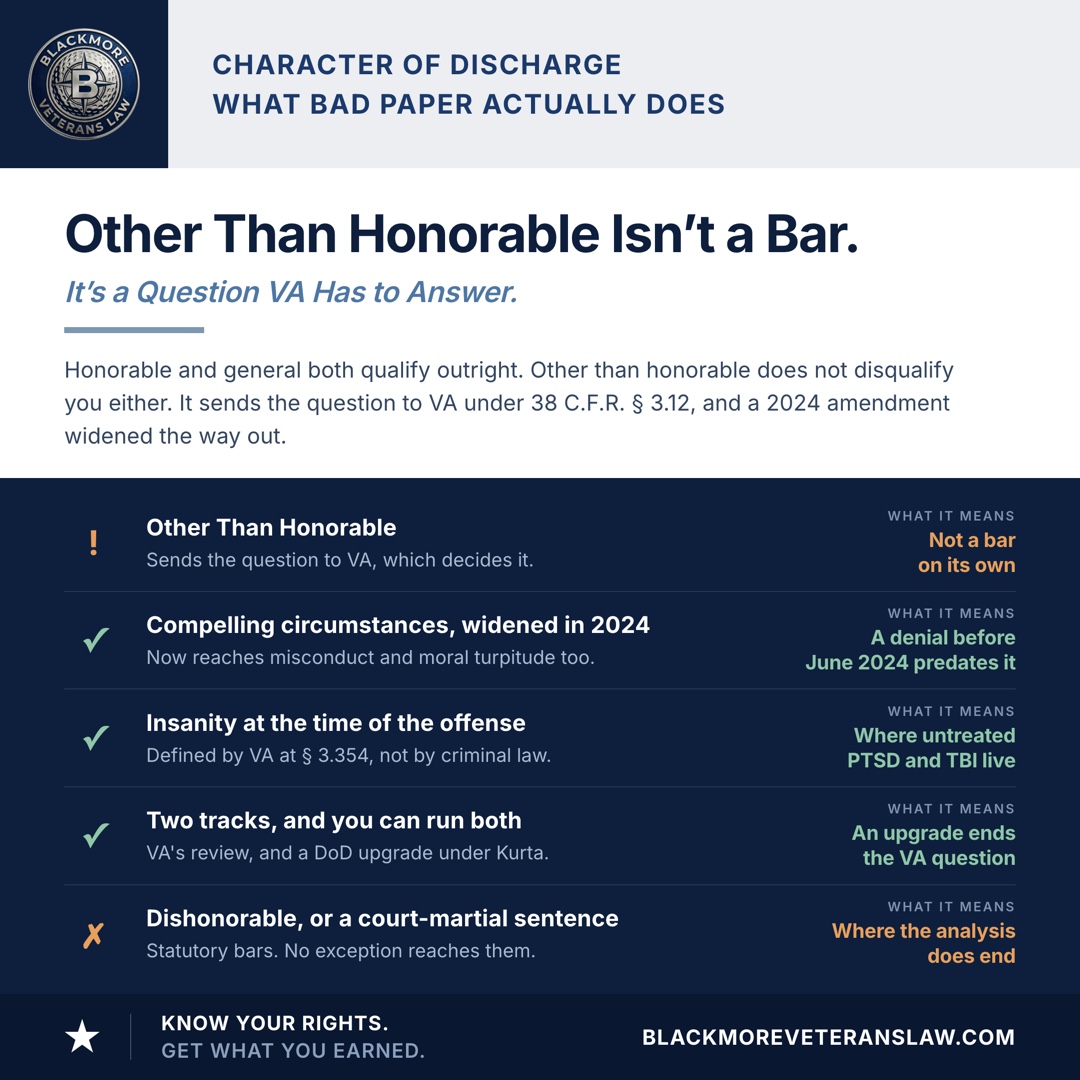
What the characterizations actually do
Honorable qualifies for everything.
General under honorable conditions qualifies for VA disability compensation, and no character of discharge review is needed. It is not a lesser form of eligibility for that purpose. One caveat: education benefits run on their own eligibility rules, and the GI Bill programs generally require an honorable discharge, so a general discharge can qualify you for compensation and still not qualify you for school.
Other than honorable does not qualify automatically and does not disqualify automatically. It sends the question to VA, which makes its own determination.
Bad conduct depends on which court imposed it. A bad conduct discharge adjudged by a general court-martial falls under the statutory bar for discharge by reason of a general court-martial sentence. One adjudged by a special court-martial does not, and gets a character of discharge determination like any other.
Dishonorable, and any discharge by reason of the sentence of a general court-martial, are statutory bars.
Uncharacterized or entry-level separation is not a bar by itself.
If your paper says other than honorable, the only accurate thing anyone can tell you without looking at the facts is that the question is open.
VA decides this itself
The determination lives at 38 C.F.R. § 3.12, implementing 38 U.S.C. § 5303, and the thing to understand is that it is a VA decision, not a military one.
It also generally has to be started by you. VA does not run these reviews on its own initiative, so a veteran who never files is a veteran whose question never gets answered.
That matters in two directions.
You do not need a discharge upgrade first. An upgrade comes from a Department of Defense review board and changes the characterization on the DD-214. A character of discharge determination comes from VA and decides whether you are eligible for VA benefits. Different bodies, different standards, different timelines. VA can find your service was under conditions other than dishonorable while your discharge paper still reads exactly as it does today.
It is appealable. Because it is a VA decision, an unfavorable character of discharge determination can be challenged through the same routes as any other, covered in How to Appeal a VA Disability Claim Denial.
The bars, and what changed in 2024
Section 3.12 sets out circumstances that bar benefits. The regulation was amended effective June 25, 2024, and the change matters a great deal to anyone who was told no before that date.
The statutory bars include discharge as a deserter, resignation by an officer for the good of the service, discharge by reason of the sentence of a general court-martial, and an other than honorable discharge resulting from being absent without leave for a continuous period of at least 180 days.
The regulatory bars include discharge in lieu of trial by general court-martial, mutiny or spying, an offense involving moral turpitude, and willful and persistent misconduct.
What the 2024 amendment changed is the reach of the compelling circumstances exception. It used to apply only to the 180-day absence. It now also reaches moral turpitude and willful and persistent misconduct, which are the two bars that catch the most veterans by a wide margin.
If you were denied on willful and persistent misconduct before June 2024, you were denied under a rule that no longer reads the way it did.
Two bars have no compelling circumstances exception at all: discharge in lieu of trial by general court-martial, and mutiny or spying.
What compelling circumstances actually weighs
The regulation tells VA what to consider, and the list is broader than people expect:
- The quality and length of the rest of the service.
- The reasons for the conduct, including mental and physical health, trauma, combat hardship, abuse, duress, family obligations, and the veteran’s age and maturity at the time.
- Whether a valid legal defense existed.
Read the middle item again. Trauma, abuse, duress, age and maturity. That is the regulation describing, in its own words, most of what actually produces a bad discharge in a nineteen-year-old who came home from something.
Willful and persistent misconduct has a definition now
The amendment also put parameters on the word persistent. Instances of minor misconduct occurring within two years of each other are persistent. An instance of minor misconduct within two years of more serious misconduct is persistent. Instances of more serious misconduct within five years of each other are persistent.
That cuts in both directions, and an honest account says so. A clearer test means some conduct patterns now meet the definition more readily than under the old standard. The counterweight is substantial: compelling circumstances now reaches this bar at all, and before 2024 it did not.
The exception that changes the most cases
If a person was insane at the time of committing the offense that caused the discharge, the bars do not apply.
VA defines insanity at 38 C.F.R. § 3.354, and it is not the criminal law standard. It does not require a court finding, a diagnosis at the time, or anything resembling a verdict.
Think about who that provision reaches. A service member comes back from a deployment different than they left. Nobody treats it, because in that era nobody was treating it, or because asking for help carried a cost they understood better than anyone reviewing the file later. What follows is drinking, absences, insubordination, a fight, a positive test. The misconduct that produced the discharge is the untreated condition expressing itself.
That is a common history, and the record usually contains the evidence in plain sight: performance that fell off a cliff after a specific point, a sudden change in evaluations, discipline that started at a particular moment and never happened before it. The same places markers live in other claims, covered in You Never Reported It. VA Still Has to Look for the Markers.
Traumatic brain injury does the same thing and is even less often connected to the behavior that followed it.
The upgrade track, and the memos that changed it
Everything above is VA deciding eligibility. The other track is changing the discharge itself, and it has moved further in the last decade than VA’s side has.
A discharge upgrade comes from a Department of Defense board, and which board depends on timing. A Discharge Review Board handles applications within fifteen years of the discharge, and it cannot touch a discharge imposed by a general court-martial. Past fifteen years, the application goes to the Board for Correction of Military or Naval Records, which reviews on the totality of the circumstances.
A series of Defense Department memos reshaped how those boards handle applications from veterans whose misconduct followed a mental health condition.
The Hagel memo, issued in September 2014, directed boards to give liberal consideration to upgrade petitions from veterans claiming post-traumatic stress disorder. It was aimed initially at Vietnam-era veterans, discharged in an era when the diagnosis did not exist.
The Carson memo in 2016 extended that guidance beyond the Vietnam era.
The Kurta memo, issued in August 2017, is the one that matters most now. It expanded liberal consideration beyond PTSD to mental health conditions generally, traumatic brain injury, sexual assault, and sexual harassment, and it set out four questions a board has to work through:
- Did the veteran have a condition or experience that may excuse or mitigate the discharge?
- Did that condition exist, or that experience occur, during military service?
- Does the condition or experience excuse or mitigate the discharge?
- Does it outweigh the reasons for the discharge?
Kurta also addressed evidence directly: it may come from sources outside the service records, and a diagnosis from a civilian provider years later is acceptable. The absence of anything in the service record is not treated as proof the condition did not exist, which is the same problem covered in You Never Reported It. VA Still Has to Look for the Markers.
How that bears on the VA question
Carefully, because this is where people are given the wrong impression.
VA is not bound by these memos. They are Defense Department guidance to Defense Department boards. A character of discharge determination applies § 3.12, not Kurta.
What is true is more useful than that sounds.
An upgrade ends the VA question. If a board upgrades the discharge to honorable or general, there is no character of discharge determination left to make. The eligibility problem is gone rather than argued.
The evidence is the same evidence. A Kurta application is built on showing that a service-connected mental health condition or a trauma experienced in service explains the misconduct. That is the identical showing that supports VA’s insanity exception, and it maps closely onto the 2024 compelling circumstances factors, which name mental health, trauma, abuse, and duress in the regulation itself. One body of evidence, developed once, serves both.
The two tracks run at the same time. Nothing requires choosing. A veteran can ask VA for a character of discharge determination while an upgrade application is pending before a board, and in many cases should.
Each period of service stands alone
If you served more than once, each period is evaluated separately.
A veteran whose second enlistment ended badly may have a first enlistment that ended honorably. Conditions incurred or aggravated during that earlier period can be service connected on the strength of that period, regardless of how the later one concluded.
People with bad paper routinely assume the last discharge erased everything that came before it. It does not.
The honest limits
This post is not an argument that everyone with an other than honorable discharge qualifies.
Some bars are absolute, and no evidence reaches them. A dishonorable discharge is a bar. A discharge by reason of a general court-martial sentence is a bar. Where a bar applies and no exception fits, the answer is no, and nobody is served by being told otherwise.
What is true is narrower and still significant: other than honorable is not one of those bars. It is the beginning of a question VA is required to answer on the facts, and a great many people who were told the answer decades ago were told it by someone who was never going to look.
Health care eligibility also runs on rules of its own, separate from compensation, so a bar in one place does not always mean a bar in the other. If care is the immediate need, that is a question to put to VA directly rather than assume.
What to do with this
- Find the actual characterization on your DD-214 and the narrative reason for separation. Those two fields start the analysis.
- Run both tracks. The VA determination and a discharge upgrade are separate processes with separate standards, and nothing requires choosing. An upgrade granted under liberal consideration ends the VA question outright.
- Write down why the conduct happened. Compelling circumstances now reaches willful and persistent misconduct and moral turpitude, not just a long absence, and the regulation names mental health, trauma, combat hardship, abuse, duress, family obligations, and your age at the time as things VA has to weigh.
- If something changed you before the misconduct started, say so. Deployment, an assault, a head injury, a death. The insanity exception exists for exactly that situation and is rarely raised by anyone else on your behalf.
- Pull the personnel file, not just the DD-214. Evaluations, counseling records, and assignment history are where a change in a person shows up on paper.
- If you were denied before June 2024, look again. The compelling circumstances exception did not reach willful and persistent misconduct or moral turpitude then. It does now.
- If you served more than once, check the earlier period.
Whether any particular veteran qualifies depends on the separation, the record, and the evidence that can be developed around it. Nobody can tell you your outcome. But “I got an other than honorable” is a description of a document. It is not a determination, and in most cases nobody has ever actually made one.
Blackmore Veterans Law, P.C. is a solo practice representing veterans in VA disability claims and appeals. Contact us to discuss your situation.
This article is general information about VA disability law and is not legal advice for any individual case. Reading it does not create an attorney-client relationship. Attorney advertising.