
A 0 percent rating looks like nothing. For erectile dysfunction it is the only rating the schedule offers, and it says very little about what the claim produced.
VA’s rating schedule evaluates erectile dysfunction at 0 percent under Diagnostic Code 7522, with or without penile deformity. A veteran who is granted service connection, sees 0 percent, and hears nothing more can fairly conclude the claim paid nothing. Whether it did depends on a separate question the percentage does not answer.
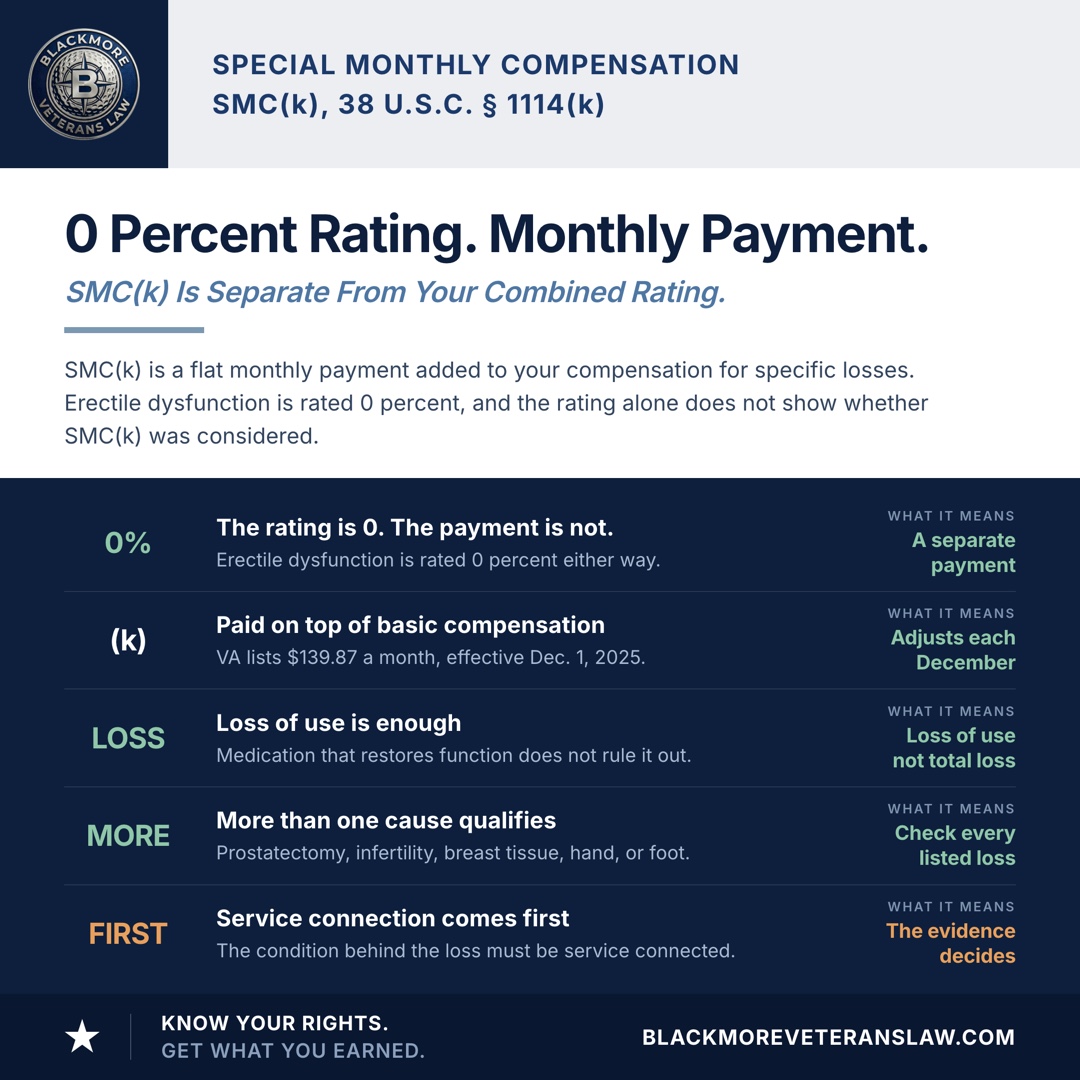
What SMC(k) is
38 U.S.C. § 1114(k) and 38 C.F.R. § 3.350(a) provide special monthly compensation for specific losses. It is a flat monthly payment, added to the basic rate of compensation. It is not a rating, and it does not change your combined percentage. We covered where it fits among the other levels in special monthly compensation.
VA lists the rate at $139.87 per month, effective December 1, 2025. VA states that it is added to basic compensation at any disability rating from 0 to 100 percent, and that a veteran may receive one to three SMC-K awards. The rate adjusts each December.
The regulation pays it for each of the following, where the loss results from a service-connected disability:
- anatomical loss or loss of use of one or more creative organs
- loss of use of one hand or one foot
- loss of use of both buttocks
- blindness of one eye with light perception only
- deafness of both ears with absence of air and bone conduction
- complete organic aphonia with constant inability to communicate by speech
- for women veterans, loss of 25 percent or more of breast tissue, including by mastectomy or partial mastectomy, or radiation treatment of breast tissue
Loss of use of a hand or foot carries the same definition used for the automobile allowance, no effective function beyond what an amputation stump with a prosthesis would give. That standard is covered in the three benefits that do not depend on your combined rating.
Erectile dysfunction and the 0 percent rating
The rating schedule itself points to the benefit. 38 C.F.R. § 4.115b opens with a note directing raters, in any claim involving loss or loss of use of a creative organ, to § 3.350 to determine whether special monthly compensation applies. Diagnostic Code 7522 carries a footnote to the same effect.
VA’s adjudication manual is specific. It says to grant SMC(k) when the evidence shows that service-connected erectile dysfunction constitutes loss of use of a creative organ. It lists other diagnoses that may amount to loss of use, including loss of libido, loss of sexual drive, and impotence.
The manual also addresses the point that stops most veterans from raising it, which is that medication works. It states that SMC(k) is established when an examiner finds erectile dysfunction even though the veteran can achieve erection and penetration with medication. Where a report shows the diagnosis but indicates the veteran can penetrate and ejaculate without medication, the manual says to resolve reasonable doubt in the veteran’s favor and grant it.
The condition has to be service connected, and the route can be indirect. The manual states that SMC(k) for a creative organ may rest on a multi-link causal chain between a service-connected disability and the loss, and gives loss of erectile power secondary to a disease process such as diabetes or multiple sclerosis as an example. Secondary service connection, including through medication, is covered in secondary service connection and medication side effects.
Other routes to the same payment
Erectile dysfunction is the common one. It is not the only one.
Radical prostatectomy. The manual directs that SMC(k) be awarded in all cases where service-connected prostate cancer was treated with radical prostatectomy, without an additional examination or medical opinion, because the surgery results in loss of ejaculatory power. The award runs from the date of the procedure if the cancer was service connected from that date. It does not depend on whether erectile dysfunction also exists.
Prostate cancer without a radical prostatectomy is different. The manual says service connection for the cancer does not automatically produce SMC(k), and that after radiation, cryotherapy, or hormone therapy the question is decided on the facts. Orchiectomy is anatomical loss of a creative organ and qualifies.
Infertility. The manual says not to establish service connection for infertility itself. It says SMC for loss of use of a creative organ is warranted when a service-connected condition results in infertility. It also lists retrograde ejaculation and spermatozoa dumping into the bladder as reproductive tract conditions that can amount to loss of use.
Women veterans. Acquired absence of the ovaries or another creative organ qualifies. So does a diagnosis of female sexual arousal disorder, which is rated at 0 percent under Diagnostic Code 7632 with a footnote directing review for SMC. 38 C.F.R. § 4.116 carries the same note as § 4.115b. Loss of breast tissue is covered in the list above.
The other listed losses. Deafness of both ears in this context means a numeric designation of XI in each ear under the hearing tables, which is a 100 percent evaluation for hearing, and the loss must be permanent. Complete organic aphonia, blindness of one eye with light perception only, and loss of use of both buttocks each have their own criteria in the regulation and manual.
How it gets missed
A 0 percent rating prompts no follow-up. There is no number to be disappointed by, so there is nothing to appeal.
VA’s manual says SMC for a creative organ may be based on a specific claim or raised within another claimed issue when the evidence shows it, such as an examination report, and that VA should develop the issue when there is a reasonable probability of entitlement. Whether it happens depends on the rater. If your decision grants service connection for a qualifying condition and says nothing about SMC, and your monthly amount does not include a (k) payment, ask in writing.
Effective dates follow service connection. The manual says the effective date for SMC based on erectile dysfunction will generally coincide with the date service connection was awarded for it, under the general rules in 38 C.F.R. § 3.400.
The limits
SMC(k) requires service connection for the underlying condition first. If the erectile dysfunction is not service connected, that claim comes first.
Loss of use is a finding on the evidence. The manual tells raters not to grant it on an examiner’s checkbox where the exam has no history, examination, or other basis for the conclusion, where there is specific evidence the account lacks credibility, or where the greater weight of the evidence is to the contrary.
Prostate cancer alone is not enough. Radical prostatectomy is the case the manual treats as automatic.
Loss traceable to an elective operation after service does not establish entitlement under 38 C.F.R. § 3.350(a)(1)(iii). The regulation says an operation advised on sound medical judgment to relieve a pathological condition is not elective.
The amount is a flat figure, and the number of awards has a ceiling. The regulation caps the combined monthly total when SMC(k) is paid with other rates, and VA’s rate tables control.
What to do with this
Look at your rating decision for any condition that touches a qualifying loss: erectile dysfunction, a prostatectomy, infertility, a hysterectomy or oophorectomy, a mastectomy, loss of use of a hand or foot, or severe hearing or vision loss.
Then check whether the decision mentions special monthly compensation, and whether your monthly amount includes a (k) payment.
If a condition is service connected and the answer to both is no, ask for SMC(k) in writing and point to the finding that supports it.
If the underlying condition is not yet service connected, that is the claim to file first.
How we can help
Whether a condition amounts to loss of use turns on the medical record and how an examiner described it. If you have a service-connected condition that may qualify and your decision does not mention special monthly compensation, contact Blackmore Veterans Law, P.C. to discuss your situation.
Related reading: special monthly compensation, the three benefits that do not depend on your combined rating, and medication side effects as secondary conditions.