
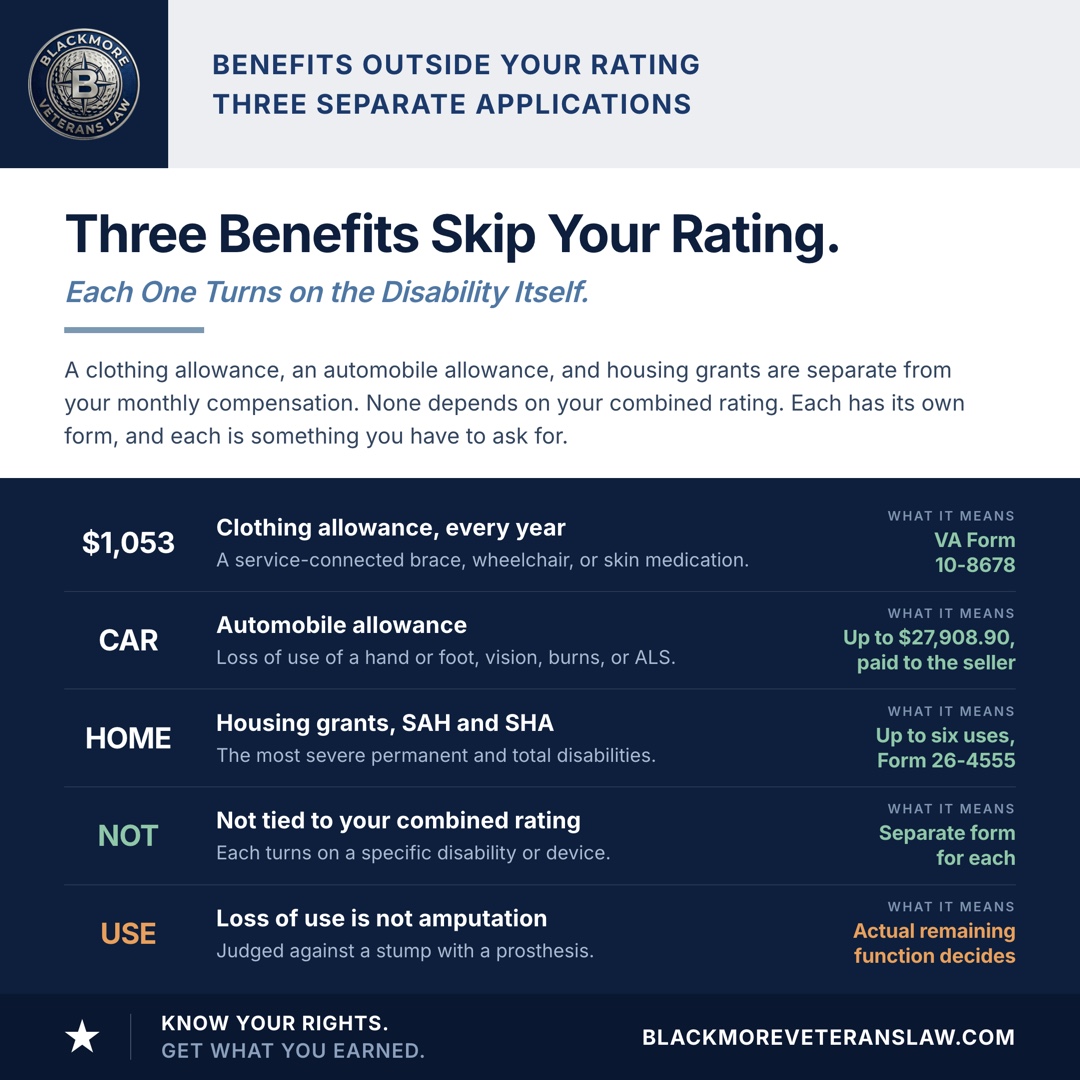
Your combined rating sets your monthly compensation. A group of other VA benefits does not run through it at all.
They turn on a specific disability, or on a specific thing that disability forces you to wear, drive, or live in. Each one has its own application, which means each one is something you have to ask for.
The clothing allowance
38 U.S.C. § 1162 and 38 C.F.R. § 3.810 provide an annual payment in two situations.
The first is a prosthetic or orthopedic appliance, a wheelchair included, that you use because of a service-connected disability and that tends to wear or tear your clothing. VA lists braces and wheelchairs as examples.
The second is a medication a physician prescribed for a service-connected skin condition that causes irreparable damage to your outer garments.
VA lists the current rate as $1,053.19, effective December 1, 2025, and it is adjusted annually. The regulation sets no minimum rating percentage. A veteran with a service-connected knee or back who wears a brace every day is the ordinary case.
The regulation also allows more than one allowance. You can receive one for each appliance or medication that affects a different type of clothing, and two when several items together wear out a single type of garment faster than one would.
How it works. The qualifying date is August 1 each year, and VA pays qualifying applicants between September 1 and October 31. The application is VA Form 10-8678. VA states that veterans who were paid in 2022 or 2023 no longer have to reapply every year, though applying is still how you request an additional allowance or start receiving it for the first time.
The regulation does not define “tends to wear or tear clothing,” and it does not say how to decide when damage is irreparable. VA makes that finding, which is why the device or medication has to be tied to a service-connected condition in the records.
The automobile allowance and adaptive equipment
38 U.S.C. § 3902 and 38 C.F.R. § 3.808 provide help buying a vehicle and equipping it. A veteran qualifies who is entitled to compensation for any of the following:
- loss or permanent loss of use of one or both feet
- loss or permanent loss of use of one or both hands
- permanent impairment of vision of both eyes, with central visual acuity of 20/200 or less in the better eye with correction, or a qualifying visual field defect
- a severe burn injury with scarring, contractures, and limited motion that prevents effective operation of an automobile
- amyotrophic lateral sclerosis
Ankylosis of one or both knees or hips qualifies for adaptive equipment only, not for the automobile allowance itself.
VA lists the allowance at up to $27,908.90, effective October 1, 2026. The cap is adjusted each October 1. The seller of the specially equipped vehicle submits the claim and VA pays the seller, as a one-time payment. VA describes limited exceptions for a second allowance, such as a vehicle destroyed in a natural disaster or one that is 30 years old.
Adaptive equipment is a separate grant. It covers features such as power steering, brakes, seats, windows, and lift equipment. The automobile allowance is applied for on VA Form 21-4502 and adaptive equipment on VA Form 10-1394.
Loss of use does not mean amputation
The phrase that decides most of these claims is “loss of use,” and it has a regulatory definition. Under 38 C.F.R. § 3.350(a)(2), loss of use exists when no effective function remains other than that which would be equally well served by an amputation stump with a suitable prosthesis.
For a foot, the question is balance and propulsion. For a hand, it is grasping and manipulation. The determination rests on actual remaining function.
The regulation gives examples. Extremely unfavorable complete ankylosis of the knee counts. So does complete paralysis of the common peroneal nerve with footdrop, when the characteristic organic changes confirm it. Neither requires an amputation.
The housing grants
38 U.S.C. § 2101 provides two housing grants, and the dividing line is severity.
Specially adapted housing (SAH) is for permanent disabilities of the most severe kind: permanent and total loss of use of both lower extremities, permanent blindness in both eyes, loss of use of one lower extremity together with another condition that prevents locomotion without aids, loss of use of both upper extremities, and certain severe burns. A narrower category covers loss of use of the lower extremities from a disability incurred on or after September 11, 2001, capped at 120 approvals per fiscal year.
Special home adaptation (SHA) covers permanent and total loss of use of both hands, certain severe burns, and residuals of inhalation injury such as pulmonary fibrosis, asthma, or chronic obstructive pulmonary disease. It is for a veteran who is not entitled to SAH.
VA lists the fiscal year 2026 maximums at $126,526 for SAH and $25,350 for SHA, and says they are adjusted yearly. Either grant can be used up to six times over a lifetime, and unused funds remain available. SAH requires that you own or plan to own the home. SHA can apply to a home owned by you or a family member. A separate temporary residence adaptation grant covers changes to a family member’s home where you are staying for a time. The application is VA Form 26-4555.
The qualifying disability has to be service connected, and the home grants require that it be permanent and total. That language attaches to the specific loss, not to your combined rating.
The limits
These are narrow benefits, and the narrowness is the point to understand before applying.
The vehicle and housing benefits require specific losses, and loss of use is a defined standard. Severe pain or a heavily limited joint does not meet it by that description alone. The test is what function remains.
The qualifying condition has to be service connected. If the disability you have is not yet service connected, that claim comes first.
The dollar figures change. The clothing allowance is adjusted annually, the vehicle cap changes each October 1, and the housing maximums change each fiscal year. The figures here are what VA listed when this was written, and VA’s current rate pages control.
The vehicle allowance is generally paid once and goes to the seller. The housing grants are maximums, not payments of whatever the work costs.
And for the clothing allowance, VA decides whether the device or medication meets the standard. That finding is not automatic.
What to do with this
If you wear a brace, use a wheelchair, or take a prescribed skin medication for a service-connected condition and it ruins your clothes, the clothing allowance is the one to apply for. The form is VA Form 10-8678.
If your records show loss of use of a hand or foot, qualifying vision loss, a severe burn injury, or ALS, ask about the automobile allowance and adaptive equipment before you buy a vehicle.
If you have one of the severe disabilities in the housing list and are buying, building, or modifying a home, ask about SAH or SHA early.
If you have the condition and it is not service connected, that is the claim to file first.
How we can help
Whether a disability amounts to loss of use, or whether a device qualifies, depends on the medical record and how it is described. If you think one of these applies to you and are unsure how your records read, contact Blackmore Veterans Law, P.C. to discuss your situation.
Related reading: special monthly compensation, aid and attendance, and how VA rates the spine and the nerve damage that comes with it.