
The letter does not say your rating has been cut. Read carefully, it says VA is thinking about it.
That distinction is the whole reason the letter exists. Open it the day it arrives, not the week you get around to it. Two deadlines started running on the date printed at the top, and neither one waits for you to be ready.
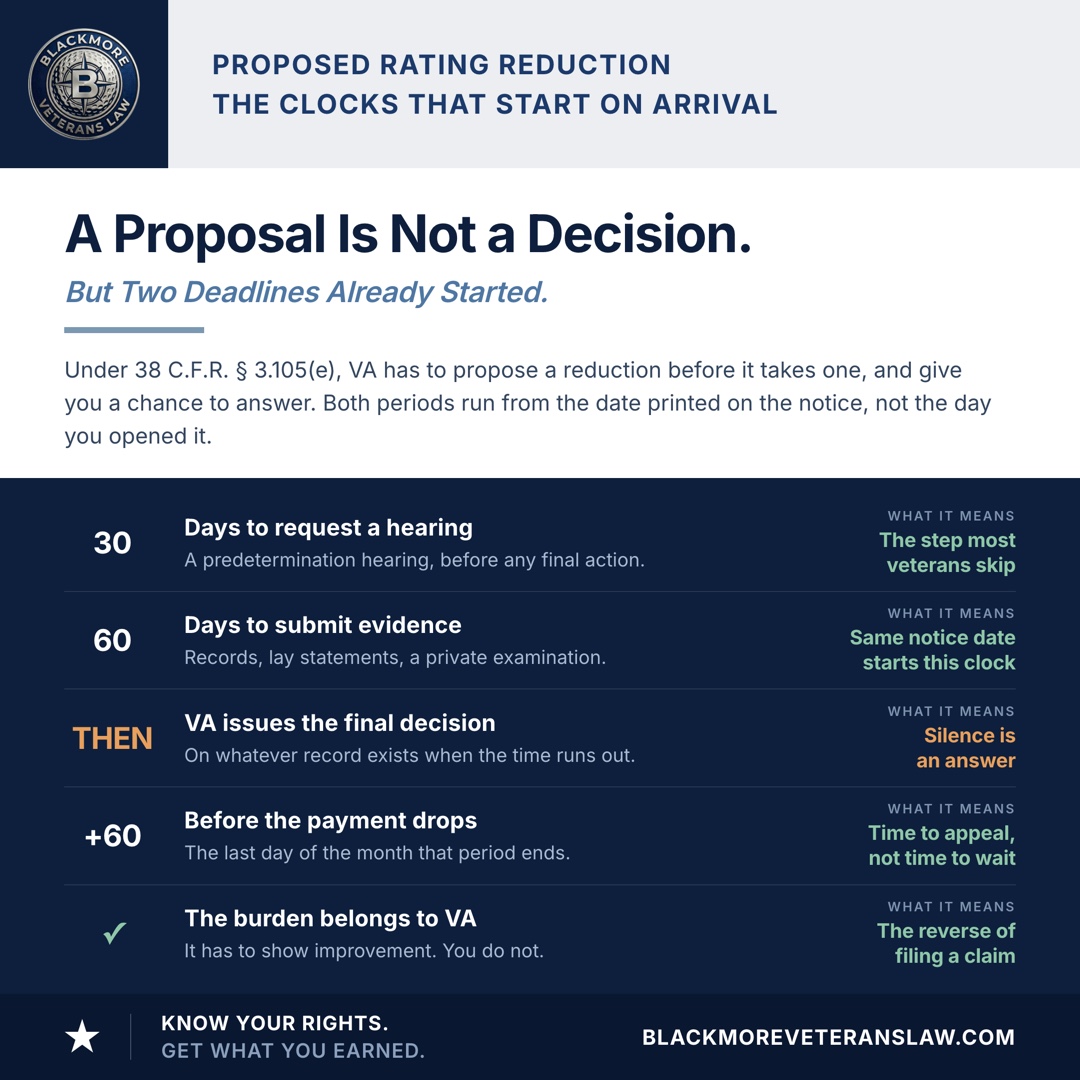
What the proposal is
38 C.F.R. § 3.105(e) governs this. When VA considers a reduction warranted, and the lower evaluation would reduce or stop the compensation you are currently paid, VA cannot simply do it. It has to prepare a rating proposing the reduction, set out all the material facts and reasons, send that to your latest address of record, and give you 60 days to submit evidence showing payments should continue at the present level.
Two things follow from that.
Your payment does not change when the letter arrives. People read the proposal, assume the money is already gone, and make decisions accordingly. It is not gone, and it will not be for months.
The reasons are in the letter. VA is required to tell you what it is relying on. That is usually a recent examination, and it is the document to get your hands on immediately, because the case against your rating lives in it.
The two clocks
Both run from the date on the notice, not the date you opened it.
30 days to request a predetermination hearing. This is the shorter deadline and the one veterans miss. If the request reaches VA within 30 days, you have a right to a hearing before VA takes any final action.
60 days to submit evidence. Records, statements, a private examination, anything showing the condition has not improved the way the proposal says.
If you do nothing, both periods expire and VA issues a final rating decision on the record as it stands. Nothing pauses on its own. No one calls.
Request the hearing
Of everything in this post, this is the step with the best ratio of value to effort.
It costs nothing. It does not waive a single appeal right. VA cannot finalize the reduction until the hearing has been held. And it puts a person in front of the evidence rather than a file moving through a queue.
Veterans skip it constantly, usually because 30 days passed while they were deciding whether the letter was serious, or because a hearing sounds like something that requires a lawyer and a courtroom. It is neither.
If you take one thing from this: if a proposal letter is in your hands, get the hearing request in. You can decide what to do with the rest afterward.
The burden is not yours
This is the part that surprises people, and it changes how the response should be built.
In a claim for benefits, you are asking VA for something and the evidence has to support it. A reduction runs the other direction. VA has an established evaluation it wants to take away, and the burden of showing improvement is on VA.
For ratings that have been in place a while, 38 C.F.R. § 3.344 makes that burden heavier. A rating held at the same level for five years or more cannot be reduced on the strength of a single examination. VA has to review the entire record, the examination it relies on has to be at least as full and complete as the one the rating was based on, and the improvement has to be material and sustained under the ordinary conditions of life and work. Improvement on one good day in one exam room is not that.
Total ratings carry their own rule under 38 C.F.R. § 3.343, and where a total rating rests on unemployability, VA has to establish that you can actually hold a job.
The longer-term protections, at five, ten, and twenty years, are covered in The VA 5-Year, 10-Year, and 20-Year Rules. Those are separate from the procedure here, and both can apply at once.
Look hard at the examination
The proposal almost always rests on one exam. That exam is the thing to attack, and the questions are specific:
- Was it as thorough as the exam the rating came from? A fifteen-minute appointment cannot undo a rating built on a full workup.
- Did the examiner review the file? An examiner who never saw the history cannot speak to whether anything improved.
- Did it capture your bad days, or the one hour you were in the room? This is the recurring problem with every VA examination, and it is covered in The C&P Exam Is Short. Preparing for It Shouldn’t Be.
- Does the report actually say you improved? Sometimes it says very little, and the proposal reads more into it than the examiner wrote. What makes an opinion adequate or inadequate is in The Exam Is the Appointment. The Opinion Is What Decides the Claim.
What to put in
Evidence that the condition is what it has been:
- Current treatment records, especially from the months around the exam VA relied on.
- A private examination or opinion addressing the same criteria, from someone who reviewed the history.
- Lay statements from a spouse, coworker, or friend describing what you can and cannot do now, compared to before. VA Form 21-10210.
- Your own statement about frequency, duration, and what the condition costs you day to day, on VA Form 21-4138.
- Work evidence, if the rating involves employability. Reduced hours, accommodations, jobs lost, attendance.
When the money actually changes
Even a finalized reduction does not hit your next deposit.
Under § 3.105(e), the reduction takes effect the last day of the month in which a 60-day period from the notice of the final rating action expires. Add the response period before it, and the distance from the proposal letter to the first reduced payment is generally around four months.
That window is time to appeal, not time to wait. A final reduction can be challenged like any other decision, and the routes are covered in How to Appeal a VA Disability Claim Denial.
There is also a separate argument available when the procedure itself was skipped. A reduction taken without the required notice and opportunity to respond is void, and the earlier evaluation is restored. That is a defect in how the decision was made rather than a dispute about the medicine, which makes it one of the cleaner errors to spot.
What to do with this
- Find the date on the notice and count forward 30 days and 60 days. Write both on a calendar.
- Request the predetermination hearing in writing, now. Before you have gathered anything, before you have decided on a strategy.
- Get the examination report the proposal relies on, and read it against the rating criteria for your condition.
- Check how long you have held the rating. Five, ten, and twenty years each change what VA has to show.
- Build the evidence for the 60-day window, and keep proof of what you sent and when.
- Do not stop treatment. A gap in records during a reduction proceeding is the worst possible time for one.
Whether any particular reduction is stopped depends on the evidence, the history, and how the response is built. Nobody can tell you your outcome. But a proposal is not a decision, the burden of showing improvement belongs to VA, and the deadline that matters most is the short one nobody reads twice.
Blackmore Veterans Law, P.C. is a solo practice representing veterans in VA disability claims and appeals. Contact us to discuss your situation.
This article is general information about VA disability law and is not legal advice for any individual case. Reading it does not create an attorney-client relationship. Attorney advertising.