
The phone calls stop after a few weeks. The casseroles stop. And somewhere in a drawer there is a folder with VA letters in it that nobody has opened, because opening it means thinking about all of it again.
What is in that folder frequently includes two things that did not end at the death.
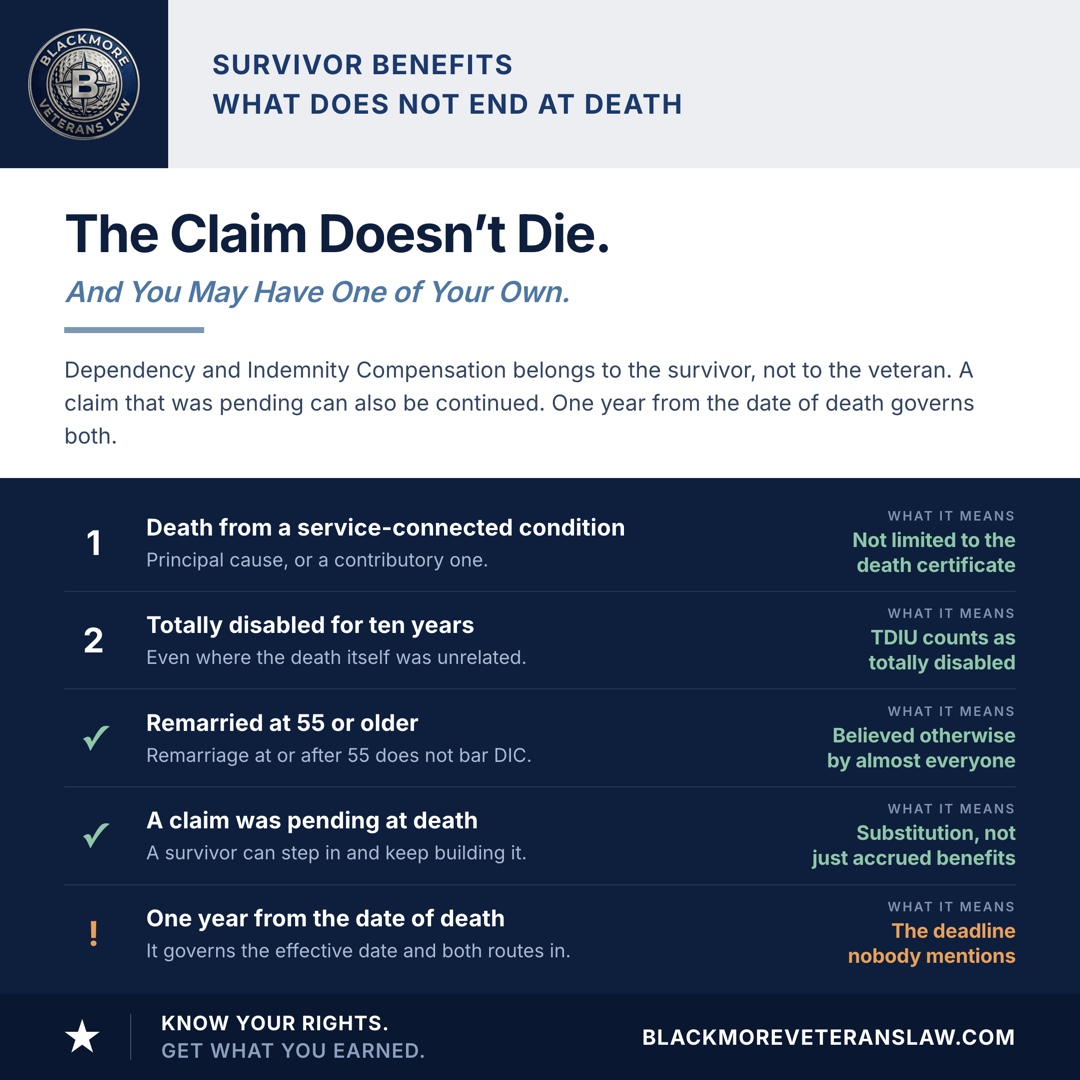
Two different things
A claim that was pending is still a claim. It does not evaporate at death, and a survivor can step into it.
You may have a claim of your own. Dependency and Indemnity Compensation belongs to the survivor. It is not the veteran’s benefit continuing. It is yours, with its own elements.
People routinely learn about one and never hear about the other.
DIC where the death was service connected
The main route is 38 U.S.C. § 1310: the veteran died from a service-connected disability.
The part that gets missed is how 38 C.F.R. § 3.312 defines that. A service-connected condition does not have to be the thing written on the death certificate. It can be:
- The principal cause, meaning it was the immediate or underlying cause of death, or etiologically related to it.
- A contributory cause, meaning it contributed substantially or materially to death, combined to produce it, or aided or lent assistance to producing it.
So a death certificate listing something else is not the end of the question. A service-connected heart condition that made a survivable illness unsurvivable, or years of a service-connected condition that left someone without the reserve to recover, can be a contributory cause.
That analysis usually requires a medical opinion, and it has the same problems as any other opinion in this system, covered in The Exam Is the Appointment. The Opinion Is What Decides the Claim.
DIC where the death was not service connected
This is the route almost nobody knows about.
Under 38 U.S.C. § 1318, DIC can be paid as though the death were service connected, without proving that it was, where the veteran was rated totally disabled for a service-connected disability for:
- the ten years immediately preceding death, or
- continuously since release from active duty and for at least five years before death, or
- at least one year for a former prisoner of war who died after September 30, 1999.
Two things make this reach further than it sounds.
TDIU counts. A veteran paid at the total rate because one or more service-connected conditions made them unemployable is rated totally disabled for this purpose. A rating sheet that never showed 100 anywhere can still satisfy it. TDIU is covered separately here.
The death can be from anything. Cancer, an accident, old age. The question under this route is not what caused the death. It is what the veteran’s rating was, and for how long.
The limit, stated honestly: this generally requires that the veteran was actually rated at that level for the required period. It is not a route to argue about what the rating should have been, except in narrow circumstances such as correcting an undebatable error in an earlier decision.
The remarriage rule
Survivors stop themselves from filing over this constantly.
Remarriage on or after age 55 does not bar DIC. If you remarried at 58, you did not give this up.
Remarriage before 55 generally does end eligibility, but that is not always permanent either. If the later marriage ends by death, divorce, or annulment, eligibility can be restored.
If someone told you years ago that remarrying ended it, check the date and your age at the time before accepting that.
The claim that was left pending
When a veteran dies with a claim or appeal still open, two different things can happen, and they are not the same.
Substitution. Under 38 U.S.C. § 5121A, an eligible survivor can request to be substituted as the claimant and continue the case. That means the claim proceeds, and the survivor can submit new evidence, get opinions, and take the appeal forward.
Accrued benefits. A survivor is paid what was already due to the veteran based on the evidence in the file at death. No new development, no new evidence.
Substitution is the stronger of the two in most situations, because it lets the case be built rather than frozen. Both generally require a request within one year of the death.
A claim that was pending for years, with a good argument in it, is not something to walk away from because the person who filed it is gone.
One year is the number to remember
It governs more than one thing at once.
- A DIC claim filed within one year of death takes an effective date of the first day of the month in which the veteran died.
- A substitution request generally must be made within one year of death.
- An accrued benefits claim must be filed within one year of death.
Nothing about this process is designed around what the first year after a death is actually like. That is the reason to write the date down somewhere, or to hand the folder to someone who can watch it for you.
Who can file
Surviving spouses, where the marriage meets VA’s requirements, which generally means married for at least a year, or a child born of the marriage, or married within fifteen years of the discharge from the period of service when the condition began.
Children, if unmarried and under 18, between 18 and 23 and in school, or permanently incapable of self-support from before turning 18.
Parents, under a separate income-based program.
The application is VA Form 21P-534EZ, which covers DIC, survivors pension, and accrued benefits together.
What to do with this
- Find the date of death and count forward one year. Write it down. That date governs the effective date and both survivor routes into a pending claim.
- Look at what the rating was, and for how long. A veteran rated totally disabled, including on unemployability, for ten years before death opens that route regardless of the cause of death.
- Do not stop at the death certificate. A service-connected condition that contributed to the death counts, and that is a medical question rather than a clerical one.
- Find out whether anything was pending. A claim or appeal still open at death can be continued by substitution.
- If you remarried, check your age at the time. Fifty-five is the line.
Whether any particular survivor qualifies depends on the records, the ratings, and the medical evidence. Nobody can tell you your outcome. But the folder in the drawer can be handed to someone else to open, and the year runs either way.
Blackmore Veterans Law, P.C. is a solo practice representing veterans and their survivors in VA claims and appeals. Contact us to discuss your situation.
This article is general information about VA law and is not legal advice for any individual case. Reading it does not create an attorney-client relationship. Attorney advertising.