
The word hearing does a lot of damage before anyone gets near a Board.
People picture a courtroom. A government lawyer across the aisle with a folder of reasons they should lose. Questions designed to catch them out. Veterans put off requesting a hearing for months over a scene that does not exist, and some skip it entirely.
There is no other side. Nobody is there to argue against you.
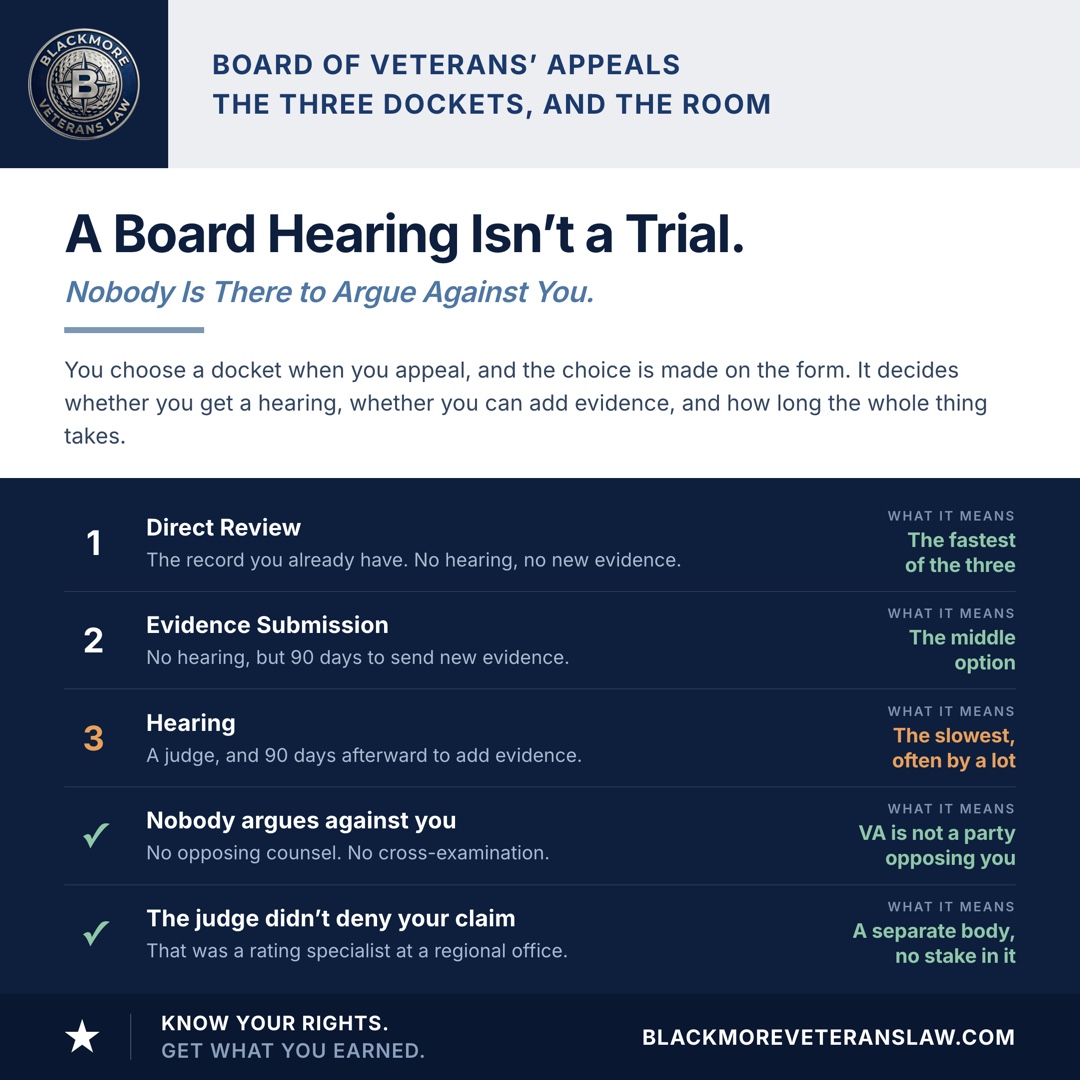
First, the choice that decides everything else
When you appeal to the Board, you pick one of three dockets, and the choice is made on the form rather than later.
Direct Review. The Board decides on the record that already exists. No hearing, no new evidence. This is the fastest of the three by a clear margin.
Evidence Submission. No hearing, but you have 90 days from filing to submit new evidence. Slower than Direct Review, faster than a hearing.
Hearing. You testify before a Veterans Law Judge, and you may submit evidence at the hearing or within 90 days after it. This is the slowest docket, often substantially so.
That last sentence is the honest part, and it should be said before anything else about hearings. Choosing a hearing can add a long wait to an appeal that has already taken years. For some cases that wait buys something real. For others it buys very little, and a veteran who picks the hearing docket out of a sense that they ought to say their piece may be paying a great deal of time for it.
The rest of this post is about what the wait actually buys, so the trade can be made with open eyes.
What a hearing is
It is you, a Veterans Law Judge, your representative if you have one, and someone making a transcript. Most hearings are now held by videoconference, and plenty of veterans appear from their own kitchen table.
Testimony is under oath and transcribed. There is no opposing counsel, because VA is not a party opposing you. Nobody cross-examines you. The judge asks questions, and the questions are generally aimed at understanding your condition and filling gaps in the file rather than testing you.
The judge also carries an affirmative obligation that surprises people: to fully explain the issues and to suggest the submission of evidence the claimant may have overlooked. A Veterans Law Judge who tells you what your case is missing is not going off script. That is the script.
The judge did not deny your claim
This gets conflated constantly, and it changes how people walk into the room.
Your denial was written by a rating specialist at a VA regional office. The Board of Veterans’ Appeals is a separate body that reviews those decisions. The judge in your hearing did not make the decision you are appealing, has no stake in defending it, and is not required to give it deference.
You are not persuading someone to admit they were wrong. You are presenting your case to someone who has not decided it yet.
What the judge is actually doing with your file
I spent years at the Board before going into private practice, and the thing I would most want a veteran to understand is how much of the work is reading rather than listening.
By the time a hearing happens, the judge has been through the file. The hearing is not where the case is learned. It is where the gaps get addressed, and there are usually three kinds:
Credibility. Where the record contains your account of something and nothing else, a judge is deciding whether to accept it. Hearing you describe it, in your own words, with detail that only someone who lived it would include, does something a written statement does not.
The things the paperwork flattened. A rating decision reduces a life to ranges of motion and symptom checklists. Testimony is where it comes back out: what a flare actually costs you, what you stopped doing, what the bad weeks look like.
Whether more development is needed. A great deal of what the Board does is identify what should have been obtained and was not, and send the case back for it.
That last one is why a remand is not a loss.
A remand is not a denial
Veterans hear remand and assume they lost. A remand sends the case back for further development, usually an examination that should have been adequate and was not, or records nobody requested.
It is a common outcome, it is often the correct one, and in a lot of appeals it is the step that eventually produces the grant. What it costs is time, which is the recurring currency of this entire system.
More on the broader appeal structure is in How to Appeal a VA Disability Claim Denial, and what makes an examination inadequate enough to require a remand is in The Exam Is the Appointment. The Opinion Is What Decides the Claim.
How to be useful at your own hearing
The veterans who get the most out of a hearing do a few things in common.
They bring specifics instead of adjectives. Not “my back is bad.” How many days last month. What you could not lift. What you stopped doing with your kids. The same principle that governs a C&P exam, covered in The C&P Exam Is Short. Preparing for It Shouldn’t Be.
They describe a bad day honestly. People minimize in front of authority. It is reflexive, it is often lifelong, and it costs claims. The judge is not impressed by stoicism. They are trying to find out what is true.
They bring someone who has watched it. A spouse, an adult child, a friend of thirty years. Testimony from someone who sees the condition from the outside is frequently more persuasive than anything the veteran says about themselves, because the veteran has adapted and no longer notices.
They answer the question that was asked. If a judge is circling something, it is usually because the record is thin there and they are trying to help you fill it.
What to do with this
- Decide the docket on the tradeoff, not on instinct. If you have no new evidence and nothing to explain, Direct Review is faster and may serve you better.
- Pick the hearing docket when testimony would actually add something. Credibility is contested, the written record flattens the condition, or someone close to you needs to be heard.
- If you request a hearing, use the 90 days after it. That window is part of what you chose. Evidence can still come in.
- Raise scheduling problems before the date, not after. A missed hearing without good cause is generally treated as a withdrawn request.
- Prepare the way you would for a C&P exam. Frequency, duration, what you can no longer do.
- Bring the witness. Most veterans do not, and most who do are glad they did.
Whether any particular appeal succeeds depends on the evidence and the record. Nobody can tell you your outcome. But a Board hearing is a conversation with someone who has read your file and has not decided yet, and whatever you have been picturing, it almost certainly is not that.
Blackmore Veterans Law, P.C. is a solo practice representing veterans in VA disability claims and appeals. Contact us to discuss your situation.
This article is general information about VA disability law and is not legal advice for any individual case. Reading it does not create an attorney-client relationship. Attorney advertising.