
The phrase gets in the way.
“Aid and attendance” sounds institutional. People hear it and picture a nursing home, a hospital bed, a hired aide in scrubs. A veteran who is managing at home, with a spouse doing the things that have gotten hard, does not recognize themselves in that picture and never asks.
The regulation describes something much closer to that household than the picture does.
Where it sits
Aid and attendance is a level of special monthly compensation, paid under 38 U.S.C. § 1114(l) and 38 C.F.R. § 3.350(b). The structure of SMC and why it goes unnoticed is covered in SMC Isn’t a Rating.
Section 1114(l) is reached several ways: anatomical loss or loss of use of both feet, loss of use of one hand and one foot, blindness in both eyes with visual acuity of 5/200 or less, being permanently bedridden, or being so helpless as to need the regular aid and attendance of another person.
The last one is the route most veterans qualify under and the one nobody claims.
What the regulation actually lists
38 C.F.R. § 3.352(a) sets out the factors:
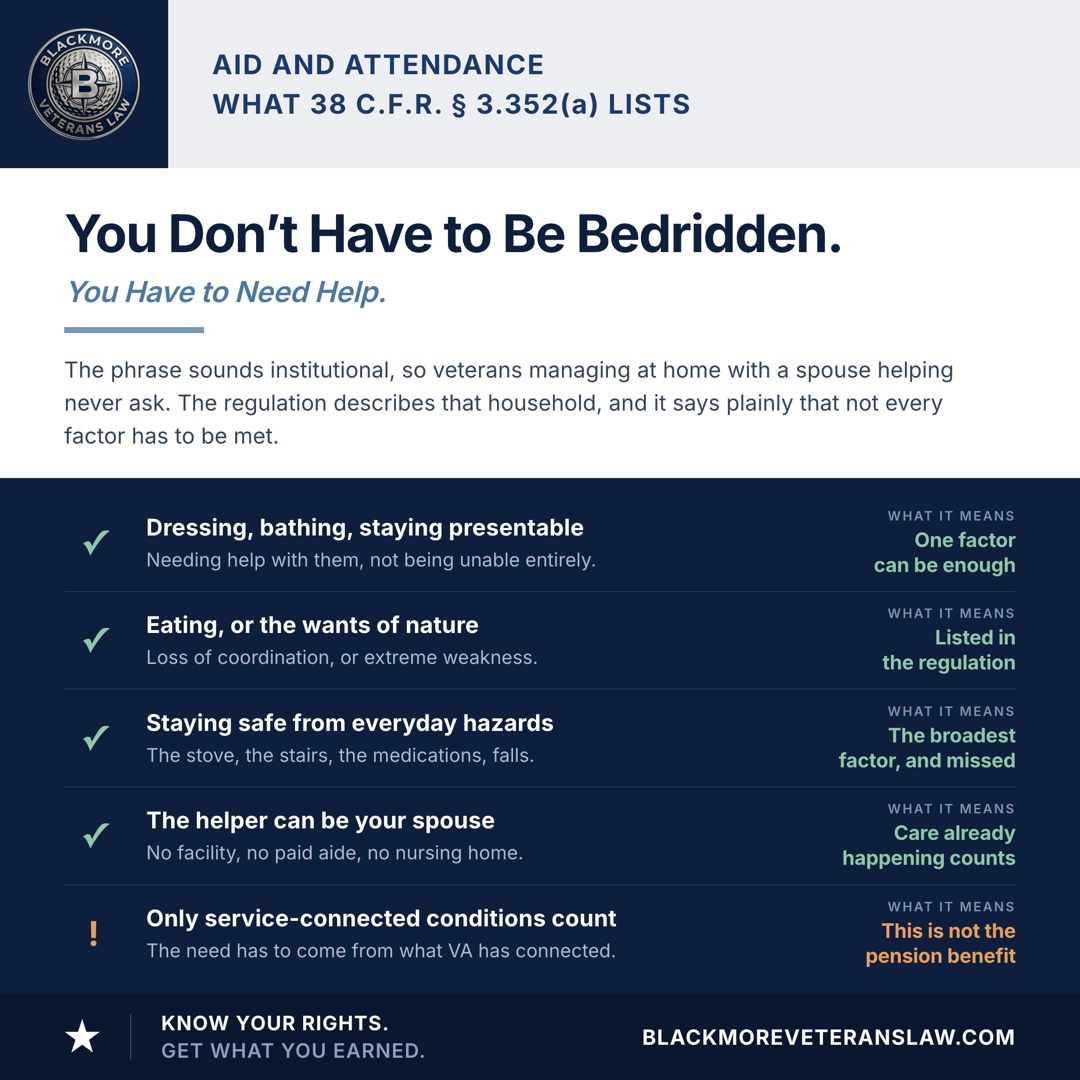
- Inability to dress or undress yourself, or to keep yourself ordinarily clean and presentable.
- Frequent need of adjustment of a prosthetic or orthopedic appliance that, because of the disability, you cannot manage without help.
- Inability to feed yourself through loss of coordination of the upper extremities or through extreme weakness.
- Inability to attend to the wants of nature.
- Physical or mental incapacity requiring care or assistance on a regular basis to protect you from the hazards and dangers of your daily environment.
Read that last one again. It is the broadest factor on the list and the least understood. It reaches a veteran who cannot safely be left alone with a stove, who wanders, who forgets medication, who falls. It is not about limbs. It is about whether the ordinary environment has become dangerous without someone there.
Bedridden is a separate route, and it has a specific meaning: a condition that actually requires you to remain in bed. Choosing to spend the day in bed, or being advised to rest, is not the same thing.
One factor can be enough
This is written into the rule and routinely ignored.
The regulation says it is not required that all of the listed conditions be found to exist. VA is directed to consider the particular functions you cannot perform in connection with your condition as a whole, and to base the determination on your actual requirement of personal assistance from others.
So a decision that denies because a veteran can still feed themselves, while saying nothing about dressing, bathing, or safety, has applied the list as a checklist when the regulation says it is not one.
And regular does not mean constant. Nobody has to be watching you every hour. A veteran who needs help at predictable points through the day meets the standard.
The person helping you can be your spouse
Nothing in the rule requires a paid caregiver, a licensed aide, a facility, or a nursing home.
In most households where this benefit is available, the care is already happening. A spouse who helps with buttons and shoes because the hands do not work anymore. An adult child who comes by to sort the medications. A partner who stopped leaving the house for long because of what happens when they do.
None of those people think of themselves as providing aid and attendance. That is a term from a regulation, not a term from a life. But the regulation is describing what they do.
The limit, stated plainly
For this benefit, the need has to come from service-connected disabilities.
That matters because a veteran can genuinely need daily help, with the need driven mostly by conditions VA has never connected to service, and not qualify here. It is the honest boundary of this post, and it is where a lot of these claims stop.
Which leads to the confusion that costs people the most time.
This is not the pension version
Two different benefits share the phrase, and mixing them up sends people to the wrong form for months.
This one is compensation. It is built on service-connected disabilities. There is no income test and no net worth test.
The pension version is a needs-based benefit with income and net worth limits and wartime service requirements, and the need is assessed on your overall condition rather than only on service-connected conditions.
Which one fits depends on your service, your ratings, and your finances, and they are not interchangeable. If someone has told you that you make too much money for aid and attendance, they were talking about the pension benefit.
The evidence that decides it
The central document is VA Form 21-2680, an examination for housebound status or permanent need for regular aid and attendance, completed by a physician.
A form that says the veteran requires assistance is weak. A form that says which functions require help, how often, and why, is the claim. The difference is the same one that separates adequate from inadequate opinions generally, covered in The Exam Is the Appointment. The Opinion Is What Decides the Claim.
What strengthens it:
- A statement from the person actually providing the care, describing a normal day in specifics. VA Form 21-10210.
- Treatment records documenting falls, wandering, medication errors, weight loss, or hygiene problems.
- Your own statement about what you have stopped being able to do alone, on VA Form 21-4138.
Vague is the enemy here. “Needs help with activities of daily living” is a phrase. “Cannot fasten buttons or tie shoes, requires assistance showering three times a week, has fallen twice in the last year getting out of the tub” is evidence.
What to do with this
- Ask who helps you, and with what. Write down a normal day honestly, including the things you have quietly stopped doing.
- Check whether the need traces to service-connected conditions. That is the boundary for this benefit.
- Take Form 21-2680 to the physician who knows you, and ask them to be specific rather than general.
- Get a statement from whoever provides the care, in their words, describing what they actually do.
- Do not let the phrase talk you out of it. If someone helps you get through the day because of a service-connected condition, this is a conversation to have.
Whether any particular veteran qualifies depends on the evidence, the ratings, and how the file is built. Nobody can tell you your outcome. But this benefit was not written for people in hospital beds. It was written for people who need a hand, and it is sitting unclaimed in a great many houses where somebody is already giving one.
Blackmore Veterans Law, P.C. is a solo practice representing veterans in VA disability claims and appeals. Contact us to discuss your situation.
This article is general information about VA disability law and is not legal advice for any individual case. Reading it does not create an attorney-client relationship. Attorney advertising.