
You separated from the service years ago. You got a separation payment on the way out, paid taxes on it, and spent it on the things people spend it on. Rent, a truck, catching up on bills, getting settled.
Then, sometimes decades later, a letter arrives from the VA. Your disability compensation is being withheld. Not reduced. Withheld. And when you read far enough down, you find out it is because of a check you cashed in 1994.
This is not a mistake, and it is not new. It has been the law since the 1940s. But most veterans have never heard of it until it happens to them, and a senator has now introduced a bill to end it.
What recoupment actually is
Federal law does not let you receive both separation pay and VA disability compensation for the same period of service. When the VA grants you compensation, it has to recover the separation pay you already received before it can start paying you (10 U.S.C. § 1174(h)(2); 38 C.F.R. § 3.700(a)(5)).
It applies broadly. Voluntary separation pay, involuntary separation pay, severance pay, readjustment pay, Special Separation Benefit, and Voluntary Separation Incentive all get recouped. If you took a payment on the way out the door and later got service connected, the VA is going to want it back.
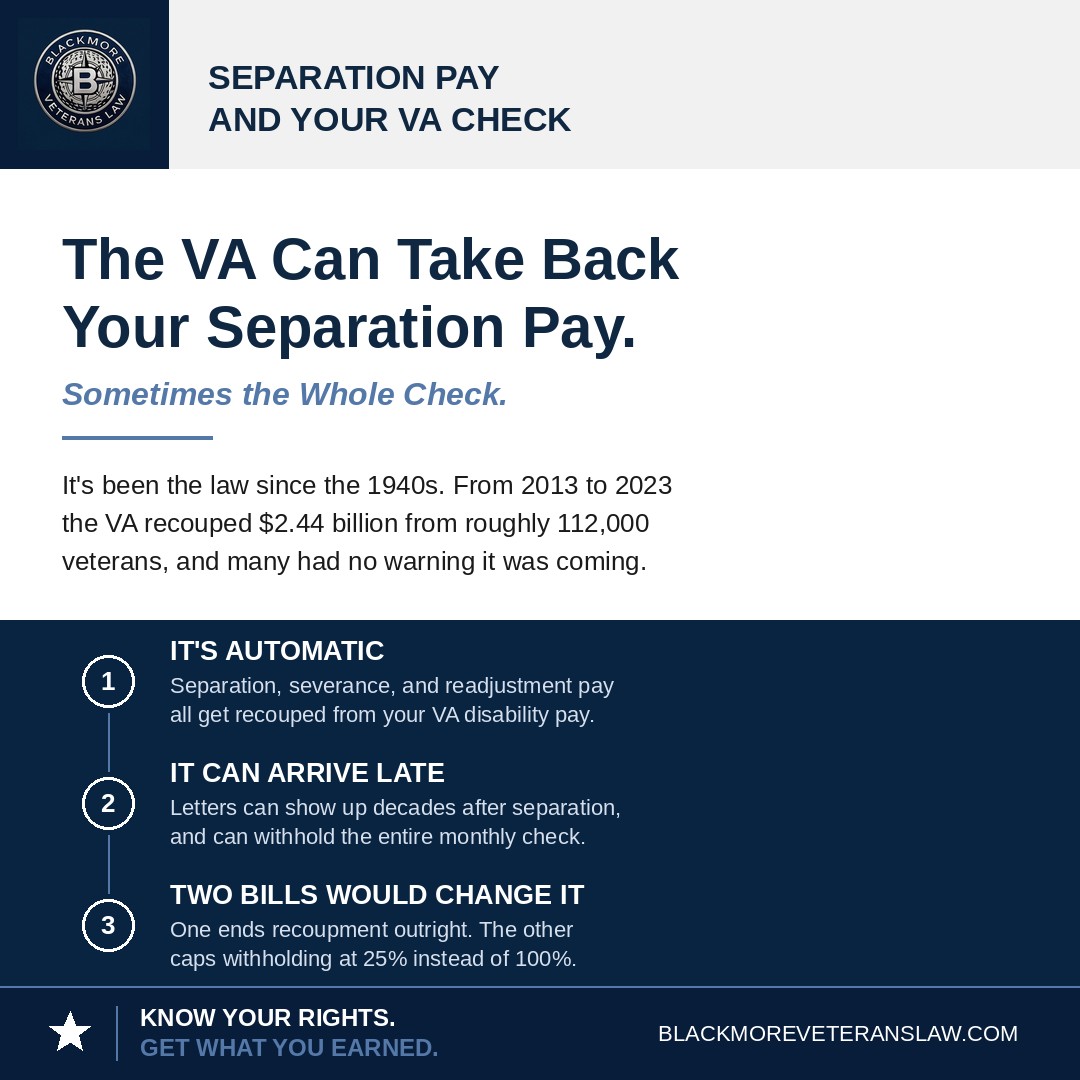
The recovery happens by withholding your monthly disability compensation. The VA is permitted to withhold the entire monthly amount until the balance is satisfied. For a veteran who received $30,000 in separation pay and is rated at 30 percent, that can mean years with no VA check at all.
Why the letters arrive so late
This is the part that catches people, and it is the part that feels the least fair.
Recoupment does not start when you separate. It starts when the VA grants compensation. A veteran who separates in 1990, files a claim in 2023, and gets granted in 2024 will see the recoupment begin in 2024, against a payment made 34 years earlier.
Military Times recently reported on a retired Air Force major in exactly that position. He received $30,000 in separation pay in 1990. In 2024 the VA began withholding his entire monthly disability check. His question was the obvious one: why did it take 34 years for the VA to come up with this?
The Defense Department is required to notify service members that separation pay may later be recouped. In practice, that notice is one paragraph in a stack of separation paperwork signed during one of the busiest weeks of a person’s life. Thirty years later, nobody remembers it.
The numbers are not small. Between 2013 and 2023 the VA recouped roughly $2.44 billion from 112,834 veterans. The peak year was 2018, when 17,066 veterans paid back more than $396 million.
The tax problem nobody mentions
Here is a detail that costs veterans real money.
When you received separation pay, taxes were withheld. You did not get the full amount. But the VA generally recoups the gross figure, the number before taxes came out, not the amount that actually landed in your account.
So a veteran who was awarded $30,000 and received about $22,500 after withholding still owes the VA $30,000. The government keeps the difference twice.
There is a limited exception. For disability severance pay paid on or after January 28, 2008, the VA recoups the after-tax amount rather than the gross. That fix was never applied backward, which is why veterans separated before 2008 are still repaying money they never received.
The carve-out most veterans do not know about
If you received disability severance pay for a condition incurred in a combat zone, or incurred during performance of duty in combat-related operations, and you separated on or after January 28, 2008, that severance pay is not subject to recoupment (10 U.S.C. § 1212(d)(3)).
This carve-out gets missed. It requires the VA to correctly identify both the type of payment and the circumstances under which the underlying disability was incurred, and those two facts live in different places in your file. If you received disability severance pay for a combat-incurred condition and the VA is recouping it, that is worth having someone look at.
Why this is not a normal VA debt
Veterans sometimes ask about requesting a waiver, the way you would for an overpayment. Recoupment generally does not work that way.
An overpayment is money the VA paid you by mistake, and there is a process for asking the VA to forgive it. Recoupment is different in kind. It is an offset built into the statute, a rule that says the VA cannot pay you compensation for a period you were already paid for. Because it is structural rather than an error, the usual waiver route is generally not available.
That is precisely why the fix has to come from Congress, and why the bills below matter more than they might sound like they do.
Two bills that would change it
The Restore Veterans Compensation Act, introduced in August 2026 by Senator Ruben Gallego of Arizona, a Marine and Iraq War veteran, would end separation pay recoupment for disabled veterans outright. It would also let veterans who later qualify for military retirement repay net amounts rather than gross, fixing the tax problem described above, and would lower the recoupment rate against retired pay from 40 percent to 25 percent.
Gallego’s framing of it was blunt. He called it ridiculous to claw back money from a veteran who has put life and limb on the line.
The Veterans Earned Benefits Access Act, introduced by Senator James Risch of Idaho, takes a narrower approach. Rather than ending recoupment, it would cap withholding at 25 percent of the monthly disability check instead of allowing the VA to take all of it.
The practical difference matters. Under the Gallego bill, the money stays with the veteran. Under the Risch bill, the veteran still repays the full amount, but keeps 75 percent of the monthly check while it happens instead of going to zero.
Neither has passed. Both are worth watching, and both are worth calling your senators about if this has happened to you.
What to check in your own case
If you are being recouped, or you have separation pay in your history and a claim pending, there are a few things worth verifying.
What kind of payment was it. Separation pay, severance pay, disability severance pay, and readjustment pay are treated differently under the statutes. The label matters.
Was the underlying condition combat incurred. If it was disability severance pay for a combat-incurred condition and you separated on or after January 28, 2008, it should not be recouped at all.
Is the VA recouping the right amount. Check the figure in the letter against your DD 214 and your separation orders. Gross versus net makes a difference of several thousand dollars, and the VA does not always get the number right.
Has it already been recouped once. Veterans who separated, returned to service, and separated again sometimes see the same payment recouped twice. That is an error, and it is correctable.
What your effective date is. Recoupment is calculated against the compensation you are owed. If your effective date is wrong, the arithmetic behind the withholding is wrong too.
Where to go from here
Recoupment is one of the few areas of VA law where the answer to “is this legal” is usually yes, and the more useful questions are whether the VA calculated it correctly, whether an exception applies, and whether your rating and effective date are right in the first place.
Those questions are answerable. They just require somebody to read the file.
If you got a recoupment letter and it does not add up, or you have separation pay in your past and a claim in progress, it is worth a second set of eyes before the withholding starts.
Blackmore Veterans Law, P.C. is a solo practice representing veterans in VA disability claims and appeals. This article is general information about how the VA claims process works. It is not legal advice about any individual claim, and reading it does not create an attorney-client relationship. Attorney advertising.