
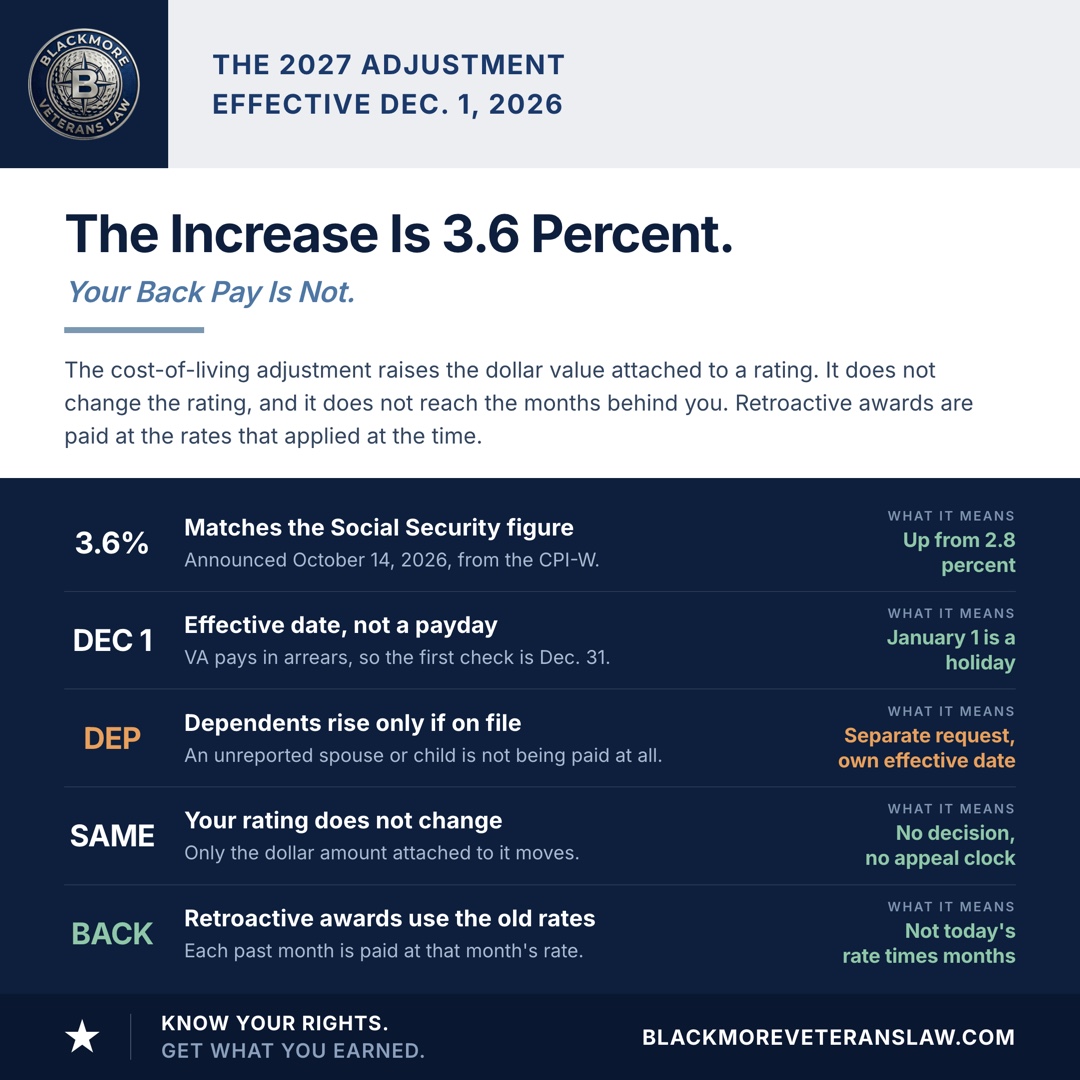
The Social Security Administration announced a 3.6 percent cost-of-living adjustment on October 14, 2026. VA disability compensation has historically moved by the same percentage, which is why every veterans website published a 2027 rate chart within about a day.
What the adjustment does is narrower than most of that coverage suggests, and one piece of it runs the opposite direction from what veterans expect.
Where the number comes from
The adjustment is not a VA calculation. It is tied to the Social Security figure, which comes from the change in the Consumer Price Index for Urban Wage Earners and Clerical Workers between the third quarter of one year and the third quarter of the next, rounded to the nearest tenth of a percent.
For 2027 that produced 3.6 percent, up from the 2.8 percent adjustment that took effect in December 2025.
Applied to the current rates, the arithmetic is straightforward. A veteran rated 10 percent with no dependents receives $180.42 a month now, so a 3.6 percent increase is about $6.50. At 70 percent with no dependents the current rate is $1,808.45, and the increase is roughly $65. At 100 percent with no dependents the current rate is $3,938.58, and the increase is roughly $142.
Those are estimates calculated from the announced percentage. VA publishes the official rate tables, and those figures govern.
December 1 is not a payday
The effective date is December 1, 2026. That is not the date money arrives.
VA pays compensation monthly and in arrears, so the payment for a given month issues at the beginning of the next one. The first payment at the new rate is the payment for December 2026, which would normally issue on January 1. January 1, 2027 is a federal holiday, so that payment is scheduled to issue on Thursday, December 31, 2026.
A veteran who checks a deposit in early December and sees the old amount has not been shorted. That deposit is the November payment.
Back pay is calculated at the old rates
This is the part that reverses most people’s assumption.
When VA grants a claim with a retroactive effective date, it does not pay the award at today’s rate. It calculates the award month by month, applying the rate that was in effect during each of those months.
An award running back to March 2019 is paid at 2019 rates for the 2019 months, 2020 rates for 2020, and forward through each adjustment. The current rate applies only to the current months.
Veterans routinely estimate a retroactive award by taking the monthly rate they see today and multiplying it by the number of months owed. That number always comes out too high, and the gap grows the further back the effective date reaches, because every intervening COLA is one the earlier months never received.
The same applies in the other direction when a rating changes partway through the period. A claim granted at 30 percent from 2018 and increased to 70 percent from 2022 is paid at the 30 percent rates for the earlier stretch and the 70 percent rates for the later one, each at the rate schedule in force at the time.
None of this reduces what you are entitled to. It means the arithmetic is more involved than a single multiplication, and an estimate built on today’s rate is not the figure to plan around.
A COLA is not a rating action
An adjustment changes the dollar value attached to a rating. It does not touch the rating.
That sounds obvious, and it still causes confusion, because the deposit changes and a change in payment is the thing most veterans associate with a decision having been made. Nothing has been decided.
A COLA does not reduce a rating, does not increase one, and is not a proposal to do either. It does not restart an appeal window or create a new decision to appeal. It has no effect on the 5, 10, and 20 year protections, which run from the date a rating was assigned and are untouched by the yearly adjustment.
If your payment changes by an amount that does not match the adjustment, that is a different event, and the notice letter explaining it is the document to read. An unexplained change in payment, especially a decrease, is not a COLA.
Dependents only count if VA knows about them
The additional amounts for a spouse, dependent children, and dependent parents rise by the same percentage. They rise only for dependents already in VA’s records.
A veteran rated 30 percent or higher is eligible for additional compensation for dependents, and veterans who married, had a child, or took on care of a dependent parent without reporting it to VA are not receiving that amount at all. The adjustment increases a figure that is not being paid.
Reporting a dependent is a separate request with its own effective date rules, and how far back the additional amount is paid depends on when the dependency was reported relative to when it arose. If there is a dependent VA does not know about, that is the thing to address, and it is not fixed by waiting for December.
What to actually do with this
Check that your dependents are current in VA’s records. That is the item on this list most likely to put real money in your account, and it is entirely within your control.
If you are waiting on a decision with a retroactive effective date, build your expectation from the historical rate schedules rather than the 2027 figure. The award will be calculated against the rates for each past month.
If your payment changes by something other than the announced percentage, read the letter. A COLA arrives without a decision attached. Anything else did not.
And treat October rate charts, including the estimates above, as projections until VA publishes the tables.
How we can help
Questions about retroactive awards and effective dates come down to the record and the rate schedules that applied across the period, and the calculation is rarely a single step. If you have received a decision with a retroactive award and the amount does not match what you expected, or you are trying to understand what a past-due award should look like, contact Blackmore Veterans Law, P.C. to discuss your situation.
Related reading: understanding VA disability ratings, the 5, 10, and 20 year rules, and what TDIU is and how it works.