
Most people read a rating decision for one thing, the percentage. Two other parts of the letter get skipped.
One is the list of issues VA deferred. That tells you what is still open. The other is the list of favorable findings. That tells you what VA has already settled in your favor and cannot easily reverse.
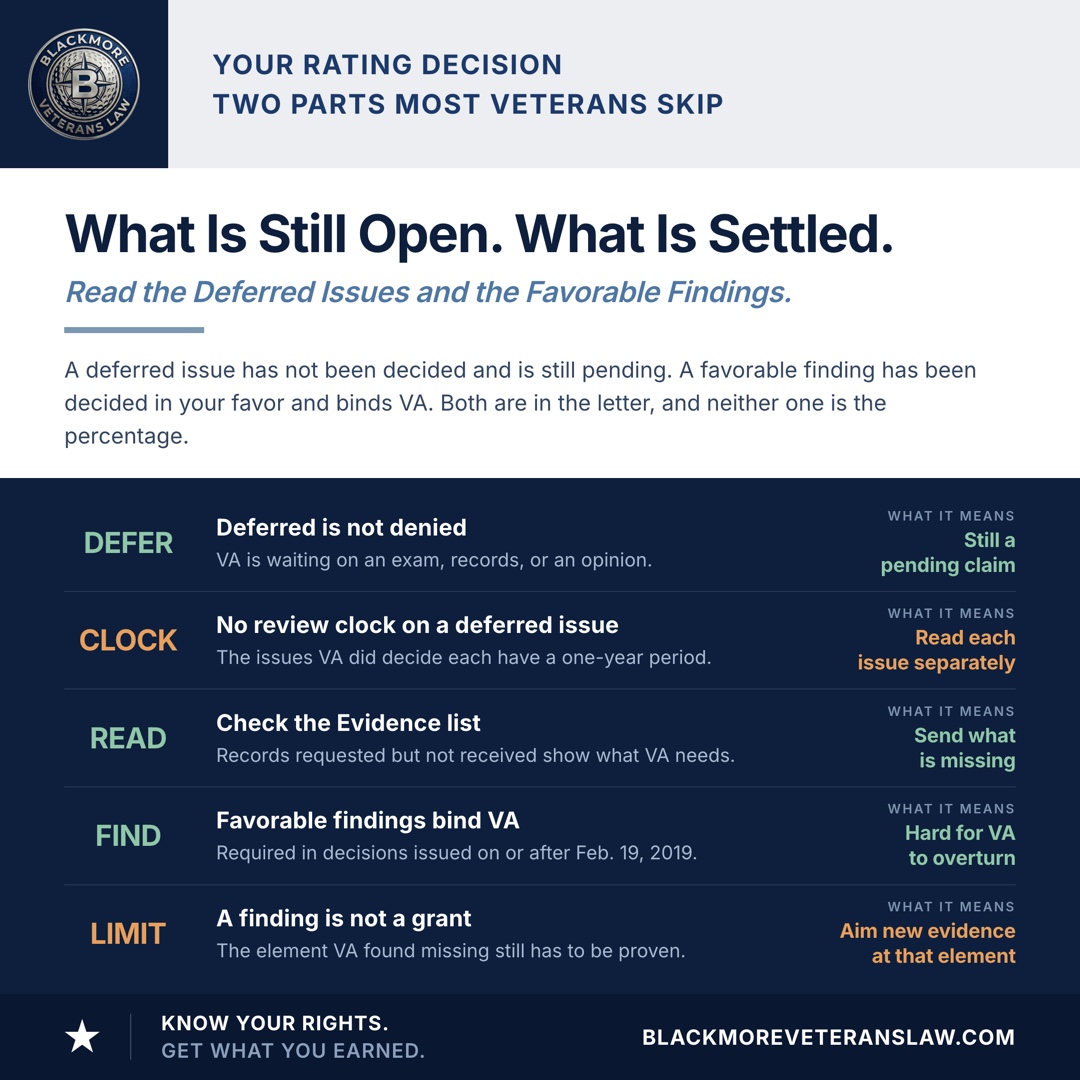
What “deferred” means
A deferred issue is one VA has not decided. It is not a grant and it is not a denial.
VA’s adjudication manual defines a partial rating decision as one that decides some issues of a claim and defers a decision on at least one other, pending additional development. It tells raters to defer an issue when the claim is underdeveloped or incomplete and the right outcome depends on a development action that has not finished.
In practice that is an exam VA ordered and has not received, records it requested and is still waiting for, or a medical opinion it is not ready to rely on. The manual says development is appropriate when more evidence would give a more complete picture of the question, or when the evidence on file is questionable or conflicting. It also says raters may not develop a claim for the purpose of building a denial.
The order inside the letter is awards first, denials second, and deferred issues last. The deferred issue is usually the final item in the Decision section, below the part most people stopped reading.
A deferred issue is still a pending claim
38 C.F.R. § 3.160 defines a pending claim as one that has not been finally adjudicated. A claim is finally adjudicated when VA has allowed or disallowed it and the time to seek review has run. A deferral is neither, so the issue stays pending.
Two things follow.
The effective date does not move. For direct service connection, the effective date is generally the date VA received the claim or the date entitlement arose, whichever is later, with a different rule when the claim comes within a year of separation. That is 38 C.F.R. § 3.400. A deferral does not reset it. An award that follows is generally measured from the original filing, not from the day the deferral ended.
No review clock runs on the deferred issue. The one-year period to choose a review option runs from notice of a decision on a claim or issue, under 38 C.F.R. § 3.2500. VA has decided nothing on the deferred issue, so there is nothing on it to seek review of yet. When VA decides it, that decision comes with its own notice and its own review options.
The issues VA did decide in the same letter are different. Their one-year periods run from the date of the notice. A partial rating decision is two things at once: issues that are finished unless you act, and an issue that is still open. Read them separately.
A deferral is written down
A deferred issue appears in the letter. The decision names the issue and says VA has not decided it.
A claim that is never mentioned at all is a different situation, and it is covered in unadjudicated claims. If something you filed does not appear anywhere in the decision, not as an award, a denial, or a deferral, that is the item to look into.
What to do with a deferred issue
Find out what the deferral is waiting on. The decision’s Evidence section lists what VA considered, and VA’s manual gives a set format for evidence it asked for and never got: records requested from a named provider but not received. A line like that tells you exactly what the deferral is stuck on.
If it is an exam, attend it. If it is records, send them yourself instead of waiting for VA to obtain them. If it is a medical opinion, ask what VA found inadequate.
Neither the regulations nor the manual section on partial rating decisions sets a calendar deadline for resolving a deferral. The manual does say suspense dates must correspond to specific actions and may not be arbitrarily extended. A deferred issue with no action behind it for months should be asked about.
There is no need to refile an issue that is already pending.
What a favorable finding is
A favorable finding is a conclusion VA reached in your favor, either on a question of fact or on how the law applies to the facts. Typical ones are a current diagnosis, an in-service injury or event, or service in a qualifying location.
38 U.S.C. § 5104(b)(4) requires the decision notice to identify findings favorable to the claimant, and 38 C.F.R. § 3.103(f)(4) repeats it. The requirement applies to decisions issued on or after February 19, 2019.
In a grant, the decision states that every element was met. In a denial, VA’s manual says each favorable finding is entered individually and must be specific enough that you can tell what evidence supported it.
That means a denial can contain a section that reads like a partial win. The diagnosis is accepted, the in-service event is accepted, and what is missing is the link between them.
Favorable findings bind VA
38 U.S.C. § 5104A makes a favorable finding binding on all later adjudicators within the Department unless clear and convincing evidence is shown to the contrary.
The regulation sets a higher bar. 38 C.F.R. § 3.104(c) says the finding binds later adjudicators at the regional office and the Board unless rebutted by evidence that identifies a clear and unmistakable error in the finding. In the rulemaking (84 Fed. Reg. 138), VA said that nothing in the statute prevented it from adopting a higher standard and that it did so as a matter of policy, to protect favorable findings.
VA’s manual adds that the standard can be met when the record as a whole completely lacks any plausible support for the finding. That is a high bar.
For the next round, the practical effect is this. A supplemental claim, which can be filed at any time after notice of a decision and needs new and relevant evidence, does not have to re-prove what VA already found. The new evidence goes to the element VA said was missing. Filing within one year of the decision keeps the effective date from the original claim. The review options are covered in how to appeal a VA denial.
The limits
A favorable finding is not a grant. The denial stands until the missing element is proven.
Only what VA wrote down counts. A fact VA seemed to accept without stating it is not a finding.
The listing requirement applies to decisions issued on or after February 19, 2019. A decision from before that date is not required to contain favorable findings.
A finding covers the issue under review, and it is only as broad as its wording. Read each one for what it actually says.
The two topics meet in one place. VA’s manual requires favorable findings for each decided issue. A deferred issue has not been decided, so do not expect findings under it.
What to do with this
Read the Decision section to the end, and mark each issue as granted, denied, or deferred.
Under each deferred issue, find what VA is waiting on. Check the Evidence section for records requested but not received.
Under each denial, copy the favorable findings word for word. They tell you which elements are settled and which are not.
Put the date of the notice on your calendar for every issue VA decided. Each one has a one-year review period.
How we can help
Working out what a deferral is waiting on, or what a denial’s favorable findings leave you to prove, takes the whole letter and the claims file. If your decision has a deferred issue or a denial with favorable findings and you are unsure what comes next, contact Blackmore Veterans Law, P.C. to discuss your situation.
Related reading: how to appeal a VA denial, unadjudicated claims, and why you shouldn’t skip your C&P exam.