
Tinnitus is the most frequently claimed disability in the VA system. It also pays less than almost anything else in the rating schedule, and the number does not move.
Ten percent. That is the entire range.
Every few months a wave of posts announces that VA is taking it away. There is a real proposal behind that, it says something narrower than the posts suggest, and it has been sitting unfinished for more than four years.
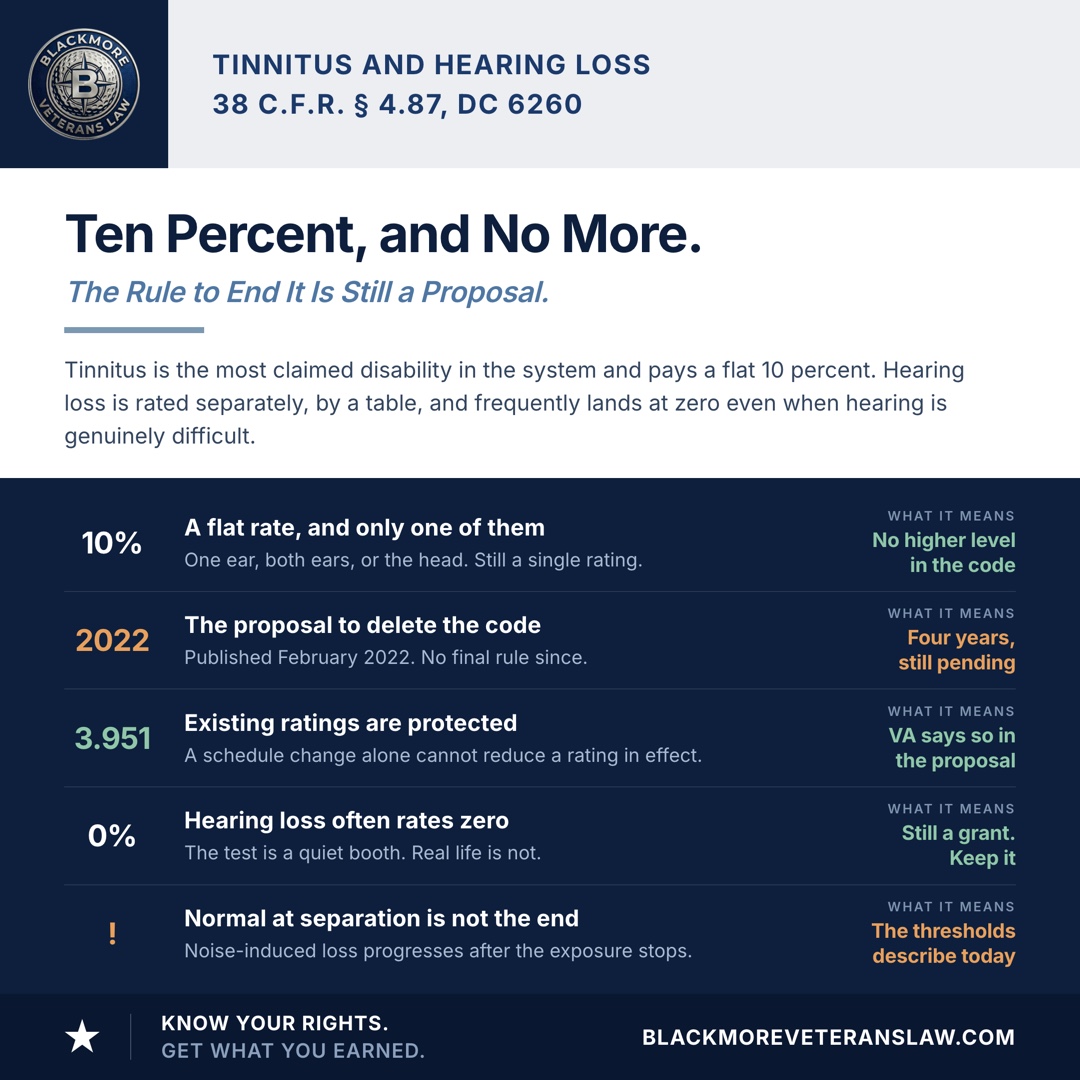
What the code actually pays
38 C.F.R. § 4.87, Diagnostic Code 6260, covers recurrent tinnitus and assigns 10 percent. There is no 20, no 30, and no path upward within the code.
The regulation also forecloses the most common assumption about it. Note (2) directs that only a single evaluation be assigned for recurrent tinnitus, whether the sound is perceived in one ear, in both ears, or in the head. Bilateral tinnitus is not two ratings.
What the 10 percent is good for is combination. It combines with hearing loss and with everything else in the file, and in a combined rating sitting near a rounding boundary, 10 percent is occasionally the step that moves the total. That is the practical value of the code, not the payment itself.
The proposed rule, and what it says
VA published a proposed rule on February 15, 2022 that would delete Diagnostic Code 6260 entirely and evaluate tinnitus only as part of the underlying pathology causing it, through the codes for hearing loss, Meniere’s disease, traumatic brain injury, and related conditions.
For tinnitus accompanying service-connected hearing loss, the proposal would permit a 10 percent evaluation only where the hearing loss is noncompensable. Where hearing loss already warrants 10 percent or more, no separate 10 percent for tinnitus would be added, on the reasoning that the hearing loss evaluation already accounts for it.
Two things about that proposal get lost in the coverage.
The first is that it remains a proposal. It was published in February 2022 and no final rule has followed. More than four years of rulemaking have produced no change to the code, and until a final rule is published, Diagnostic Code 6260 reads exactly as it reads today.
The second is what VA said about veterans already rated. The proposal states directly that it would have no impact on veterans currently in receipt of service connection for tinnitus under Diagnostic Code 6260, and cites 38 C.F.R. § 3.951(a) as the reason. That regulation provides that a readjustment to the rating schedule is not grounds for reducing a rating in effect on the date of the readjustment unless medical evidence establishes that the disability has actually improved.
A change to the schedule, by itself, does not reach a rating already assigned. That is VA’s own position in its own proposal, not an optimistic reading of it.
Hearing loss is a different rating, and a mechanical one
Tinnitus and hearing loss are claimed together constantly and rated nothing alike.
Hearing loss is measured before it is evaluated. 38 C.F.R. § 3.385 sets when hearing impairment counts as a disability for VA purposes: an auditory threshold of 40 decibels or greater at 500, 1000, 2000, 3000, or 4000 Hertz; or thresholds of 26 decibels or greater at three of those frequencies; or a Maryland CNC speech recognition score below 94 percent.
Once it qualifies, 38 C.F.R. § 4.85 runs the evaluation. A state-licensed audiologist performs puretone audiometry and the Maryland CNC test. The puretone threshold average is the average of the thresholds at 1000, 2000, 3000, and 4000 Hertz. That average and the speech discrimination score are crossed in a table to produce a Roman numeral for each ear, and the two numerals are crossed in a second table to produce the percentage.
The examination is conducted without hearing aids. The point is to measure the underlying loss, not the corrected result.
Why hearing loss so often comes out at 0 percent
Veterans who plainly cannot follow a conversation in a restaurant receive 0 percent evaluations regularly, and the reason is structural rather than unfair adjudication.
The tables are built around speech discrimination measured in a quiet booth, with a single speaker, at a controlled volume, and no competing noise. That is close to the easiest listening environment a person will ever be in, and it is not where hearing loss causes problems. The difficulty most veterans describe is understanding speech with background noise present, which the test does not reproduce and the tables do not capture.
So the evaluation can be 0 percent while the disability is real. That is a limitation of the measurement, and it is not something a better-written personal statement will change, because the numerals come from the audiogram.
A 0 percent evaluation is still a grant. The condition is service connected, which is the part that is difficult to obtain and easy to lose by walking away. If hearing continues to deteriorate, an increase is filed against an established service-connected condition rather than starting over. It also supports claiming conditions secondary to it.
A normal audiogram at separation does not end the claim
This is where correct information matters most, because the denial language sounds final and usually is not.
The thresholds in § 3.385 describe when hearing impairment amounts to a current disability. They do not impose a requirement that the loss have been present and measurable at discharge. Where a veteran has current hearing loss meeting those thresholds, and the evidence supports that it resulted from in-service noise exposure, service connection is not barred because the separation audiogram was within normal limits.
Noise-induced hearing loss frequently progresses after the exposure ends, and the service treatment records of people who worked around aircraft, armor, artillery, and small arms often show either normal findings or no audiogram at all.
What tends to carry these claims is the exposure itself and its documentation: the military occupational specialty, the duty assignments, the equipment, and a consistent account of when the difficulty began. A shift in thresholds across the service period, even one staying inside normal limits, is also meaningful evidence.
What to do with this
If you have ringing you have never claimed, claim it. It is 10 percent, it is a single evaluation, and the rule removing it has not been adopted.
If you already have the 10 percent, the coverage announcing its removal does not describe your rating. VA said so in the proposal.
If hearing loss came back at 0 percent, that is a grant and not a denial. Keep it, and file for an increase when the audiogram supports one.
If a hearing loss claim was denied because the separation examination was normal, that reason alone does not settle the question, and it is a decision to look at again.
How we can help
Hearing claims turn on exposure evidence and on audiometric results that are easy to misread, and a denial resting on a normal separation audiogram is a common reason that does not always hold up. If you have been denied service connection for hearing loss or tinnitus, or received an evaluation that does not reflect your hearing, contact Blackmore Veterans Law, P.C. to discuss your situation.
Related reading: understanding VA disability ratings, pyramiding and why two ratings for one problem get denied, and what happens when your rating seems too low.