
Your VA rating tells a story. The question is whether it’s telling the whole story.
Many veterans receive ratings that fall short of what the evidence and the law actually support. It’s not always because the VA is acting in bad faith. Often it comes down to incomplete records, missed conditions, or a rushed examination that didn’t capture how your disability truly affects your daily life. Understanding where ratings go wrong is the first step toward getting them right.
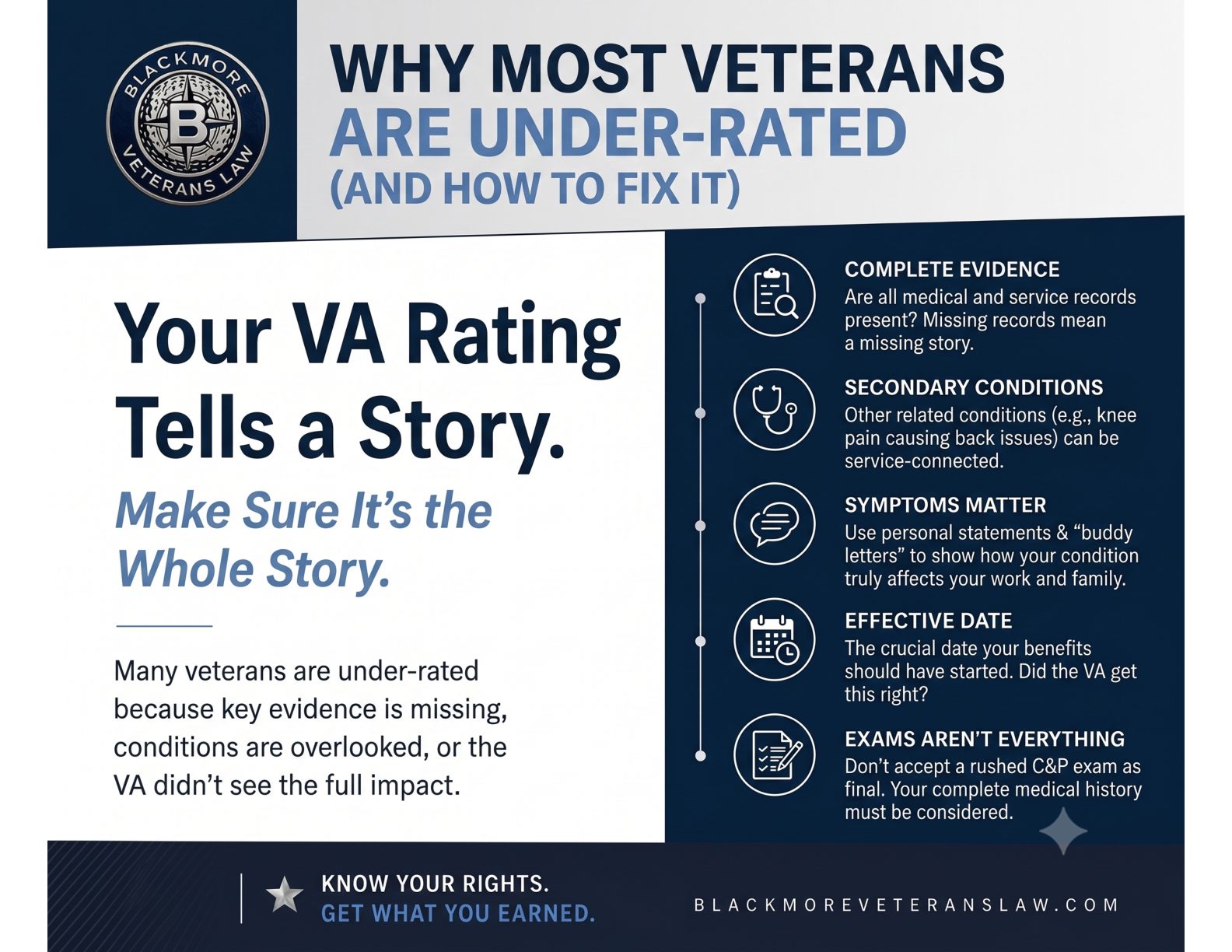
Here are the five most common reasons veterans end up under-rated, and what you can do about each one.
1. The Evidence Record Is Incomplete
The VA rates what it can see. If your medical records, service treatment records, or deployment history are incomplete, the picture the VA sees will be incomplete too, and an incomplete picture produces a lower rating.
Missing records are more common than most veterans realize. Service treatment records from certain eras are fragmented. Private medical records from before or after service are often never obtained. Records from military specialty units or joint task forces can be difficult to track down.
Before accepting any rating, ask yourself: does the VA have all of my relevant medical records? That includes private treating physicians, VA medical facilities outside your region, and any hospitalization records from your time on active duty.
If you filed a claim and the VA says it couldn’t locate certain records, that gap may be grounds to reopen the claim with new evidence.
2. Secondary Conditions Are Overlooked
A service-connected condition doesn’t exist in isolation. The VA is required to rate secondary conditions: conditions that are caused by, or aggravated by, an already service-connected disability. In practice, these secondary connections are frequently missed.
A common example: a veteran with a service-connected knee injury develops a gait abnormality that, over time, causes a lumbar spine condition. The knee is rated; the back is ignored. But under 38 CFR § 3.310, the VA is required to consider and rate that back condition as secondary to the knee.
Other frequent secondary relationships include:
- Sleep apnea secondary to PTSD
- Hypertension secondary to chronic pain conditions
- Depression or anxiety secondary to physical disabilities that limit activity and independence
- Peripheral neuropathy secondary to diabetes
If you have a service-connected condition and have developed other health problems over the years, it’s worth having an attorney or accredited claims agent evaluate whether a secondary service connection claim is warranted.
3. Your Symptoms Weren’t Fully Documented
The VA rating schedule assigns percentages based on the severity of your symptoms. That means what matters isn’t just the diagnosis. It’s how bad the condition is, and how much it limits your ability to function at work, at home, and in your relationships.
A C&P examiner who spends fifteen minutes reviewing your file and conducting a brief physical examination may not capture the full picture. That’s where personal statements and lay witness letters, sometimes called “buddy letters,” become critical.
Your personal statement (submitted on VA Form 21-4138 or through a written statement in support of claim) should describe in plain language how your condition affects you day to day. How often do you have flare-ups? What activities can you no longer do? How has the condition changed over time? Has it affected your ability to work, drive, sleep, or care for your family?
Lay witness letters from spouses, family members, close friends, or former coworkers can provide powerful independent corroboration of your symptoms. The VA is required to consider this evidence. A letter from your spouse describing how your PTSD has changed your behavior at home, or from a former supervisor explaining how your back condition affected your work performance, can directly influence the outcome of a rating decision.
These statements cost nothing and can make a significant difference. If you haven’t submitted them, it’s not too late.
4. The Effective Date Was Set Incorrectly
Your effective date is the date from which the VA owes you benefits. Getting the effective date right isn’t a technicality. It can mean years of back pay.
The general rule is that the effective date is the date the VA receives your claim, or the date you became entitled to benefits, whichever is later. But there are important exceptions:
- If you filed within one year of discharge from active duty, the effective date can go back to the day after your discharge
- If you filed a claim and the VA lost or misdirected it, you may be entitled to an earlier date based on your informal claim
- Intent to file a claim, even an informal one, can lock in an earlier effective date while you gather evidence
Effective date errors are some of the most consequential errors the VA makes, and they are also some of the hardest to spot without legal training. If the VA assigned your claim an effective date later than the date you first communicated an intent to file, that may be a legal error worth challenging.
5. A Rushed C&P Exam Doesn’t Have to Be Final
The Compensation and Pension exam is one of the most important events in your claim, and one of the most misunderstood. Many veterans believe the C&P examiner’s opinion is final. It isn’t.
C&P exams are often brief, sometimes as short as fifteen to twenty minutes. The examiner may not have reviewed your full medical history. The report may contain factual errors, or the examiner may have applied the wrong diagnostic criteria. In some cases, the examiner may not be a specialist in the condition being evaluated.
If the C&P exam report is inadequate (meaning it lacks a thorough review of your history, contains errors, or doesn’t address the relevant diagnostic criteria), you have the right to challenge it. Options include:
Requesting a new C&P exam. If new evidence undermines the existing exam, the VA is required to schedule a new one.
Obtaining a private medical opinion. A treating physician or independent medical expert can prepare a detailed Disability Benefits Questionnaire (DBQ) or nexus letter that directly addresses the questions the C&P exam failed to answer. A thorough, well-supported private medical opinion can overcome a deficient VA exam.
Challenging the exam’s adequacy at the BVA. If your case reaches the Board of Veterans’ Appeals, an experienced attorney can argue that the C&P exam was inadequate and request that the Board order a new one.
Don’t treat a flawed exam as the last word. The law gives you tools to push back.
What to Do Next
If any of the five issues above sound familiar, the right move is to have your claim reviewed by someone who knows how the VA rating system works. As a former BVA Attorney, I have reviewed hundreds of VA rating decisions and seen these errors up close.
A free consultation won’t cost you anything. If there’s a problem with your rating, I’ll tell you what it is and what your options are. If there isn’t, I’ll tell you that too.
Your VA rating tells a story. Make sure it’s telling the whole story.
Bryan R. Blackmore is a veterans law attorney, VA-accredited attorney, and former Attorney at the Board of Veterans’ Appeals. He served 24 years in the U.S. Coast Guard, including a deployment to Baghdad during Operation Iraqi Freedom. Mr. Blackmore is licensed in California and Virginia and represents veterans nationwide through Blackmore Veterans Law, P.C.