
A claim date is fixed by when VA receives the filing, and a claim that takes months to assemble can lose months of back pay while it is being assembled.
The intent to file exists to close that gap. It is one of the simplest tools in the system, and it has more rules than its one-page form suggests.
What it does
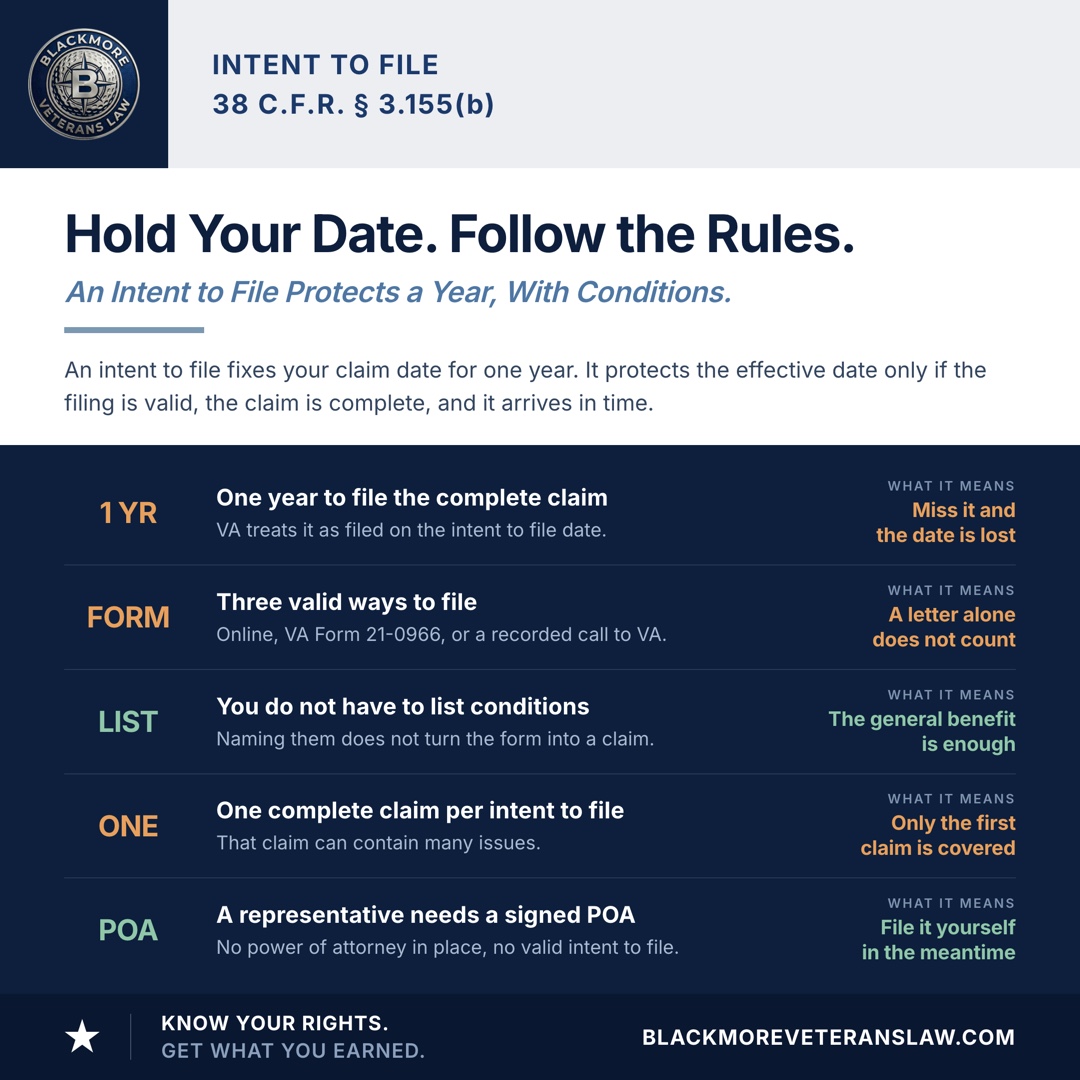
38 C.F.R. § 3.155(b) says that if VA receives a complete application within one year of receiving your intent to file, VA considers the complete claim filed as of the date the intent to file was received.
That matters because of how effective dates work. For disability compensation, the effective date is generally the date VA received the claim or the date entitlement arose, whichever is later, with a different rule for claims filed within a year of separation. That is 38 C.F.R. § 3.400. The intent to file fixes the first of those two dates. It does not move the second.
So it protects the gap between deciding to file and finishing the file. It does not create back pay for a period before your entitlement began. How it interacts with increased rating claims is covered in the one-year lookback.
The process has existed since March 24, 2015, when VA’s standard claims forms rule took effect. Before that, a letter or other communication could itself be an informal claim. It no longer can. A complete claim on the prescribed form is required, and the intent to file is what holds the date in the meantime.
Three valid ways to file one
38 C.F.R. § 3.155(b)(1) allows exactly three.
A saved online application, § 3.155(b)(1)(i). When you start an application in VA’s online claims system and save it before filing the complete claim, VA treats that as an intent to file.
A signed and dated VA Form 21-0966, § 3.155(b)(1)(ii). This is the prescribed intent to file form. It can be submitted online, by mail, or in person.
An oral statement to designated VA personnel, § 3.155(b)(1)(iii). The statement must go to a VA employee designated to receive it, who verifies identity and documents the date VA received it in your records, following 38 C.F.R. § 3.217(b).
A letter that says you intend to file is not one of the three. Neither is a message to a clinic or a conversation with someone at a VA facility who is not designated to take it. Under § 3.155(b)(4), an intent to file that is not submitted in one of these ways is not acted on, though VA treats a communication like that as a request for an application form under § 3.155(a). That request carries no date protection.
What goes on it, and what does not
An intent to file must give enough identifying information to identify you, and it must identify the general benefit: compensation, pension, or survivors’ benefits. It does not need to identify the specific benefit or any condition.
If you list conditions anyway, the regulation says the information has no effect except that it is added to the file as evidence. Naming a condition does not convert the form into a claim.
Each benefit type needs its own. VA states that a pension intent to file does not cover a disability compensation claim, and the regulation does not recognize more than one intent to file at the same time for the same benefit.
The one-year deadline
The complete claim has to be received within one year. A complete claim, under 38 C.F.R. § 3.160(a), is an application on the prescribed form that is signed, identifies the benefit sought, gives the claimant’s identifying and service information, and describes the conditions to the extent the form requires.
If the year passes with no complete claim, VA takes no further action unless it receives a new claim or a new intent to file. The old date is gone.
Refiling inside the year does not extend it. If an intent to file has not been followed by a complete claim, a second one for the same benefit received within a year of the first has no effect, under § 3.155(b)(6). The original date and deadline stand.
Example. You file an intent to file in March and file the complete claim eleven months later. VA treats the claim as filed in March. If you file the complete claim thirteen months later, the March date does not apply, and the claim’s own receipt date governs.
One intent to file covers one complete claim
This is the rule most likely to be missed. Under § 3.155(d)(1)(ii), only one complete claim for a benefit may be associated with each intent to file, though that claim can contain multiple issues. If several complete claims for the same benefit are filed within the year, only the first is tied to the intent to file.
VA’s own guidance says the same thing from the other direction: you can have one active intent to file at a time, and once you file your completed claim, it is no longer active.
If you plan more than one claim, the regulation has a path. When an intent to file has been followed by a complete claim, it recognizes a later intent to file for the same benefit, received within a year of the previous one, to set the date for the next complete claim. In practice that means filing a fresh one as soon as the first claim goes in.
Representatives and the power of attorney
An intent to file from a service organization, attorney, or agent may not be accepted if a power of attorney was not executed at the time the communication was written. An oral intent to file from a representative is accepted only if a power of attorney is of record when the call is received.
A representative cannot hold your date before the appointment is signed. If you are deciding whether to hire someone, do not wait on that decision to protect the date. File the intent to file yourself in the meantime.
Where it does not apply
The regulation states that the intent to file provision does not apply to supplemental claims. Review of a decision runs on a different set of rules.
A supplemental claim, a request for higher-level review, or an appeal to the Board has its own one-year period under 38 C.F.R. § 3.2500, running from the notice of the decision. A supplemental claim that arrives incomplete gets a 60-day window to be completed. Those options are covered in how to appeal a VA denial.
The limits
An intent to file protects a date. It does not make a claim stronger, and it does not shorten the work of assembling evidence.
It does not reach back before entitlement. The effective date is still the later of the claim date and the date entitlement arose.
The year is strict, and the form has to be one of the three valid kinds, received by VA.
A complete claim still has to be complete. An application that is unsigned or does not identify the benefit does not meet § 3.160(a).
What to do with this
If you plan to file and the evidence is not ready, file the intent to file first. Do it online, on VA Form 21-0966, or by speaking with a VA employee who is designated to take it.
Keep the confirmation and write down the date.
Put the one-year deadline on a calendar and file the complete claim before it.
Check that the benefit type matches what you are claiming.
If you plan to file a second claim after the first, file a new intent to file once the first claim is in.
Do not rely on a letter, a clinic message, or a representative whose power of attorney is not yet signed.
How we can help
Whether an effective date can still be protected, or was lost, depends on what VA received and when. If you are unsure whether a filing counted as an intent to file, or what date VA used on your claim, contact Blackmore Veterans Law, P.C. to discuss your situation.
Related reading: the one-year lookback, found service records and effective dates, and how to appeal a VA denial.