
A veteran gets a decision that says there is no evidence of something, and they know with certainty that the evidence exists, because they have seen it. It is in the file. They submitted it, or VA obtained it, and there it sits.
The usual explanation offered is that the examiner disagreed, or that the evidence was outweighed.
Often the explanation is simpler and worse. The examiner never saw it.
Who is actually examining you
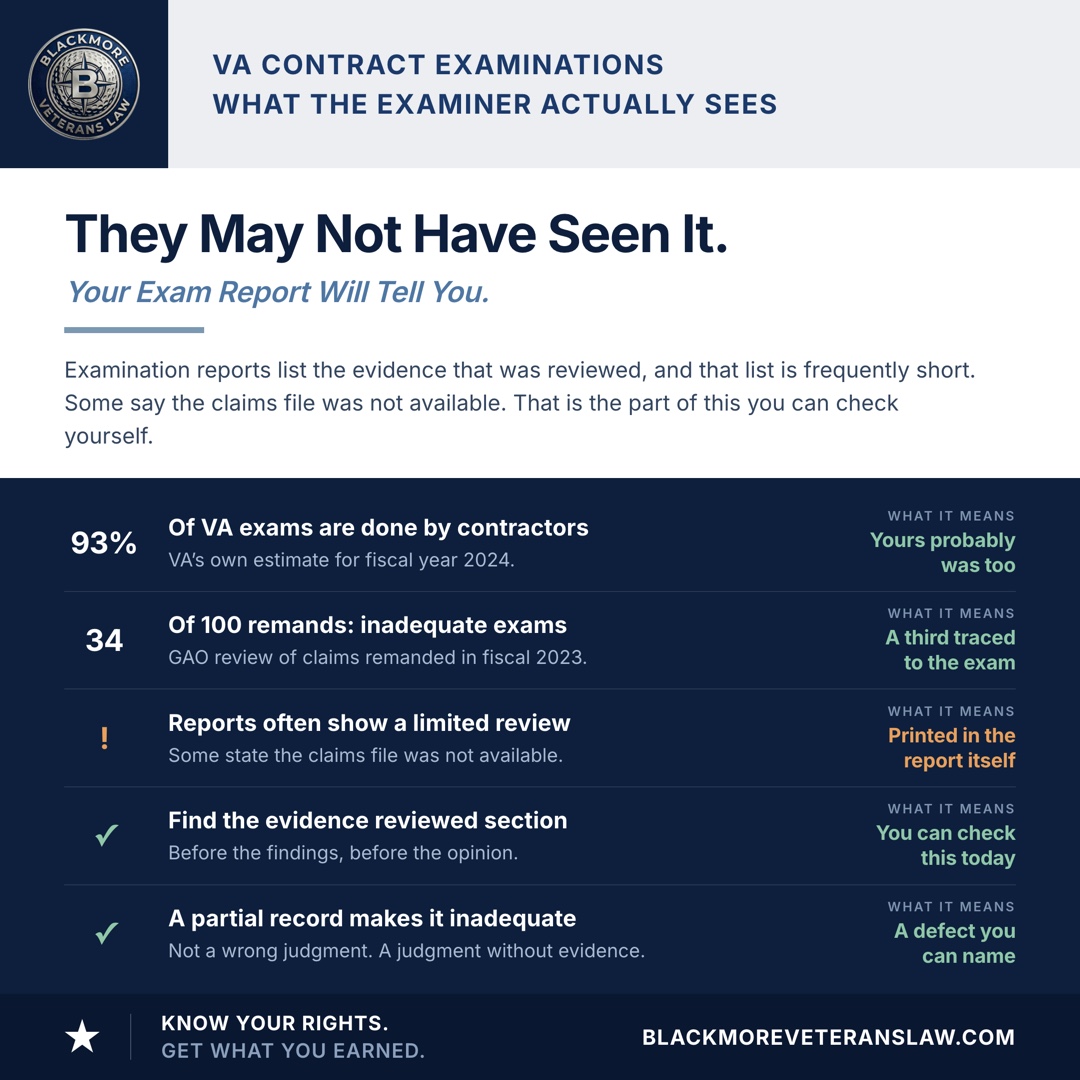
For most veterans the examiner is not a VA employee. VA estimates that contractors performed about 93 percent of disability examinations in fiscal year 2024, through a small number of national vendors.
That is not a scandal by itself. Contract examiners include capable clinicians, and VA has used them for years to handle volume it cannot staff internally.
The problem is what they are given to work with.
What the reports actually show
The place this surfaces is the examination report itself.
Reports routinely list a short set of records as the evidence reviewed. Some state that the claims file was not available. Some say review was limited. Some name two or three documents in a file that runs to hundreds of pages.
That part is observable, and it is the piece of this a veteran can verify without taking anyone’s word for it.
What it means in practice is that an examiner can write that there is no evidence of something, and be describing the records in front of them accurately, while the evidence sits in your file.
Congressional correspondence has raised the same concern directly, including reports that contractor examiners did not review service treatment records before appointments.
This is documented, not alleged
Federal oversight has looked at the contract exam program repeatedly.
The VA Office of Inspector General reported that contract exams were not meeting contractual accuracy requirements, and that claims processors may therefore have relied on inaccurate or insufficient medical evidence when deciding claims.
The Government Accountability Office found that of 100 claims remanded in fiscal year 2023, 34 were remanded for inadequate examinations or medical opinions. A third of remands in that sample traced back to the exam rather than to anything the veteran did or failed to do. GAO has separately called for stronger oversight of contracted exam quality.
Congressional correspondence has raised the same records problem directly, including reports that contractor examiners did not review service treatment records before appointments.
None of that proves what happened in any individual case. It does mean a veteran who suspects the examiner never saw the evidence is describing something the government has already found occurring at scale.
The part you can check today
Pull your examination report and find the section that lists what evidence was reviewed.
It is usually short. Sometimes it names a handful of documents. Sometimes it says the claims file was not available, or that review was limited. Occasionally it says nothing meaningful at all.
Then compare it against what you know is in your file. The service treatment record with the entry. The private records you submitted. The earlier exam. The statement from your spouse.
If the records that matter are absent from that list, you have located the defect, and it is a better defect than disagreeing with a conclusion. You are not arguing that the examiner reached the wrong judgment. You are showing the judgment was made without the evidence.
Why that matters legally
A medical opinion has to rest on an accurate factual premise and account for the relevant history. An opinion that assumes an absence of evidence, where the evidence exists and was not reviewed, is not built on an accurate premise.
An inadequate examination is also a duty to assist problem rather than a disagreement about weight, which affects which routes are available. Duty to assist failures cannot support a clear and unmistakable error motion, which is covered in our guide to CUE, but they can be raised in a Higher-Level Review, and a supplemental claim can put the missing evidence squarely in front of a decision maker.
What makes an opinion adequate or inadequate generally is covered in The Exam Is the Appointment. The Opinion Is What Decides the Claim. This post is about a narrower defect: not flawed reasoning, but reasoning performed on a partial record.
What to do about it
- Request the examination report, not just the rating decision. They are different documents and the report is where the review list lives.
- Read the evidence reviewed section first. Before the findings, before the opinion.
- Make a list of what is missing, by document name and date.
- Submit the key records again, with a cover statement identifying each one and what it shows. Evidence sitting in the file is not the same as evidence reaching the examiner.
- Say it specifically. “The examiner did not review the March 1994 treatment record documenting the knee injury, and the opinion states there is no record of an in-service injury” is an argument. “The examiner was wrong” is not.
- Ask for a new examination where the defect is substantial, and say why the existing one cannot support a decision.
- Prepare for the next exam on the assumption that the examiner is seeing very little, which is covered in The C&P Exam Is Short. Preparing for It Shouldn’t Be.
Whether any particular examination was adequate depends on the report, the record, and what was actually reviewed. Nobody can tell you your outcome. But if a decision says there is no evidence of something you know is in your file, that is a question with an answer, and the answer is printed in your own exam report.
Blackmore Veterans Law, P.C. is a solo practice representing veterans in VA disability claims and appeals. Contact us to discuss your situation.
This article is general information about VA disability law and is not legal advice for any individual case. Reading it does not create an attorney-client relationship. Attorney advertising.